The New York Times Learning Network runs a year-round series of free writing contests for students aged 13 to 19 anywhere in the world. Across the school year it invites teenagers to write editorials, personal narratives, science explainers, reviews and more — each with a tight word limit and a published list of winners. This independent guide explains what the contests are, who can enter, and how to choose the one that fits you.
Quick facts (2025-26)
| What it is | A year-round series of free student writing contests from The NYT Learning Network |
| Who can enter | Students aged 13–19 worldwide (where permitted), entering individually — no fee |
| Main contests | Student Editorial · Personal Narrative · STEM Writing · Review · Summer Reading · Profile · Vocabulary · Podcast & more |
| Length | Short — roughly 100–600 words depending on the contest |
| Deadlines | Set in U.S. Pacific Time; winners are published on the Learning Network |
| Official source | nytimes.com/section/learning |
One point to settle first, because families ask it constantly: the Learning Network is The Times’s free education arm, and its contests are not the paid news subscription, the crossword, or anything you need a login to read. They are open, no-cost writing competitions built for classrooms — which is exactly why they travel so well to international schools.
The five families of contests
There is no single “NYT writing contest.” Over a year the Learning Network runs roughly a dozen, and the cleanest way to make sense of them is to group them by what kind of writing they ask for. Almost every contest falls into one of five families.
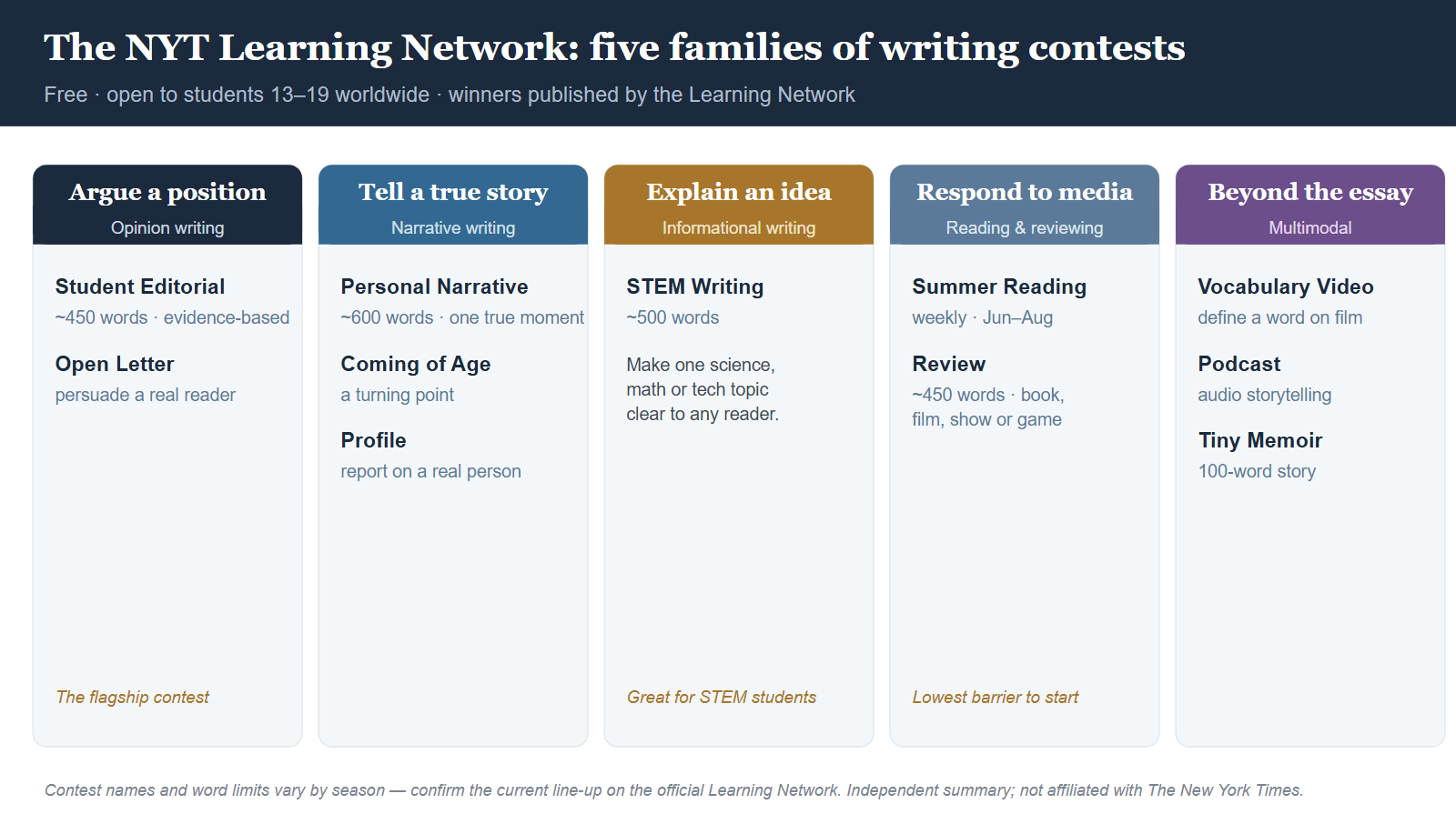
Two things are worth noticing. First, every contest is short — most cap out between 100 and 600 words, so the skill being tested is compression, not endurance. Second, the contests rotate through the year, so there is almost always one open or about to open. For the full season at a glance, see our 2025-26 contest calendar, and for the official line-up our contests page links straight to each one.
How to choose the right contest
Most students lose time trying to pick the “most impressive” contest. That is the wrong question. The contests are not ranked, and judges are not comparing an editorial against a personal narrative — each is judged on its own terms. The better question is which kind of writing you can do well, right now. The flowchart below is the fastest way to narrow it down.
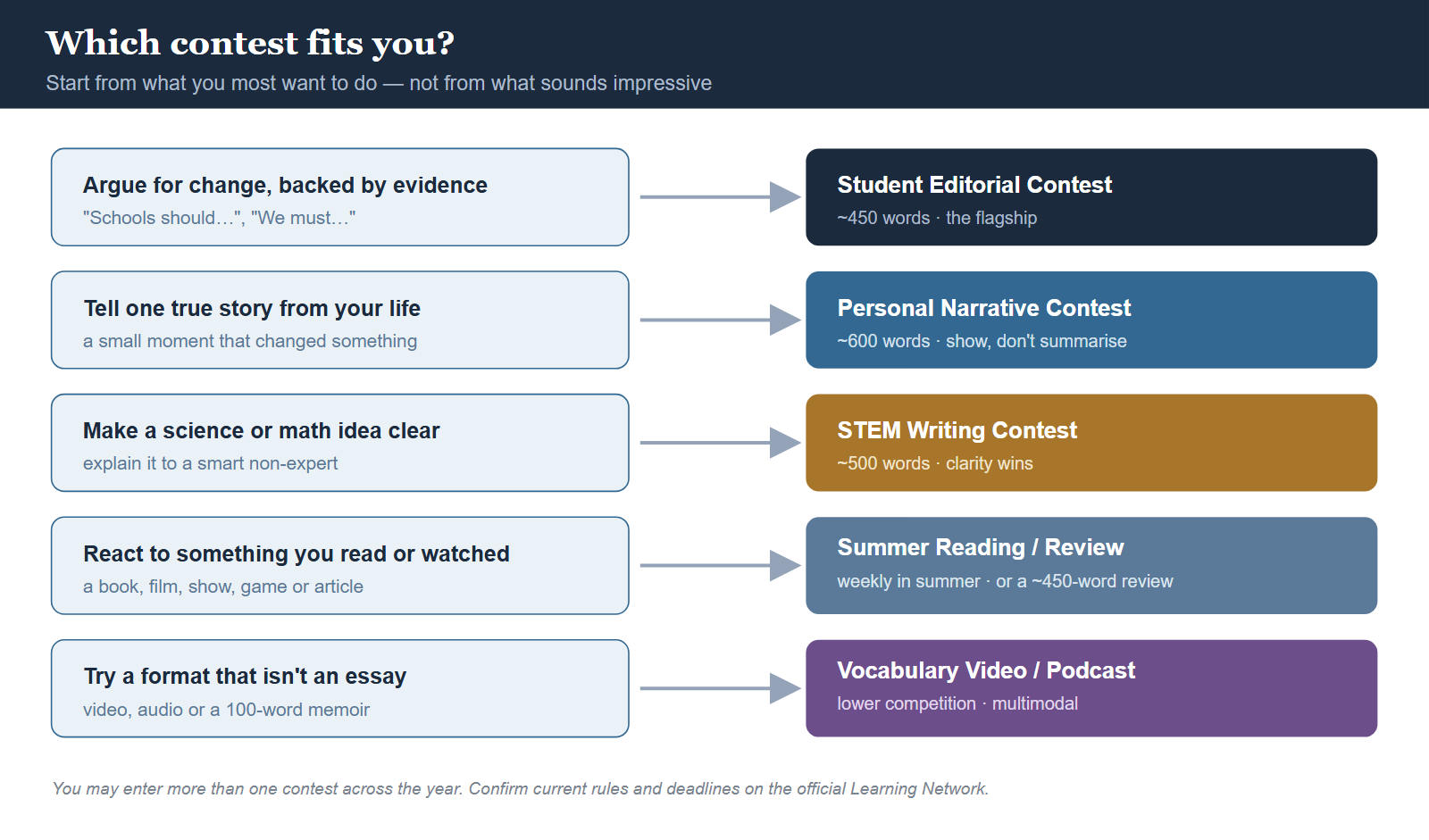
A practical tip: if you are new to these contests, the Summer Reading Contest is the gentlest on-ramp. It runs weekly through the summer, it accepts a response to anything in The Times that genuinely interested you, and the word count is small — so you can practise the habit of writing-on-deadline before the higher-profile editorial and narrative contests open in the school year.
Can international and China-based students enter?
Yes — and this is the question we are asked most. The Learning Network contests are open to students roughly 13 to 19 around the world, not only in the United States, and entering is free. For students at international schools in China, three practical details matter more than anything else:
1 · Deadlines are in U.S. Pacific Time. A contest that closes at 11:59 p.m. Pacific closes in the middle of the next afternoon in Beijing (roughly 2:59–3:59 p.m., depending on daylight saving — the 2025-26 rules pages give 11:59 p.m. U.S. Pacific; nytimes.com is the final authority). Read the deadline as a Pacific-Time deadline and convert it — do not assume it is local midnight. This single misread is the most common way strong entries are lost.
2 · English does not have to be your first language. These contests reward clear thinking and a real voice, not a native accent on the page. Plenty of recognised entries come from multilingual students; the judges are reading for ideas, structure and honesty.
3 · You enter as an individual. You do not need your school to organise anything, though a teacher’s encouragement helps. If you are under 18, check the parental-permission step in the official rules before you submit. Our how-to-enter page walks through the submission form field by field.
Are these contests worth it for college applications?
The honest answer is: worth it as evidence of real writing, not as a trophy. A recognised NYT Learning Network entry is a credible, widely understood signal — admissions readers know the contests are competitive and that winning pieces are edited to a high standard. But the deeper value is upstream of any award: the discipline of arguing a point in 450 words, or shaping a true experience into 600, produces exactly the kind of writing that later becomes a strong college essay. We routinely see students reuse the thinking from a contest entry in their personal statement. Treat the contest as training that happens to come with a chance at recognition, and the time is well spent whether or not you place.
What we see with China-based students
This site is run by the editorial team at Hanlin Education, and we work with students at international schools in China who enter these contests each year. A few patterns hold up season after season. Students who start with the Summer Reading Contest build the deadline habit that makes the editorial and narrative contests far less stressful. Students who pick a narrow, specific topic — one policy, one moment, one idea — almost always outperform those who try to cover everything in a few hundred words. And recognition is achievable: students we have supported have earned standing in the Learning Network’s contests, including an Honorable Mention in the Summer Reading Contest. We mention that not as a headline statistic — the pool is large and these contests are genuinely competitive — but as evidence that a focused, well-coached international entry can be read and recognised on the same page as students anywhere.
Questions about the contests?
Scan the WeChat QR code — we help with contest registration, one-on-one topic coaching, and full guidance to the deadline.
Scan the WeChat QR code

The mistakes that cost good writers
When strong entries fall short, it is rarely the writing — it is one of three avoidable habits. Misreading the deadline: as above, the Pacific-Time conversion catches careful students off guard every year. Trying to sound like The Times instead of yourself: the editorials and narratives that win have a clear, specific voice, not an imitation of a professional columnist. Ignoring the word limit until the end: these contests are won in the cutting, so write long, then compress hard — a 600-word draft trimmed to a tight 450 almost always beats one padded up to length. For more on what readers reward, see what judges look for in a winning entry.
Frequently asked questions
Are the New York Times Learning Network contests free to enter?
Yes. The Learning Network’s student writing contests are free and do not require a Times subscription. They are part of The Times’s education work, separate from the paid news product. You submit through an official online form during each contest’s open window.
Can students outside the United States enter?
Yes. The contests are open to students roughly 13 to 19 around the world, including international and China-based students, where local rules permit. Deadlines are set in U.S. Pacific Time, so convert them to your local time before you submit.
Which NYT contest should a beginner start with?
The Summer Reading Contest is the gentlest on-ramp: it runs weekly through the summer, accepts a short response to anything in The Times that interested you, and builds the writing-on-deadline habit before the editorial and narrative contests open.
Do these contests help with college applications?
They help as evidence of real writing ability, and the work itself often becomes material for a college essay. Recognition is a credible signal, but the training value — arguing or narrating well under a tight word limit — is the larger benefit.
This site is an independent editorial guide to The New York Times Learning Network’s free student writing contests, operated by Hanlin Education for China-based international-school students. We are not affiliated with, endorsed by, or sponsored by The New York Times Company or its Learning Network. Contest names, formats, word limits and dates change by season — always confirm the current rules on the official NYT Learning Network. Confirmed errors are corrected within 7 working days.
One of the most competitive is the NYT Student Editorial Contest — a 450-word opinion piece backed by evidence.
New to these contests? One of the most beginner-friendly is the New York Times Open Letters Contest — a short public letter of opinion aimed at a specific audience.