The New York Times Learning Network has announced seven free opportunities for 2026-27, and the shape of the year has changed. The autumn opens with the 100-word Tiny Memoir, two of the seven are not writing contests at all — a visual art contest and a STEM interview video contest — and the Summer Reading Contest now runs as three one-week windows rather than a weekly cycle. This independent calendar lays out every window, how to convert the deadlines from China, and the new rules on AI and translation.
Where these dates come from: nytimes.com blocks our fetching tools, so we have not read the Learning Network’s own announcement page directly. The dates below come from two independent republications of that announcement — an English-language education site in August 2026 and a Chinese-language republication in September 2026 — which agree with each other on every window, word limit and format. Treat them as reliable but not official: the live page on the NYT Learning Network is the only authority, and you should confirm your own contest there before you write.
The 2026-27 contest year at a glance
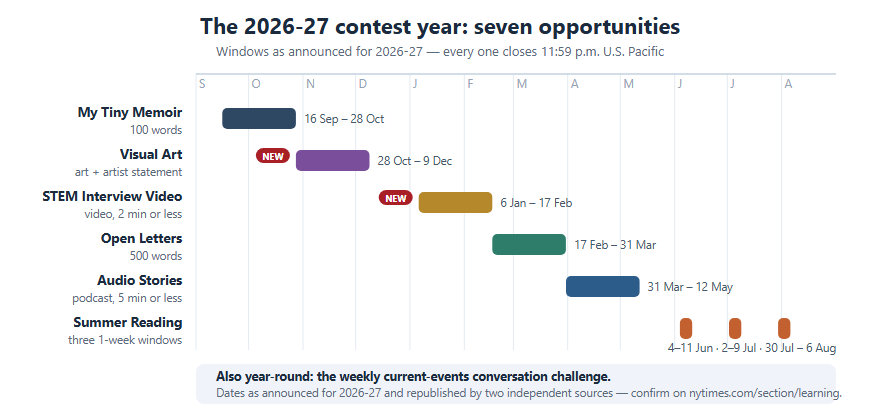
Seven opportunities, spread deliberately so that only one is usually open at a time. Read the year as a ladder rather than a list: the autumn contest is short and low-risk, the winter and spring contests reward a bigger investment, and the summer windows are the place to build the habit of finishing.
| Window | Opportunity | What it asks |
| 16 Sep – 28 Oct 2026 | My Tiny Memoir | One true moment from your own life, in 100 words — the lowest barrier and the tightest craft test |
| 28 Oct – 9 Dec 2026 | Visual Art new | A piece of original artwork submitted with an artist statement |
| 6 Jan – 17 Feb 2027 | STEM Interview Video new | Interview someone who works in science, maths or tech — two minutes or less on video |
| 17 Feb – 31 Mar 2027 | Open Letters | Persuade one real reader in about 500 words |
| 31 Mar – 12 May 2027 | Audio Stories | A podcast-style piece of five minutes or less |
| 4–11 Jun · 2–9 Jul · 30 Jul – 6 Aug 2027 | Summer Reading | Respond to anything in The Times that caught your interest — three one-week windows |
| All year | Weekly conversation challenge | A running current-events prompt rather than a judged contest window |
For what each contest is and which one suits you, start with our guide to the Learning Network contests. The one that is open right now is the 100-word Tiny Memoir.
Two of the seven are new — and they are not essays
The Visual Art Contest (28 October – 9 December 2026) asks for original artwork plus an artist statement, which means the writing you do is short but load-bearing: the statement is where you explain what the work is doing. The STEM Interview Video Contest (6 January – 17 February 2027) asks you to interview someone whose work involves science, maths or technology and to cut it to two minutes or less.
Two practical points for students at international schools in China. First, a new contest has no back catalogue of published winners, which cuts both ways: there is no model to study, but the field is also smaller and less rehearsed than the long-running essay contests. Second, both formats travel well from where you are — a local engineer, a hospital researcher, a factory automation team or a university lab is a perfectly good interview subject, and an artist statement written in plain, exact English beats a decorated one. Our guide to the 2026 Visual Art Contest goes into the artist statement in detail, our STEM Interview video guide covers finding an expert and cutting the interview to two minutes, and our Audio Stories guide covers scripting a five-minute story around spring exams.
Summer Reading has changed shape
For years the Summer Reading Contest ran as a weekly cycle: a new prompt every week through the summer, enter as often as you liked. For 2027 the announced structure is three one-week windows — 4–11 June, 2–9 July and 30 July – 6 August — with entries of about 250 words or a video of up to 90 seconds.
That is a real planning difference, not a cosmetic one. Under the weekly model a missed week cost you nothing; under three windows, missing one removes a third of your chances. If Summer Reading is part of your plan, put the three windows in your calendar now and treat each as a fixed commitment. Our Summer Reading guide walks through what to write about and how the entry works.
What is not on this year’s announced list
The seven opportunities above are what the 2026-27 announcement we have seen lists — and the more useful thing to understand is that the Learning Network rotates its line-up. Last season was already a different set: as our own contests page recorded the 2025-26 year, it ran Growing Up With A.I., My Tiny Memoir, Local Lens photo essays, My List student review, Open Letters, Audio Stories and the weekly Summer Reading contest. Four of those — Tiny Memoir, Open Letters, Audio Stories and Summer Reading — carry into 2026-27; the other three do not appear on this year’s list.
So several contests that older guides still treat as fixtures — the Student Editorial Contest, STEM Writing, Review, the longer Personal Narrative and Profile — have not appeared in either of the last two announced line-ups. That is not the same as saying they have been cancelled. An announcement that does not mention a contest is silence, not a decision, and only the Learning Network can tell you whether something returns. The practical lesson for planning is simply this: check the current year’s list before you commit to a contest, because roughly half of it changes.
What we would not do is plan a year around a contest that is not on the announced list. If you were counting on the Student Editorial Contest as your flagship, the closest substitutes on this year’s calendar are Open Letters (argument, but addressed to one real reader) and the artist statement or interview framing of the two new contests. The craft guides for the older contests still stand — the skills transfer even when the window does not exist this season.
How to read a deadline from China
This is the single most important line in this whole calendar. Every Learning Network deadline is in U.S. Pacific Time (the rules pages we have seen give 11:59 p.m. U.S. Pacific; nytimes.com is the final authority), and that catches careful students out every single year. A contest that closes at 11:59 p.m. Pacific closes at roughly 2:59 p.m. or 3:59 p.m. the next day in Beijing — the gap is 15 or 16 hours depending on U.S. daylight saving. In practice that is good news: a U.S. late-night deadline becomes a comfortable next-day afternoon in China, as long as you do not assume it means local midnight.
| If the deadline says… | In Beijing it is roughly… |
| 11:59 p.m. PT (daylight saving, Mar–Nov) | 2:59 p.m. the next day (+15h) |
| 11:59 p.m. PT (standard time, Nov–Mar) | 3:59 p.m. the next day (+16h) |
Build the habit of submitting the day before the Beijing-time deadline. Servers get busy near the close, and “I had it ready but the form timed out” is not a category the judges can rescue.
The 2026-27 rules on AI and translation
This is the change that matters most to students writing in a second language, and it is stricter than most school policies. As republished for 2026-27, the rules bar using a chatbot to draft your entry, using AI to edit or polish it, submitting AI-generated images, audio, video or text, and using AI tools or Google Translate to turn your entry into English. Entries that break these rules are disqualified, and most contests will ask entrants to document their process — a document version history, for instance.
For a China-based writer the translation clause is the one to sit with. Drafting in Chinese and machine-translating into English is now explicitly out. That sounds harsh, but the practical answer is the one good writing teachers give anyway: draft in English, even if it is clumsy English, and fix it by cutting rather than by decorating. A 100-word memoir or a 500-word letter written plainly in your own English will read as yours — and it will survive a process check. If you think in Chinese first, translate it yourself, sentence by sentence, rather than pasting it into a tool; the translation you do by hand is your writing, and the one a tool does is not.
Questions about the contests?
Scan the WeChat QR code — we help with contest registration, one-on-one topic coaching, and full guidance to the deadline.
Scan the WeChat QR code
A simple habit covers you: write in one document from the first line to the last, do not paste text in from elsewhere, and keep version history on. If you are asked to show your process, you will have it.
Planning a realistic contest year
You do not need to enter everything. Students who chase all seven usually produce seven rushed entries and place in none. A stronger plan is to pick a small, deliberate set and give each one real time.
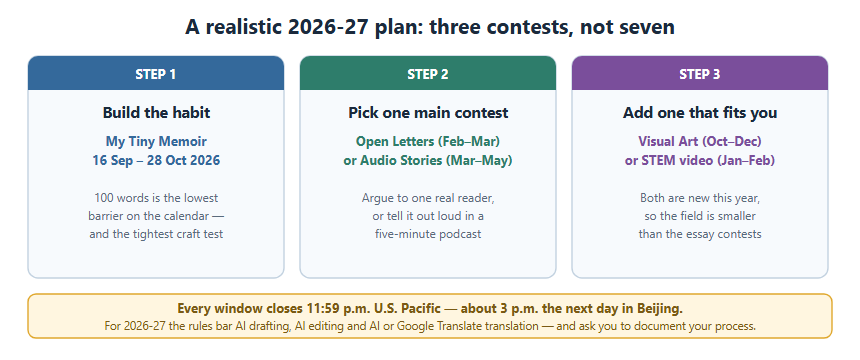
One extra tip for students at international schools in China: map the windows against your own exam calendar first. The Open Letters window (17 February – 31 March 2027) sits squarely in mock-exam and IB internal-assessment season, and the STEM video window runs through January. If your spring is already heavy, the autumn Tiny Memoir and the summer windows are the smarter places to invest — you will write better when you are not also revising for finals.
What to do once you have picked your dates
A calendar is only useful if it changes what you do this week. Once you have chosen your two or three, work backwards from each Beijing-time deadline and block out drafting time — for a main contest that means starting three to four weeks early, not the weekend before. Read the official rules for your chosen contest in full, because word limits, formats and permission requirements differ, and if you want to know what separates a shortlisted entry from the rest, read what judges look for in a winning entry before you start drafting, not after.
Frequently asked questions
How many NYT writing contests are there in 2026-27?
The announcement we have seen lists seven opportunities: My Tiny Memoir, a new Visual Art Contest, a new STEM interview video contest, Open Letters, Audio Stories, Summer Reading in three windows, and a year-round weekly conversation challenge. Confirm the current line-up on the official Learning Network page.
Which NYT contest is open right now?
My Tiny Memoir, from 16 September to 28 October 2026. It asks for one true moment from your own life in 100 words or fewer.
What time zone are NYT contest deadlines in?
U.S. Pacific Time. An 11:59 p.m. Pacific deadline falls around 2:59 p.m. to 3:59 p.m. the next day in Beijing, depending on daylight saving. Aim to submit a day early to avoid last-minute server load.
Can I use AI or Google Translate on my entry?
No. As republished for 2026-27, the rules bar chatbot drafting, AI editing or polishing, AI-generated images, audio, video or text, and the use of AI tools or Google Translate to translate an entry into English. Entries that break the rules are disqualified, and most contests will ask you to document your process.
Is the Student Editorial Contest running this year?
It is not on the 2026-27 list we have seen, but an announcement that does not mention a contest is silence rather than a cancellation. Check the official Learning Network page before planning a year around it.
This site is an independent editorial guide to The New York Times Learning Network’s free student writing contests, operated by Hanlin Education for China-based international-school students. We are not affiliated with, endorsed by, or sponsored by The New York Times Company or its Learning Network. Contest names, formats, word limits and dates change by season — always confirm the current schedule on the official NYT Learning Network. Confirmed errors are corrected within 7 working days.
For the opinion-writing craft that carries over from past seasons, see our guide to the NYT Student Editorial Contest.
For this year’s argument contest, see our full guide to the New York Times Open Letters Contest.