The Audio Stories podcast contest runs from 31 March to 12 May 2027 on the Learning Network’s announced calendar, for students aged 13 to 19, with a limit of five minutes. For students at international schools in China, that window overlaps spring exams and two public holidays. The practical plan is to find the story early, script it for the ear rather than the page, and record before exam weeks begin.
What the calendar lists, and what to check on 31 March
The contest details here come from the 2026-27 calendar the Learning Network announced, as relayed to us in September 2026. We have not seen this season’s rules page for the contest, so treat the two lists below as a boundary: the first is what has been announced, the second is what you should look for when the contest opens.
Announced on the calendar:
- The name, listed as the Audio Stories podcast contest
- The window: 31 March to 12 May 2027
- The length: up to five minutes
- Eligibility for the calendar as a whole: ages 13 to 19
- The republished 2026-27 AI and translation policy, which applies across the contests
Check when the contest opens:
- Whether you may work in a team, and how large
- Whose voices may appear, and whether interviewees must give permission in a particular form
- What music and sound effects are allowed
- File format, upload method and whether a transcript or description is requested
- Whether non-English audio is accepted
- Judging criteria, and what documentation of your process the form asks for
The deadline clock is worth fixing in your calendar now. Republished rules from the 2025-26 season closed entries at 11:59 p.m. U.S. Pacific time. If this contest keeps that clock, 12 May becomes 2:59 p.m. on Thursday 13 May in Beijing, because the United States is on daylight time in May. The window also opens on the day the Open Letters contest closes, 31 March, so anyone entering both should finish the letter before turning to audio.
Writing for the ear: what changes when nobody can re-read
Strong writers are often surprised that their best prose makes a weak script. On the page, a reader controls the pace: they can slow down, look back at a name, and see a paragraph break announcing a shift. A listener gets one pass, at your speed, with no visual structure at all. Every habit that relies on the eye has to be replaced by something the ear can follow.
| On the page | For the ear | Example rewrite |
|---|---|---|
| Long sentences with clauses tucked inside | One idea per breath | “My grandmother, who ran the shop for thirty years, closed it in March.” becomes “My grandmother ran the shop for thirty years. In March, she closed it.” |
| Pronouns that point back several sentences | Repeat the name | After a clip of someone else speaking, say “my grandmother”, not “she” |
| Precise figures | Rounded figures the ear can hold | “37.4 percent” becomes “more than a third” |
| Paragraph breaks and headings | Spoken signposts | “Here is the part I did not expect.” |
| A quotation introduced after it appears | Name the speaker before the tape plays | “My cousin, who drives the night bus, put it like this.” |
| A reflective final paragraph | End on a sound or one plain line | Let the last word belong to the person you interviewed |
The single most useful editing tool is reading the script aloud, standing up, at the speed you will actually record. Mark every place you stumble, run out of breath or have to re-read a line silently before saying it. Those marks are your revision list. A sentence you trip over in your own bedroom will be harder still with a microphone in front of you.
Structure matters more in audio, not less. A listener who loses the thread cannot find it again by scanning, so the first thirty seconds need to make a promise: here is a question, a person or a situation, and by the end you will know something about it. Then the rest of the piece has to keep that promise in order.
The five-minute word budget
Most people read a script aloud at somewhere around 130 to 160 words a minute. Time your own read before trusting that range, because nerves usually speed people up. At that pace, five minutes of pure narration is roughly 650 to 800 words. Very few good audio stories are pure narration, though. Interview clips, scene recordings and pauses all take time without taking script words, which is why the budget below sets aside 90 seconds for tape.
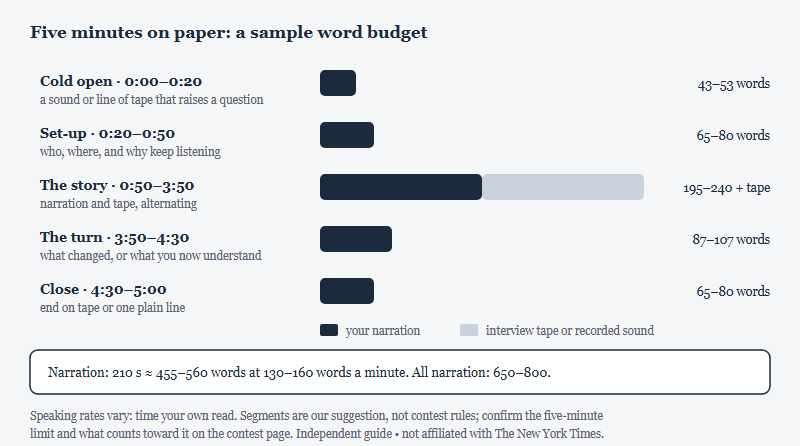
The budget has two practical uses. First, it stops the most common audio failure, which is a script of 900 words read too fast to fit. Second, it shows where the time really goes: the story section takes three of the five minutes, so the set-up and the ending have to be brief. If your set-up runs past a minute, the listener is still waiting for the story to start when a third of the piece has gone.
Recording from a school or home in China, within the AI rule
You do not need a studio. You need a quiet room with soft surfaces, and a routine. A bedroom with curtains drawn works better than an empty classroom, and speaking towards a wardrobe full of clothes absorbs a surprising amount of echo. Put the phone in airplane mode so notifications cannot interrupt a take, hold it roughly a hand’s width from your mouth and slightly to one side, use the highest-quality recording setting your app offers, and record thirty seconds of the room’s silence before you start. Record every section at least twice.
Interviews need permission before the recorder is on. Tell the person how the audio will be used, get their agreement in writing, and involve a parent or teacher if you are under 18 or interviewing a younger child. Whether a family member speaking Chinese can appear, with your English narration around it, is not in the announced details; check the rules when the contest opens. If it is allowed and you explain what they said, the English is yours to write. The republished policy rules out Google Translate, DeepL and any AI tool for translating an entry.
Questions about the contests?
Scan the WeChat QR code — we help with contest registration, one-on-one topic coaching, and full guidance to the deadline.
Scan the WeChat QR code

That policy, as republished for 2026-27, bans chatbot drafting, AI editing or polishing, and AI-generated audio, video, images or text; violations are disqualified. Audio software is now full of features that fall on the wrong side of it, often behind friendly labels:
- One-click “enhance speech” or AI noise removal. On a plain reading these are AI editing. Record cleanly instead, and use ordinary controls you adjust yourself, such as cutting, fading and volume.
- AI voices and text-to-speech. Every voice in your narration should be a real person recorded speaking.
- AI-generated music and sound effects. Leave them out. The safest soundtrack is none, or music you or a friend performed; confirm the posted rules on music before using anything else.
- Automatic transcription and captions. These are AI speech-to-text, and the cautious reading of the policy is to keep them out of an entry, so write your script and any transcript yourself.
If you edit in Jianying, the Chinese version of CapCut, use it as a plain audio timeline and keep its AI audio and caption features switched off. Audacity’s built-in effects are conventional, but optional AI plug-ins exist for it; do not install them for this project. Keep a process record as you work: the script in a document with version history, the raw recordings with their original file dates, and a short log of each session. Most contests will ask entrants to document their process, and an audio piece is easy to document if you save as you go.
Plan backwards from 12 May
Six weeks sounds generous until you lay them over a spring term in China. Qingming falls in early April and the May Day holiday starts on 1 May, and both are inside the window. For Grade 11 and 12 students on IB, A-level or AP programmes, external exams often begin in late April or May, which means the final fortnight may belong to revision. Everything that can happen before 31 March should.
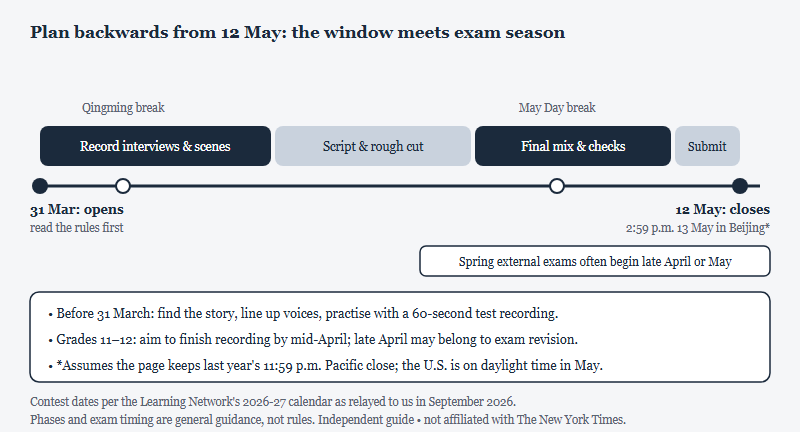
The work before the window is where most of the quality comes from, and none of it needs a rules page:
- Find a story, not a topic. “Air pollution” is a topic. “The morning my grandfather stopped doing tai chi in the park” is a story, with a person, a place and a change. Audio rewards stories with voices in them.
- Line up the voices. Decide who you need to hear from and ask whether they would be willing to be recorded in April. People say yes more easily with six weeks’ notice than with six days’.
- Make a 60-second test piece. Record, script and edit one minute on any subject during a school break. It teaches you your equipment, your speaking pace and how long editing really takes, before the entry depends on it.
- Collect what can only be heard. A story about a place needs its sounds. Note which ones you will want: a bell, a market, a bus announcement.
Whether audio recorded before 31 March can be used in the entry is a rules question, so treat anything you record early as practice until you have read the posted rules. For how this contest fits with the others in the school year, see our overview of what the NYT writing contests are and the contest calendar page, which is being updated for 2026-27.
Frequently asked questions
When is the NYT Audio Stories podcast contest open?
Per the Learning Network’s announced 2026-27 calendar, 31 March to 12 May 2027, for ages 13 to 19. Confirm on the contest page when it opens.
How long can the podcast be, and how many words is that?
Up to five minutes, per the announced calendar. At a typical speaking pace, that is roughly 650 to 800 words of pure narration.
Can I use AI to clean up audio or make music?
No. The republished 2026-27 policy bans AI-generated audio and AI editing or polishing. Record cleanly and edit with conventional tools.
What time does it close in Beijing?
If the page keeps last year’s 11:59 p.m. Pacific close, it is 2:59 p.m. on Thursday 13 May 2027 in Beijing.
This is an independent guide operated by Hanlin Education for China-based international-school students. It is not affiliated with, endorsed by, or sponsored by The New York Times Company or its Learning Network. Contest dates, rules, eligibility and AI policies are set by the Learning Network and change from year to year — confirm current details on nytimes.com/learning before you plan or submit. Errors are corrected within 7 working days of being reported.