For the NYT Audio Stories Podcast Contest 2027, which runs March 31 – May 12, 2027, students aged 13–19 worldwide may submit an original podcast of no more than five minutes on any theme they like. The 2026-27 New York Times Student Contest Calendar, reported by Hanlin Course on September 6, 2026, lists accepted audio forms such as expert interviews, friend conversations, news investigations and fictional stories. The binding constraint is the five-minute ceiling; the strategic decision is which of these forms fits the material you can actually gather, ethically record, and resolve inside that ceiling. Choose the format before you write the script — not after.
This article walks through the window, the four forms the calendar names, a three-step decision tree, a format-fit table, a labelled teaching illustration of the same topic adapted to interview and investigation, five-minute segment maps for each form, and a clear pivot plan for when your first format fails. Eligibility, cost and the 2026-27 AI rule are covered near the end because they can eliminate a format choice before craft ever comes into it.
The 2027 Window and the Five-Minute Constraint
Per the 2026-27 calendar (Hanlin Course, 2026-09-06), the Audio Stories: Our Podcast Contest runs from March 31 to May 12, 2027 and requires an original podcast of no more than five minutes on any theme. Two implications matter for format choice.
First, five minutes is short. A relaxed spoken pace covers roughly 130–160 words per minute, so a five-minute file typically contains 650–800 words of speech once pauses, music beds and natural interruptions are counted. That budget is a ceiling on how much context you can set up. Any format that needs more than about 45 seconds of background before the listener hears the first real content is already loading the middle of your episode.
Second, the window opens in late March and closes in mid-May. That period sits alongside the final weeks of many international school terms. Students who decide their format in late April often discover that the format they chose requires an interviewee they cannot reach, or a research trail they cannot finish. Deciding the format in February or early March — before scripting starts — removes that risk almost entirely. The window itself is fixed and cannot be extended.
Formats the Calendar Lists — and How to Read That List
The calendar names expert interviews, friend conversations, news investigations and fictional stories as examples of accepted audio forms. The source wording lists these four forms and adds an “and others like them” phrase, which signals that they are illustrations of a broader allowance rather than a closed list of four exclusive categories. In practice, that means most coherent short audio pieces — including lightly narrated hybrids — sit inside the allowance, provided the piece is an original podcast and fits under five minutes. It does not mean anything goes: the piece still has to function as a listenable five-minute audio story.
Expert interview
An expert interview depends on access to someone with specialised knowledge: a doctor, engineer, economist, teacher, researcher or working practitioner. The value of the format is the guest’s specific perspective — the thing you cannot Google in thirty seconds. The failure mode is a generic biography: if your questions can be answered by any informed adult, the interview is not doing work.
Friend conversation
A friend conversation is an informal dialogue between peers. It works when the topic lives in shared experience rather than in a data set: school culture, gaming, family expectations, first jobs, language and identity. The format’s strength is authenticity; its weakness is meandering. A five-minute conversation with no narratorial shaping usually drifts.
News investigation
A news investigation reports on a specific event or issue using gathered facts, quotes and analysis. It needs a research trail: at least two or three independent sources, one of which you personally verified. The format plays to students who can find documents, compare claims and reach a defensible finding. It fails when the evidence base is thin, because a five-minute investigation with one source sounds like an opinion piece with a microphone.
Fictional story
A fictional story is a scripted narrative with characters and plot. It offers the greatest creative freedom and the hardest craft problem: without visuals, every emotional beat must be carried by voice, sound design and pace. Fiction rewards writers who already know how to build a scene in very few words.
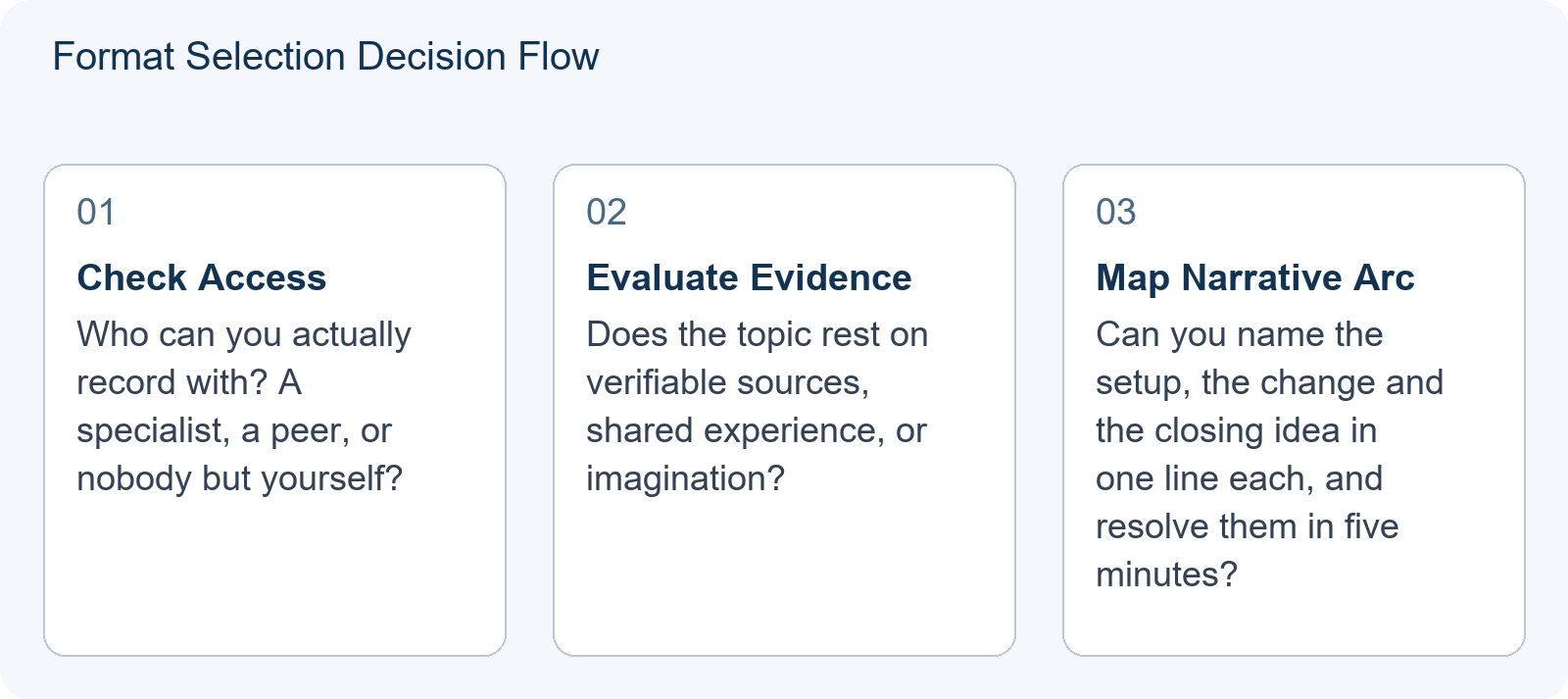
Decision Tree: Access, Evidence, Arc and Privacy
Use this three-step diagnostic before committing to a format.
Step 1 — Access. Who can you actually record with? If you have a name and a contact channel for a specialist, the expert-interview route is alive. If you have a friend who can hold a thirty-minute conversation on a shared topic, the conversation route is alive. If you have neither, and the topic requires a voice other than your own, drop the interview and conversation options and move to investigation or fiction.
Step 2 — Evidence. What does your topic rest on? Verifiable external facts push you toward investigation. Internal experience, imagination, or the texture of daily life push you toward fiction, conversation or a first-person narrative. A topic that feels factual but has no documentable sources is the wrong topic for investigation — switch the topic, not just the format.
Step 3 — Arc. Can you name the beginning, the change and the closing idea in one sentence each? If yes, the format works. If not, the five-minute limit will expose the gap. This is the step where most weak entries die, regardless of how good the topic is.
Then check Privacy. Any recorded person — guest, friend, family member — should know how the audio will be used and where it will be submitted. Get that understanding before the recorder goes on. This is ordinary recording practice, not a rule quoted from the calendar; the calendar does not publish a privacy clause for this contest, so treat it as the baseline ethical minimum you would want from the other side of the microphone.
Format Fit Checklist Before You Write a Script
| Criterion | Interview | Conversation | Investigation | Fiction |
|---|---|---|---|---|
| Primary asset | Guest expertise | Shared experience | Verified sources | Creative idea |
| Typical prep time | High (booking, prep, backup guest) | Low (scheduling only) | Medium to high (research, verification) | High (writing, revision, sound) |
| Main risk | Guest cancellation or flat answers | Unshaped, drifting dialogue | Thin evidence, unfounded claim | Weak plot, no clear change |
| Best fit when… | Topic needs a specialist voice | Topic lives in shared daily experience | Topic rests on documentable facts | Topic is emotional or speculative |
| Five-minute shape | Question → answer → meaning | Scene → exchange → reflection | Question → evidence → finding | Setup → conflict → resolution |
Read the table as a risk filter. The format with the most assets on your side is not always the most interesting — it is the one you can actually finish inside the window and inside five minutes without padding.
Labelled Teaching Illustration: One Topic, Two Formats
The following is a teaching illustration created for this article, not a real contest entry or a quoted example from the calendar.
Topic: whether AI writing tools are changing how students do homework.
Questions about the contests?
Scan the WeChat QR code — we help with contest registration, one-on-one topic coaching, and full guidance to the deadline.
Scan the WeChat QR code
Teaching illustration — Interview format. The host records a twelve-minute conversation with a computer-science teacher at their own school. The teacher explains how language models generate text from patterns in training data and where that produces confident but inaccurate answers. The host cuts the interview to a two-minute core, then frames it with a thirty-second intro and a forty-second closing synthesis in the host’s own voice. The shape is question → expert answer → host’s meaning for listeners. The listener finishes informed rather than moved.
Teaching illustration — Investigation format. The host gathers three concrete items: the school’s written homework policy, a summary of two subject teachers’ observations about how submissions changed over the past term, and a short recorded statement from a classmate about how they use an AI tool and where it fails them. The host builds a single claim — for example, that the existing homework policy names the tool but not the process, so it is hard to enforce — and walks the listener from the policy text to the classroom observations to that claim. The shape is question → evidence → finding. The listener finishes with a specific, defensible argument.
Same topic, same five-minute budget, same host. The interview produces a specialist voice; the investigation produces a claim. Only one will fit your real access and preparation time.
Five-Minute Segment Maps for Each Format
Building a rough time map before scripting prevents the last-minute cut that damages the ending.
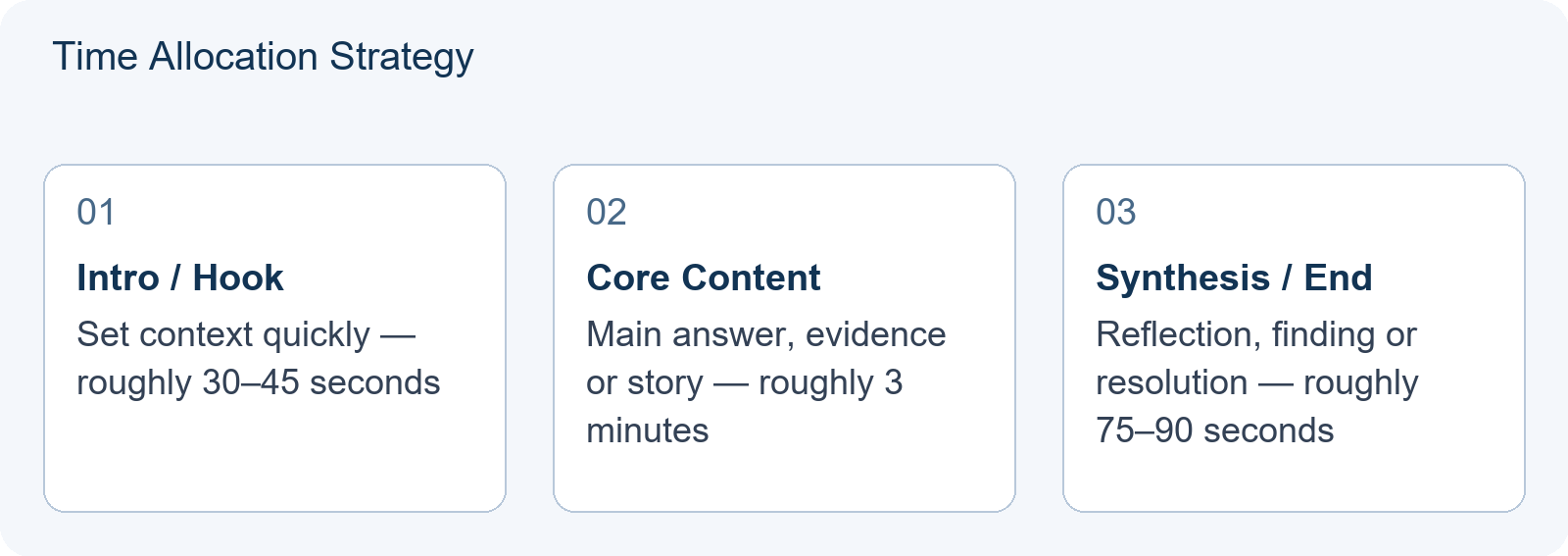
- Interview: ~30 s intro that states the question, ~3 min of edited Q&A, ~90 s of host synthesis and close.
- Conversation: ~45 s setup that places the listener inside the topic, ~3 min of shaped dialogue with a clear turning point, ~75 s of reflection from one of the speakers.
- Investigation: ~45 s hook and question, ~2 min 30 s of evidence and reporting with at least two named sources, ~1 min of finding and its implication.
- Fiction: ~30 s of setting and character, ~3 min of conflict and action, ~90 s of resolution and final image.
These maps are teaching suggestions, not published rules — the calendar does not prescribe internal structure. What they protect against is a common early-draft failure: spending the first ninety seconds on setup, running out of room, and ending before anything has resolved.
What to Do When Your First Format Choice Fails
Format problems show up early, usually at the first real draft. Pivot then, not after you have recorded an hour of audio.
- The interviewee cancels or is unreachable. Convert the material into an investigation: use their written replies if you have them, and add one or two additional sources you can verify. Do not silently reuse a phone call as if it were a formal interview.
- The conversation is flat. Add short narration in the host’s voice to frame the exchanges and name the change in the discussion. This is the most common way a drifting conversation becomes a coherent piece.
- The investigation has only one source. Narrow the claim until one verified source is genuinely sufficient — for example, quote the policy text itself and analyse it, rather than claiming to prove how it is enforced.
- The fiction has no turn. Introduce a concrete constraint: a deadline, a lie the character tells, a decision the character must make and then cannot undo. A change of understanding in the last thirty seconds is what most short fictional audio successfully delivers.
Because the calendar lists the accepted forms as examples rather than a closed set, a coherent hybrid — narrated investigation, framed conversation, first-person story with sound design — sits inside the allowance if the piece is still recognisably an original short podcast. Aim for one primary shape rather than three competing ones.
If you already have a topic and a rough script, the companion piece NYT Audio Stories Podcast Contest (2027): How to Script a Five-Minute Story and Finish Before Exam Season covers the drafting and scheduling side of the same contest.
Eligibility, Cost and the 2026-27 AI Rule
Three qualifications can end a format decision before craft comes in.
- Age and region. The New York Times student contests are open to students aged 13–19 worldwide, per the calendar’s general eligibility description. Students who have graduated from high school but not yet started university may also enter. Close relatives or household members of New York Times employees are excluded.
- Cost. The NYT student contests are free to enter; there is no submission fee for the Audio Stories contest.
- AI rule. The 2026-27 calendar introduces a zero-tolerance AI policy across all NYT student contests: generative AI may not be used in any part of the process — including drafting, scripting, editing, voice generation and sound design. Process documentation is described as counting toward evaluation. If any stage of your chosen format would rely on a generative AI tool, that format is not viable for this contest.
Attribution: the age and eligibility points and the 2026-27 AI rule come from the 2026-27 New York Times Student Contest Calendar as reported by Hanlin Course on September 6, 2026. Hanlin Course’s August 13, 2026 report on the NYT Summer Reading Contest describes the New York Times student contests as free to enter.
Choosing Before You Write
The whole format decision collapses into one question: what can you honestly assemble in the weeks between mid-February and the March 31 opening — a specialist voice, a peer dialogue, a verifiable evidence base, or an imagined world? Answer that, run the three-step access-evidence-arc check, and commit. Students who commit early spend April scripting; students who commit late spend April searching for their format, and often arrive at the submission window with a piece that does not quite fit the material they actually had.
For adjacent skills, the NYT Interview Follow-Up Questions: Moving Beyond the Answer You Expected page strengthens the interview and conversation formats specifically, while the The NYT STEM Interview Video Contest (2027): How to Find an Expert, Run the Interview and Cut It to Two Minutes page shows how similar access and cutting problems are handled when the format is video instead of audio.
General event background is available at Event background.
This is an independent preparation guide, not affiliated with, endorsed by, or sponsored by The New York Times.
Frequently Asked Questions
Can I mix formats, like an interview inside a fictional story?
The calendar lists expert interviews, friend conversations, news investigations and fictional stories as examples of accepted forms, using wording that indicates these are illustrations rather than a closed list. A coherent hybrid is therefore not excluded by the calendar. The practical caution is craft, not permission: a five-minute piece that opens as fiction, becomes an interview, and ends as an investigation usually runs out of room before any one of those modes lands. Pick one primary shape and let the others serve it.
Does the contest require professional audio equipment?
The calendar does not publish an equipment requirement for the Audio Stories contest. Content and clarity are the practical priorities for a five-minute audio piece: record in a quiet room, use a phone or basic USB microphone, and check that speech is intelligible before you edit. Poor production is a fixable problem; a five-minute piece that never resolves is not.
What happens if my podcast exceeds five minutes?
The 2026-27 calendar states that the submission is an original podcast of no more than five minutes. An entry longer than that does not meet the stated requirement, so the safe approach is to edit strictly under the limit and verify the final file length before submitting. The calendar does not publish a separate disqualification procedure for this point, so any claim about how a late-running entry would be handled is speculation rather than a documented rule.