According to the 2026-27 New York Times student contest calendar, Open Letters: Our Opinion Writing Contest runs Feb. 17-March 31, 2027. Students write a public letter of 500 words or fewer, excluding the title, addressed to an individual or group with the power to drive change about a social issue they care about. The letter is addressed to the recipient but also written for the public, stating the writer’s position and thinking.
For the NYT Open Letters Contest 2027, the hardest work often begins before the first sentence. Many students know the issue they want to discuss, but they do not know who should receive the letter. Choosing a recipient who can act is not a cosmetic detail. It determines the evidence you need, the tone you adopt, and the request you make in the final paragraph. A letter to a vague audience can read like a complaint. A letter to a specific decision-maker can read like a serious attempt to change something.
This guide offers a recipient-selection framework for the February 17-March 31, 2027 contest. It compares possible recipients by decision power, proximity, and public relevance, then shows how one issue changes when addressed to a principal, a district leader, or a legislator. The comparison is a labelled teaching illustration, not an official prompt or scoring guide.
Why ‘Everyone’ Is Not a Recipient in a 500-Word Open Letter
The core mechanic of the Open Letters contest is specificity. Unlike a standard editorial that might address a general readership, an open letter here functions as a persuasive instrument aimed at a defined actor. When a student writes to ‘everyone,’ the argument becomes diffuse. There is no single entity responsible for implementing the change requested, which weakens the logical structure of the appeal.
In a 500-word limit, every sentence must serve two purposes: convincing the recipient and engaging the public reader. If the recipient is undefined, the writer cannot tailor the tone, evidence, or call to action effectively. For a teaching illustration, arguing for better recycling facilities requires different language when addressing a municipal waste director versus a corporate sustainability officer. The former controls infrastructure budgets; the latter controls product packaging choices. Choosing a vague audience forces the writer into abstract moralizing rather than concrete policy or behavioral requests.
Furthermore, the contest description says the letter is addressed to the recipient but also written for the public. This means the choice of recipient signals the writer’s understanding of how change happens. A well-chosen recipient demonstrates civic literacy: knowing who holds the levers of power in a specific context. Students should avoid the temptation to write to famous figures unless those figures have direct jurisdiction over the issue. A letter to a celebrity about climate change may be emotionally resonant but logically hollow if that celebrity cannot alter energy policy.
A useful habit is to write one sentence before drafting: ‘I am writing to X because X can decide Y.’ If you cannot complete that sentence, your recipient may be too broad or too distant from the action you want. For a teaching illustration, ‘I am writing to the school board because it can vote on later start times’ is specific. ‘I am writing to adults because they should care about teenagers’ is not a recipient choice; it is a wish for attention.
Recipient Test: Decision Power, Proximity, and Public Relevance
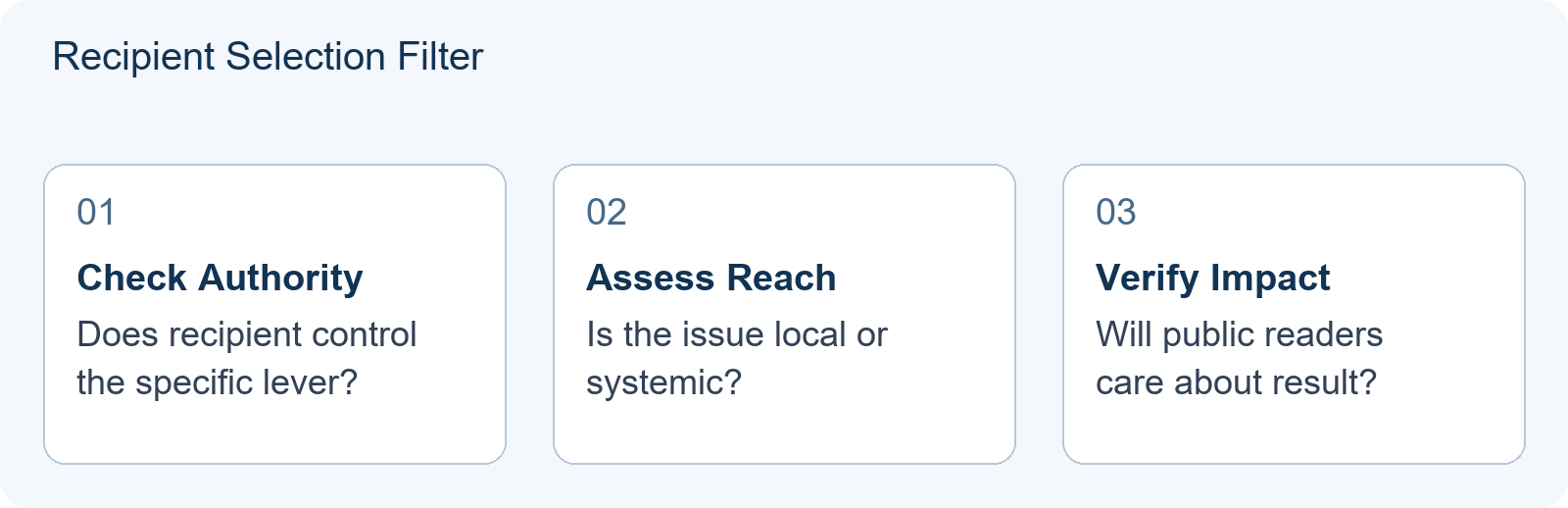
To select the right target for the NYT Open Letters Contest 2027, students can apply a three-part filter: Decision Power, Proximity, and Public Relevance. This is not an official rubric. It is a practical planning filter that helps a writer move from a general concern to a letter with a real addressee and a real ask.
Decision Power asks: Does this person or group have the authority to say yes or no to my request? If I ask them to change a rule, fund a program, or alter a practice, can they actually do it? For a teaching illustration, if the issue is school lunch quality, the principal or the district food services director has decision power. The local mayor usually does not. If the issue is a city bus route, the transit authority may have decision power, while a single classroom teacher does not.
Proximity considers the relationship between the writer’s community and the recipient. Is the recipient accessible enough that their response could realistically affect the writer’s daily life or immediate environment? While national leaders are powerful, their distance from a specific local issue can make the argument feel theoretical. Local officials, school boards, or regional company managers often offer a clearer path from complaint to resolution. Proximity does not mean the issue must be small. It means the writer can show a concrete connection between the recipient’s decision and a visible consequence.
Public Relevance ensures the issue matters beyond the individual case. Even if the recipient is local, the problem should reflect a broader trend or injustice that readers will recognize. A letter about a single pothole is less compelling than a letter about systemic neglect of pedestrian safety in aging neighborhoods. The recipient must be able to see the precedent their decision sets. In a short letter, public relevance is what keeps the piece from reading like a private grievance.
When these three factors conflict, decision power should usually come first. A recipient who cares deeply but cannot act may make the letter emotionally satisfying, yet it will struggle to answer the question every open letter implies: What should happen next, and who can make it happen?
Comparing Three Possible Recipients for One Issue
Consider a labelled teaching illustration where a student wants to address the lack of mental health resources in high schools. This is not an actual contest prompt or official example. It simply shows how the argument shifts based on the recipient chosen.
| Recipient | Focus of Argument | Call to Action |
|---|---|---|
| School Principal | Immediate operational gaps; counselor-to-student ratios in this school; scheduling barriers. | Implement a peer-support program; adjust the bell schedule so students can access counseling. |
| District Superintendent | Budget allocation; hiring standards; district-wide policy consistency. | Increase funding for licensed therapists; support a district-wide mental health plan. |
| State Legislator | Legal mandates; statewide data; comparative analysis with other states. | Support legislation requiring minimum staffing levels for public schools. |
Each recipient demands a different evidentiary base. In this teaching illustration, the principal needs data on current utilization rates. The superintendent needs budget comparisons. The legislator needs legal precedents and statewide context. Choosing the wrong recipient results in a mismatched argument. Asking a legislator to hire a specific counselor at one school is outside their likely scope. Asking a principal to pass state law is impossible. The strongest letters match the request to the recipient’s actual authority.
The same issue also changes tone. A letter to a principal can use direct knowledge of the school: ‘You have seen the counseling waitlist grow.’ A letter to a legislator needs broader framing: ‘Your district has one of the lowest counselor-to-student ratios in the state.’ A letter to a company executive might focus on employee policies or product design. The recipient is not a label at the top of the page; it is the organizing principle of the whole argument.
Addressing the Recipient While Still Speaking to Readers
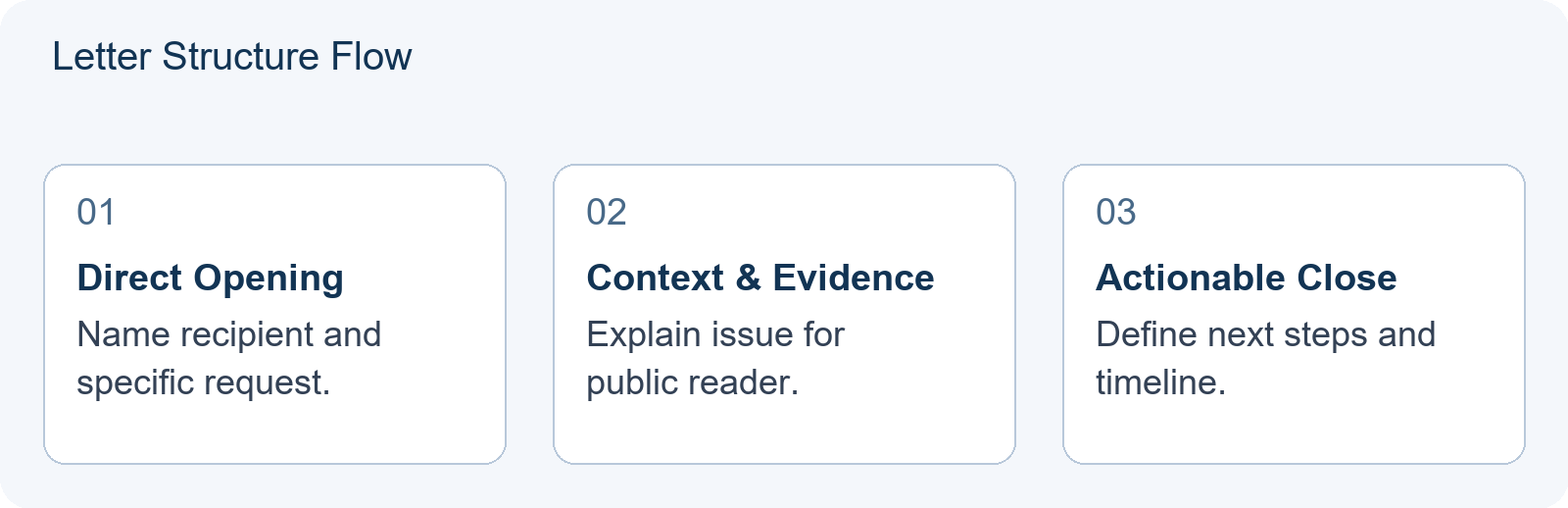
The challenge in the NYT Open Letters Contest 2027 is maintaining a dual voice. A strong letter often speaks directly to the recipient using second-person pronouns such as ‘you’ while providing context that allows the public reader to understand why this recipient matters. This requires careful framing of the opening paragraph.
Questions about the contests?
Scan the WeChat QR code — we help with contest registration, one-on-one topic coaching, and full guidance to the deadline.
Scan the WeChat QR code

Instead of starting with a general statement like ‘Mental health is important,’ a strong opening might say, ‘Dear Principal Smith, you have the authority to approve the after-school counseling pilot program that our student council proposed last month.’ This immediately establishes the recipient’s role and the specific stakes. In this teaching illustration, the subsequent paragraphs would then explain the background for the public reader, detailing the wait times students face and the potential benefits of the program.
Tone management is critical. Addressing a figure of authority requires respect and professionalism, avoiding accusatory language that might shut down dialogue. However, the letter must remain firm in its stance. The public reader judges the writer’s credibility based on how well they balance deference to the recipient’s position with confidence in their own argument. Phrases like ‘we urge you to consider’ can maintain persuasiveness without sounding demanding. The key is to make the recipient feel that the writer understands their constraints, not that the writer is ignoring them.
One practical technique is to write two audience notes before drafting. At the top of your planning page, write ‘Recipient needs to know’ and list the facts that person would find relevant. Then write ‘Public reader needs to know’ and list the context that makes the issue understandable beyond your school or town. When you merge the two lists, unnecessary private detail falls away, and your letter becomes both personal and publicly meaningful.
Anticipating the Recipient’s Main Objection in One Paragraph
A sophisticated open letter anticipates the recipient’s likely resistance. In the 500-word limit, dedicating one paragraph to addressing the primary objection strengthens the argument significantly. For the mental health teaching illustration, a principal might object due to budget constraints or liability concerns.
The writer should acknowledge the concern explicitly: ‘You may worry that adding counselors strains the annual budget.’ Then, in this imagined case, the writer might point to two concrete pieces of evidence the student has already checked: last year’s counseling waitlist data and a grant deadline for school mental health programs. Because this is an invented illustration, a real writer should replace those details with verifiable local information. The point is not to claim that a generic study proves the case. The point is to show that the writer has considered the recipient’s position and has a plausible next step.
This paragraph should not become a debate. It is a bridge. The writer acknowledges the obstacle, offers a path, and returns to the main request. Ignoring objections makes the letter seem naive; addressing them shows strategic thinking. In a short letter, one well-chosen objection is enough. Trying to answer every possible concern will crowd out the argument and weaken the final ask.
Final Check: Does the Letter Ask for a Specific Action?
Before submitting to the NYT Open Letters Contest 2027, review the closing paragraph. It should contain a clear, actionable request. Vague endings like ‘please think about this’ are insufficient. The request should be measurable and time-bound if possible.
For example, in the teaching illustration: ‘We request that you schedule a meeting with the student council by April 15 to discuss the pilot program details.’ This gives the recipient a concrete next step. If the letter ends without a specific ask, it is unlikely to drive change. The entire argument should build toward this final request, with each preceding paragraph removing barriers to saying yes.
A final recipient audit can be done in five minutes. Read only the first and last paragraphs. Does the first paragraph name the recipient and the issue? Does the last paragraph name the action and, if possible, a deadline? If either answer is no, revise before worrying about smaller style issues. For contest preparation, the recipient decision is not separate from the writing. It is the spine of the writing.
Students who prepare early can test two or three recipient options and see which one produces a clearer action request. If one recipient leads to a vague ending, that may be a sign the recipient lacks decision power. If another leads to a specific, realistic demand, the letter is more likely to feel purposeful within the 500-word limit. The best recipient is not the most famous or most emotionally satisfying one. The best recipient is the one who can act, who is connected to the issue, and whose decision the public can understand.
For related craft help, read How to Handle the Counterargument in a Short NYT Contest Entry (2026), How to Sound Like Yourself: Building Voice in a Short Contest Entry, and The Detail That Proves It: Choosing Evidence for a Short Contest Entry.
Frequently Asked Questions
Does the 500-word limit include the title?
No. The supplied contest notes say students write a public letter of 500 words or fewer, excluding the title.
Can I write to a group rather than one person?
Yes. The contest describes an individual or group with the power to drive change. Choose a group with clear authority, not a vague audience such as ‘society.’
When does the 2027 Open Letters contest open and close?
The 2026-27 contest calendar lists the Open Letters: Our Opinion Writing Contest as running Feb. 17-March 31, 2027.