A short contest entry cannot carry eight pieces of evidence. It can carry two or three, which means selection matters far more than accumulation. The skill is not finding support for your claim — it is choosing the one detail that proves it, making it specific enough to do the work, and cutting everything that merely agrees with you.
Four kinds of evidence a short piece can carry
Students often assume evidence means a statistic. In short-form writing, four types are available, and the strongest entries usually mix two.
- Observed detail. Something you saw, heard or counted yourself. Cheapest in words, highest in credibility, and impossible for another writer to duplicate. A queue that formed at 5.40am. A sign that has been mis-spelled for three years. This is the most under-used category by a wide margin.
- Reported fact. A figure, date, finding or event drawn from a published source. Powerful, but it costs words to attribute, and it is only as good as your ability to state it accurately.
- Testimony. What a specific named or described person said — a teacher, a neighbour, a shopkeeper, a researcher quoted in an article you read. A single sentence of real speech often outperforms a paragraph of your own explanation.
- Lived experience. Your own history, used as an argument rather than a story. This is legitimate evidence when it demonstrates a mechanism, and weak when it is offered as proof of a general trend. One student’s experience shows something is possible, not that it is typical — claim accordingly.
Whether a given contest expects sourced material at all, and how it expects sources to be handled, varies by contest and season — confirm current requirements on nytimes.com/learning before you draft. This guide is about which evidence to choose and how to deploy it, not about the rules governing citation.
The specificity ladder
Most weak evidence is not false. It is simply too high up the abstraction ladder to prove anything. Every claim can be supported at four levels, and each rung down costs almost no words while gaining substantial force.
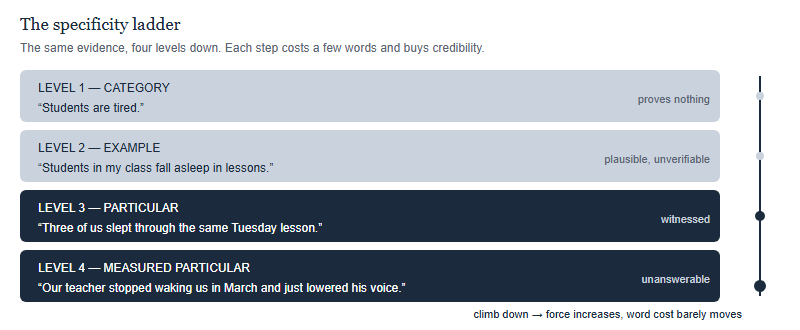
Two rules follow. First, if a sentence contains a plural noun and no number, name, place or time, it is probably at level 1 or 2 — climb down. Second, a detail becomes evidence at the moment it stops being available to anyone. “It was crowded” is available to everyone; “the door could not close on the 7.10” belongs to one writer.
Budgeting evidence against a word limit
The arithmetic is unforgiving, and doing it before you draft prevents the most common structural failure. Take a hypothetical 400-word entry — check your own contest’s stated limit, which varies — and the space genuinely available looks roughly like this:
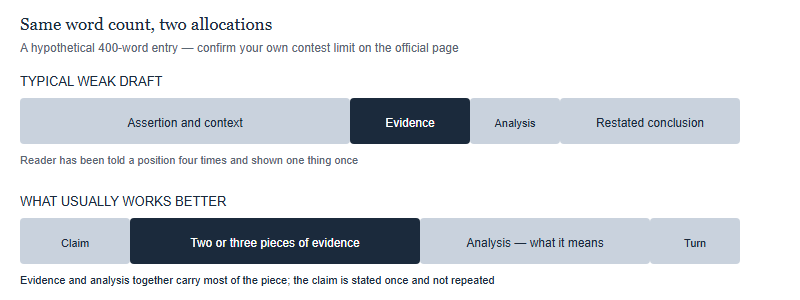
Three practical consequences. A short entry supports roughly one claim, not three. Each piece of evidence needs its own sentence of interpretation, so evidence you cannot afford to explain is evidence you cannot afford to include. And a conclusion that restates the opening is the cheapest thing to cut when you are over the limit.
This is also the answer to the most common question about over-length drafts. When students are forty words over, they trim adjectives and tighten clauses across the whole piece — a slow process that weakens every sentence slightly and improves none. The better move is structural: delete one entire piece of evidence, usually the weakest of three, along with the sentence interpreting it. You lose nothing a reader was relying on, and the two survivors get room to be developed properly. Cutting by subtraction of a whole unit almost always beats cutting by erosion.
The load test: does it prove this claim?
The subtlest failure in student argument is evidence that is true, relevant-sounding, and proves something adjacent to the claim rather than the claim itself. Judges notice this immediately, because the piece feels supported while remaining unconvincing.
| Claim | Evidence offered | What it actually proves | Fix |
|---|---|---|---|
| School should start later. | Teenagers need more sleep than adults. | That teenagers need sleep — not that the start time is the cause, or that moving it would help. | Add evidence linking start time to outcomes, or narrow the claim to what you can support. |
| This novel is overrated. | A summary of the plot and its awards. | That the book exists and was praised. Neither supports the judgement. | Quote or describe one specific passage that fails, and name the standard it fails against. |
| My city has changed. | Population figures for the province. | Regional growth — a different scale from the claim. | Use one street-level observation across two points in time. |
| Group projects teach collaboration. | “In my experience, I learned a lot from my group.” | That one project went well for one student. | Either narrow the claim to your own case, or add a second, different kind of evidence. |
The test is one question, asked of every piece of evidence: if a reader accepted this completely, would they have to accept my claim? If they could accept it and still disagree, the evidence is decoration. Either strengthen it or narrow the claim to fit — narrowing is almost always the better move in a short piece, and a precise small claim beats a vague large one.
Once the evidence survives the load test, five deployment habits decide whether it actually lands on the page.
Attribute in the sentence, not around it. Short forms rarely have room for formal apparatus, so the source name usually travels inside the clause: a Times piece on port automation reported that… Keep it under about eight words and put it before the fact, so the reader knows how much weight to give what follows. How each contest expects sources handled is set out on its own page — check it.
Questions about the contests?
Scan the WeChat QR code — we help with contest registration, one-on-one topic coaching, and full guidance to the deadline.
Scan the WeChat QR code

Never stack weak evidence. Three vague supports do not add up to one strong one; they read as padding and dilute the good material. If you have one excellent detail and two mediocre ones, cut both mediocre ones and spend the reclaimed words interpreting the excellent one.
Interpret immediately. Evidence dropped without comment makes the reader do your work. The reliable pattern is evidence, then the sentence that says what it means — and the second sentence should say something the evidence does not already say on its own.
Lead with your strongest. In a piece of a few hundred words there is no build-up. Your best detail belongs early, where it buys the reader’s attention for everything after it.
Let evidence do double duty. The best details prove a point and set a scene at the same time. This is how strong short entries feel longer than they are, and it is the main advantage that observed detail holds over borrowed statistics.
What counts as evidence in different forms
The form changes what your reader will accept. Requirements and formats differ by contest and change between seasons — plan against the current contest calendar and confirm on the official page.
- Editorial and argument. Reported fact and testimony carry most of the load, with one observed detail to keep it human. Anticipating the strongest objection is itself a form of evidence-handling.
- Personal narrative. Observed detail is the whole currency. Sensory particulars and remembered speech; statistics almost always feel imported.
- Review and criticism. The work itself is your evidence. Description of a specific moment, plus the standard you are applying — a judgement without a visible standard is only a preference.
- Explanatory and STEM writing. Mechanism is evidence. A clear causal chain and one concrete instance beats a list of findings.
- Open letters. Shared knowledge between you and the recipient functions as evidence you do not have to prove, which is why letters can argue so efficiently — see our Open Letters guide. What you cannot assume, you still have to show.
If you are still deciding which form suits the material you have collected, start from the overview of the contests — it is often easier to match a strong detail to a contest than to invent evidence for a contest you have already chosen.
Frequently asked questions
How many pieces of evidence should a short entry have?
Usually two or three, each interpreted. More than four in a few hundred words normally means none of them is developed.
Does personal experience count as evidence?
Yes, when it shows a mechanism. It proves something is possible, not that it is typical — so match your claim to it.
Do I need statistics to be taken seriously?
No. A precise observed detail often outperforms a borrowed figure, and it is harder to challenge.
Where do I put the source name in a short piece?
Inside the sentence, before the fact, in a few words. Check your contest’s stated source requirements on the official page.
This is an independent guide operated by Hanlin Education for China-based international-school students. We are not affiliated with, endorsed by, or sponsored by The New York Times Company or its Learning Network. Contest rules, word limits, eligibility and deadlines change each season — confirm current details on nytimes.com/learning before entering. Errors reported to our editorial desk are corrected within 7 working days.