In the 2026-27 New York Times (NYT) student contest calendar, six competitions open and close inside fixed windows. The seventh, Our Conversation Challenge for Weekly Current Events, runs all school year: students respond to the Learning Network’s Daily Writing Prompts, and each week selected comments are gathered into “Current Events Conversations.” For a student aged 13-19 who wants steady writing practice rather than a single deadline, that makes the Challenge the calendar’s only continuous practice surface — and a sensible weekly training ground before the next fixed-window contest opens.
This guide covers what the Challenge actually is, how it differs from the other six calendar items, a 20-minute weekly routine, and a worked transfer from a short comment to a longer contest entry. Every calendar date and structure below is drawn from an operator report on the published 2026-27 NYT calendar: Hanlin, “The 2026-2027 New York Times Student Contest Calendar Is Out: Two New Events and a Further AI Ban,” published 6 September 2026 (translated from Chinese). Where the notes do not state a rule, this article says so rather than guessing.
What the Weekly Conversation Challenge Is and Who Can Use It
The Our Conversation Challenge for Weekly Current Events appears as item 07 of the seven opportunities in the 2026-27 calendar described by the Hanlin report. Its structure is deliberately simple: it runs all school year rather than in a dated window; students respond to Daily Writing Prompts from the Learning Network; and each week a set of selected comments is collected and displayed in “Current Events Conversations.”
Eligibility, as the same report states it, mirrors the broader NYT student contest framework: the Challenge is open to students aged 13-19 worldwide. Students who have graduated from high school but have not yet entered college may also take part. Children, stepchildren and others sharing a household with NYT employees are excluded.
Two things the source notes do not specify are worth stating plainly, because students often assume them: the notes give no word limit for a Challenge comment, no published selection criteria, and no described prize structure or end-of-year result. Treat anything beyond the mechanics above — how long comments should be, how many are selected, what selection is worth — as unconfirmed until you read the current rules on the Learning Network itself.
How It Differs From the Other Six Calendar Items
The reporting distinction is not that the Challenge sits outside the calendar; it is in the calendar. The difference is timing and format. The other six items each have a defined window and a defined submitted form, judged as complete work. The Challenge trades the deadline for repetition and public display.
| 2026-27 calendar item | Reported window | Reported submitted form |
|---|---|---|
| My Tiny Memoir: Our 100-Word Personal Narrative Contest | Sept 16 – Oct 28, 2026 | Unpublished personal narrative of up to 100 words |
| What It’s Like to Grow Up in 2026: Our Visual Art Contest | Oct 28 – Dec 9, 2026 | Photography, drawing, comic, chart, screenshot, short film or sculpture, with an artist’s statement |
| The STEM Interview: Our Informational Video Contest | Jan 6 – Feb 17, 2027 | Interview video of up to 2 minutes with an expert |
| Open Letters: Our Opinion Writing Contest | Feb 17 – Mar 31, 2027 | Open letter of up to 500 words, excluding title |
| Audio Stories: Our Podcast Contest | Mar 31 – May 12, 2027 | Original podcast of up to 5 minutes |
| Voice and Choice: Our Summer Reading Contest | June 4–11; July 2–9; July 30–Aug 6, 2027 | Short written response of about 250 words, or video of up to 90 seconds |
| Our Conversation Challenge for Weekly Current Events | All school year | Comment responding to a Daily Writing Prompt; selected comments gathered weekly |
Read the table as a planning tool, not as a rulebook. Because the reported dates come from a second-hand summary of the published calendar, confirm each window on the Learning Network before you build a final plan around it. What the table reliably shows is the shape of the year: long stretches without an open contest, and therefore long stretches where the Challenge is the only NYT writing activity available.
One further series-level point from the same 2026-27 report is worth carrying into your routine. The report describes a zero-tolerance AI policy across the contests, with generative AI disallowed at any stage, and states that documentation of the creation process counts toward judging. That is context for how to practise: the point of weekly commenting is to build a habit you can defend as your own work, not to produce text for later recycling.
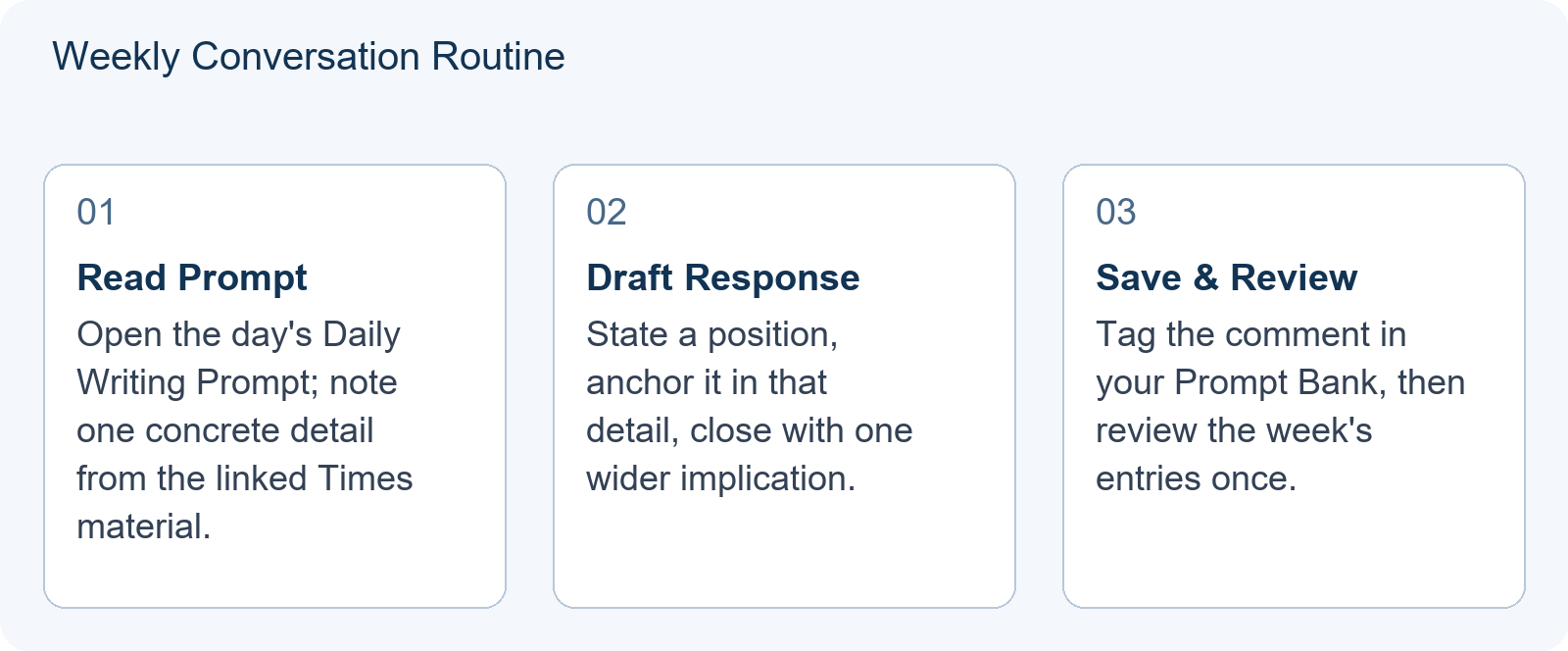
A 20-Minute Weekly Routine: Read, Respond, Save, Review
The following is a teaching illustration — a suggested practice structure, not an official NYT procedure or a scoring rubric.
- Read (5 minutes). Open the day’s Daily Writing Prompt. Identify the actual question being asked. Note one concrete detail from the linked Times material — a quoted line, a statistic, a photographed object — that you could refer to by name.
- Respond (10 minutes). Draft a short comment. State a position in the first sentence, anchor it in the detail you noted, and close with one implication that reaches past your own reaction. Resist generic praise (“great article”) and generic complaint (“this is bad”); both are unreusable later.
- Save (2 minutes). Paste the comment into a single personal document you call your Prompt Bank. Add two or three tags, and record the date and prompt link. The tag is what makes the bank searchable months later.
- Review (3 minutes, once a week). Read the past week’s entries together. Which argument advanced most? Which one was a feeling with no evidence behind it? Adjust the next week’s drafting accordingly.
If you also adopt a version-history habit for longer pieces — keeping drafts in one shared document rather than scattered files — you are preparing for a process-documentation expectation the 2026-27 report describes at series level. Whether a version history is required for any individual Challenge submission is not something the notes establish, so do not present it to yourself as a Challenge rule; do present it as good practice for the fixed-window contests.
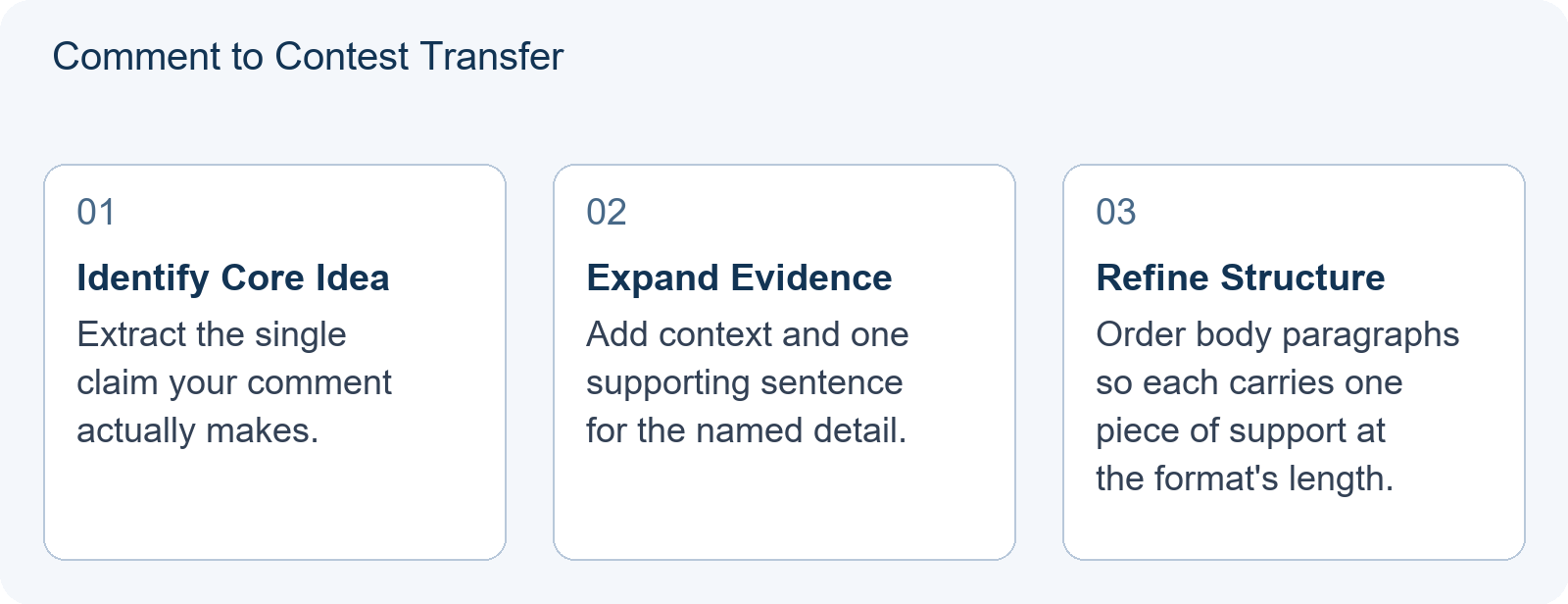
From Comment to Contest Entry: A Transfer Table
The table below is a teaching illustration. It maps elements a short comment tends to contain onto elements a longer entry needs. It is not a description of official judging criteria.
| Element in the comment | What it can become in an entry | How the move works |
|---|---|---|
| A named specific detail | Evidence anchor | Keep the detail, then add one sentence explaining why it supports your claim and one sentence of context. |
| A first-person reaction | Voice and stake | Convert “I felt this” into “here is why this matters to people in my position, and what follows from that.” |
| A counterpoint you noticed | Nuance | Give the opposing view its own sentence before answering it; do not bury it in a concession clause. |
| A one-line claim | Structure | Make that claim the thesis, and order the body paragraphs so each one carries one piece of support. |
A worked example (teaching illustration). Suppose a student reads Times coverage of retail districts after a local economic shock and writes this comment: “The photograph of empty shelving units said more than the employment figures did. Numbers describe a town; the photograph describes a Tuesday afternoon.” That is a complete, well-built comment. To turn it into an open letter paragraph of up to 500 words, the student would name the photograph’s subject, state who the letter addresses and why that recipient can act, then use the image as the entry’s central evidence rather than a decoration. To turn the same idea into a Summer Reading response of about 250 words, the student would choose one of the three reported windows in 2027, keep the photographic detail, and add a single sentence connecting the image to a wider question about how a community is represented. Same insight, three different lengths — the shift is how much evidence and structure the format can carry, not how loudly the point is made.
Questions about the contests?
Scan the WeChat QR code — we help with contest registration, one-on-one topic coaching, and full guidance to the deadline.
Scan the WeChat QR code
What Selected Comments Show and What They Do Not Prove
Being gathered into “Current Events Conversations” is a signal worth reading accurately. It indicates that your comment was short, clear and engaged enough for editors to highlight in that week’s collection. That is real information about your ability to compress an argument and speak to a public reader. Both skills transfer directly to a 100-word memoir or a tight podcast script.
It does not establish that a longer entry will succeed. A 500-word open letter is judged at least partly on sustained argument, evidence handling and structure — capacities that a two-sentence comment never exercises. A comment can also succeed because it is funny or timely, which will not carry an entry that must stand on reasoning alone. Use selection as feedback on clarity and tone, and treat it as one data point among many rather than a forecast.
Building a Prompt Bank Before the Next Fixed Window
The practical payoff of weekly commenting is a searchable archive. By February 2027, a student who has written one comment a week since September has roughly twenty tagged short arguments — on climate policy, technology, identity, local economics, whatever the prompts happened to cover.
When the Open Letters window opens on February 17, 2027, the work is selection and expansion rather than blank-page panic. Search the bank for the two or three arguments where you already found a concrete detail and a real recipient who could act. Those are your strongest candidates. If you would rather work in a group, the same bank can supply material for a school writing club session, and our guide to How to Run a NYT Contest Writing Club at a China International School (2026-27) covers how to structure that kind of meeting.
The same applies to the Summer Reading Contest, whose three reported 2027 rounds (June 4–11, July 2–9, and July 30–Aug 6) reward students who already know how to react to a Times item in a few hundred words. Weekly commenting is, in effect, the low-stakes rehearsal for exactly that task. Students who also want to broaden the range of NYT formats they have attempted can look at NYT Vocabulary, Multimedia and ‘Why I Write’ Contests: The Lesser-Known Wins (2026), though those run on their own schedules and should not be confused with the Challenge.
Weekly Practice Checklist
- Confirm eligibility once. Age 13-19 worldwide; graduated high school but not yet in college is allowed; NYT employee households are excluded, per the 2026-27 calendar report.
- Read even in weeks you do not submit. Half the value of the Challenge is staying fluent in what the paper is covering.
- Submit only when you have a real position. A weak comment teaches you nothing and clutters the bank.
- Write it yourself. The 2026-27 report describes a zero-tolerance AI policy and process documentation at series level; build the habit of drafting in a document you can trace.
- Read other selected comments. Ask specifically what makes each one readable: brevity, one sharp detail, an unexpected turn.
- Review and tag monthly. Untagged notes do not get reused.
- Keep expectations honest. Selection in the weekly showcase is not a prize, and no NYT contest outcome guarantees admission anywhere. The value is the writing itself, and the routine in How to Get Useful Feedback on a Contest Entry — and What to Ignore is what turns that writing into something sharper.
Used this way, the Our Conversation Challenge for Weekly Current Events is not a waiting room between deadlines. It is the part of the year when the writing actually gets built — one prompt, one comment, one tagged entry at a time — so that when a fixed window opens, you are expanding material you already understand rather than starting from nothing.
General event background is available at Event background.
This is an independent preparation guide, not affiliated with, endorsed by, or sponsored by The New York Times.
Frequently Asked Questions
Is the Weekly Conversation Challenge a separate contest outside the NYT calendar?
No. It is listed as item 07 among the seven opportunities in the 2026-27 NYT student contest calendar as reported by Hanlin (6 September 2026). The difference is timing: the other six run inside fixed windows, while the Challenge runs all school year and selected comments are gathered weekly into Current Events Conversations.
Can I use my comments as material for future contest entries?
Yes, as raw material rather than as submitted text. A comment often contains a claim, a concrete detail and a first-person reaction that can be expanded with evidence and structure for a fixed-window entry such as Open Letters (up to 500 words) or Summer Reading (about 250 words). The expansion is new writing; the comment is the starting point.
Does being selected for Current Events Conversations mean I won something?
The source notes describe weekly selected comments being collected for display, and do not describe a prize structure or an end-of-year winner for the Challenge. Treat selection as evidence that a comment was clear and engaging in that week’s collection — useful feedback, not an award equivalent to a contest result.