A contest writing club succeeds or fails on one number: how many finished entries actually get submitted before the deadline. Not how many students attend, not how many drafts exist. This is a practical plan for teachers and student leaders at China-based international schools — meeting structure, term calendar, feedback rules and the logistics that quietly sink most clubs.
Decide what the club is for before you book a room
Most school writing clubs drift into being reading groups with snacks. That is a perfectly good thing to be, but it is not what a contest club is. A contest club exists to convert interest into submitted work against an external deadline, which means every meeting has to move a specific draft closer to a specific closing date.
Write the purpose down in one line and put it on the first slide of the first meeting: we each submit at least two finished entries this year. Then pick your measure. Attendance is a vanity metric; drafts started is only slightly better. The number worth tracking on a whiteboard is entries submitted, because it is the only one that cannot be faked and the only one that produces the experience students came for.
Two structural decisions follow from that:
- Who is in the room. Mixed-grade works well — older students who have submitted before are the most credible evidence that the deadline is survivable. Cap the group at a size where every member can read work aloud within one meeting; beyond roughly a dozen, split into two rooms rather than lengthening the meeting.
- Who owns the deadline. One person — teacher or student officer — maintains the deadline board and confirms each contest’s live rules on the official Learning Network page. Rules, lengths and closing dates are set per contest and change year to year, so this is a recurring job, not a start-of-term job.
Run the first meeting on orientation rather than writing: what the family of contests is, which ones your members are eligible for, and what the year looks like. Our overview of the NYT Learning Network writing contests works as a pre-read; eligibility rules are set by the Learning Network and must be confirmed on their site for each contest.
The 60-minute meeting template
Clubs that spend the hour discussing writing produce discussion. Clubs that spend most of the hour writing and responding produce entries. The template below is deliberately unbalanced towards production.
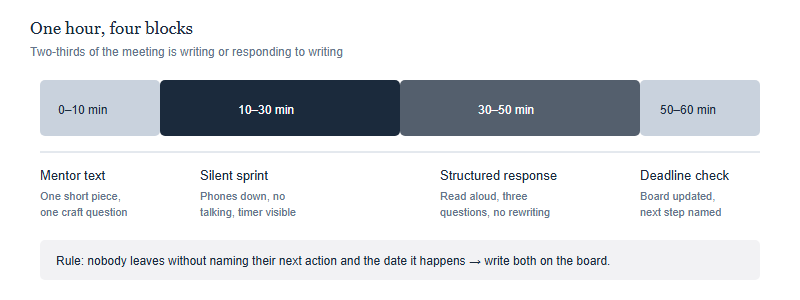
Three details make the difference between this working and not working. The mentor text must be short — ten minutes means one article or one passage, with a single craft question attached (“where does this writer stop explaining and start arguing?”). The sprint must be genuinely silent, with a visible timer; twenty protected minutes produces more usable text than an evening of interrupted work at home. And the response block must not become editing: readers describe their experience, they do not rewrite sentences.
The season shape: three phases per year
Contest seasons are lumpy. Some contests sit in autumn, some in spring, and one runs weekly across the summer break — the Summer Reading Contest, whose window this year runs from 5 June to 14 August 2026, with entries due each Friday. That shape should drive your club calendar rather than the school’s activity timetable. Build the year from the contest calendar, and re-verify every date on the official Learning Network page as the season approaches.
| Phase | Roughly when | What the club does | Output by the end |
|---|---|---|---|
| 1. Set-up | Start of the academic year | Orientation, eligibility check, deadline board built, everyone picks two target contests | A named target contest per member, with dates confirmed on the official page |
| 2. Production | The bulk of the year | Weekly meetings on the 60-minute template; each cycle ends in a submitted or shelved draft | At least one submitted entry per member per term |
| 3. Review and handover | After each closing date | Read published winning work as mentor texts; debrief what the club got wrong; brief next year's officers | A one-page lessons file and a trained successor |
Two scheduling notes specific to international schools in China. First, put your heaviest production weeks away from internal assessment and mock windows — a club that competes with IB or AP deadlines loses. Second, if a contest closes during a holiday, the club has to run asynchronously: agree before the break who is checking the deadline and where drafts live, because a group that goes quiet in July does not reassemble in August.
A feedback protocol that does not flatten voice
The fastest way to ruin a club is to let feedback become a committee edit. Twelve people with opinions will sand a distinctive entry into a competent, anonymous one. Use a fixed protocol and enforce it.
- The writer reads aloud. Hearing it catches rhythm problems no silent reader reports.
- The writer stays silent afterwards. No explaining what you meant — if it needs explaining, that is the finding.
- Readers answer three questions only: What do you think this is arguing? Where did your attention drop? What did you not believe?
- No line edits in the room. Sentence-level fixes go in the margin of a printed copy and are handed over silently at the end.
- The writer decides. Close by having the writer say aloud which single change they will make. One, not five.
That last rule is the one people skip and the one that matters. A protocol that produces twelve suggestions and no decision has wasted the hour.
The logistics that actually decide it — and three ways clubs die
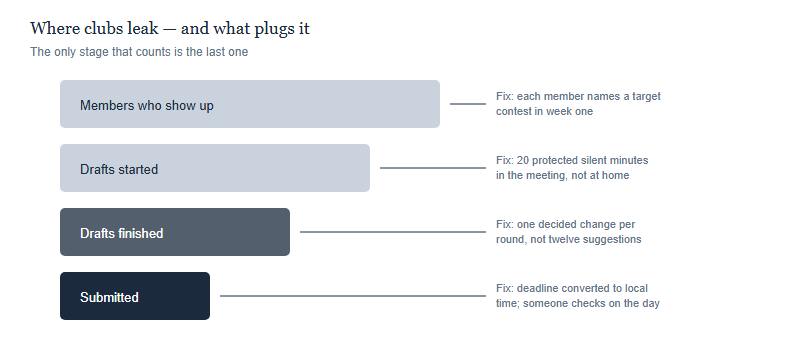
Every club leaks members between “interested” and “submitted.” The leaks are predictable, and each has a cheap fix.
Questions about the contests?
Scan the WeChat QR code — we help with contest registration, one-on-one topic coaching, and full guidance to the deadline.
Scan the WeChat QR code

Time zones are the club's job, not the student's. Deadlines are published by the Learning Network with a stated time and time zone; because of the gap between New York and Beijing, the effective local moment can fall on a different calendar day here. Do the conversion once, centrally, write the local date and time on the board, and treat the published deadline as the source of truth. Confirm the exact stated closing time on the official contest page — never carry over last year's conversion, since daylight-saving shifts move it.
Confirm the submission mechanics before the final week. Whether entries are submitted by students themselves or through a teacher, what form is used, and what identifying information is required are all set by the Learning Network per contest — check the current contest page rather than assuming, and have one member complete a submission early so the club learns the interface before the deadline crush.
Check access to the source material early. If a cycle depends on everyone reading a particular text, confirm in the meeting before the sprint that every member can actually open it on the device they will write on. Discovering this at 9pm on deadline day is how finished drafts go unsubmitted.
The three ways clubs die, in order of frequency: the meeting becomes a lecture and stops producing text; every member writes about the same subject because the mentor text was too prescriptive; and nobody owns the deadline, so a room full of good drafts misses the close. All three are structural, and all three are cheap to prevent.
One note from our own work with China-based students, de-identified and per Hanlin, with results varying and no outcome predictable: students we have supported have taken Honorable Mentions in the Summer Reading Contest. What those cycles had in common was unglamorous — a fixed weekly slot, a named target contest, and a person whose job was the calendar. If your club wants a lower-pressure first target, a single-form contest with a clear ask, such as the Open Letters Contest, is an easier first submission than an open-topic one.
Frequently asked questions
How many members does a contest writing club need?
Enough that every member can read aloud in one meeting — roughly a dozen. Beyond that, split into two rooms instead of extending the hour.
Do teachers submit entries on students' behalf?
Submission mechanics are set by the Learning Network and differ per contest. Confirm the current process on the official contest page before the final week.
How do we handle a deadline that falls during a school holiday?
Agree before the break who owns the deadline board and where drafts live, then convert the closing time to local time in advance.
Can a club run without a teacher sponsor?
Student-led clubs work if one officer owns the calendar. Most schools still require a staff sponsor for room booking — check your own school's activity policy.
This is an independent guide operated by Hanlin Education for China-based international-school students. We are not affiliated with, endorsed by, or sponsored by The New York Times Company or its Learning Network. Contest rules, eligibility, submission mechanics and deadlines are set by the Learning Network and change from year to year — confirm current details on nytimes.com/learning before you enter. Any error reported to our editorial desk is corrected within 7 working days.