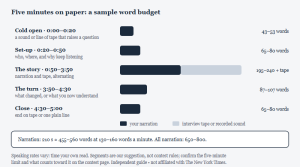
If your contest entry spends most of its space telling the reader what happened in the book, film or article, you have written a summary, not an entry. The fix is not to bolt analysis onto the end. It is to decide what you are claiming first, then give only the description that claim needs. This guide gives you a five-minute diagnostic and a rewrite method.
Why strong readers write weak entries
The students who fall into the summary trap are almost never lazy readers. They are usually the opposite: they have read the thing twice, they can recall the structure, and they want that work to show. So the entry becomes a demonstration of comprehension.
The problem is that comprehension is assumed. Nobody is checking whether you finished the book. What a short contest entry has to prove is that you did something with it — that you noticed a pattern, disagreed with a consensus, or found the one detail that explains the rest. Retelling is also psychologically safe: a summary cannot be wrong. A claim can be argued with, which is precisely why it is worth reading.
Then there is the arithmetic. These are short forms. The Summer Reading Contest, for example, asks for a response of roughly 1,500 characters, with entries due each Friday inside a window that runs from 5 June to 14 August 2026 — check the current limit and closing date on the official Learning Network page before you submit, since the Learning Network sets these per contest and they change year to year. At that length, four sentences of plot recap is not a slow start. It is a third of your entry, spent on information the judge did not ask for. If you are still working out how the family of contests fits together, start with our overview of what the NYT Learning Network writing contests are.
The highlight test: a five-minute diagnostic
Print your draft, or open it and use four highlighter colours. Go sentence by sentence and tag each one as exactly one of four jobs:
- Context — the minimum the reader needs to follow what comes next.
- Claim — an arguable statement that a reasonable person could contest.
- Proof — a specific detail, quotation, number or observation that supports the claim.
- Consequence — what follows from the claim being true; why it matters beyond the text.
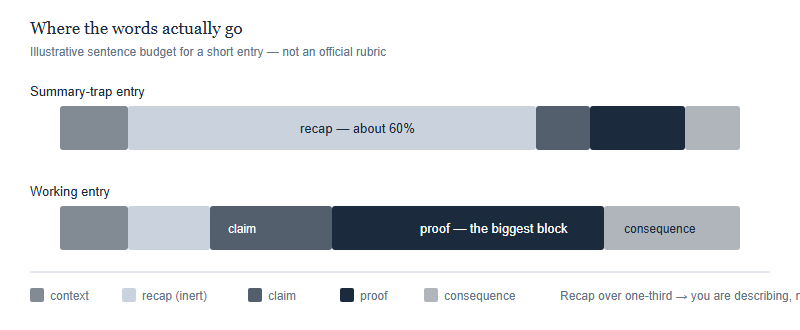
Any sentence that does none of those four is recap. Now count. The ratio is the diagnosis. As an editorial rule of thumb — ours, not an official rubric — if more than about a third of your sentences are pure recap, the entry is describing rather than arguing, and no amount of polishing the prose will fix it.
What actually counts as a claim
Three tests. A claim has to be arguable (a thoughtful reader could disagree), specific (it names the thing doing the work, not a category), and sized (you can support it inside the limit you are given). “This novel explores identity” fails all three: nobody disagrees, nothing is named, and it would take a dissertation to demonstrate.
Most workable claims in short contest writing take one of three shapes:
- Mechanism — it works because of a particular choice. (“The interviews land because the director never cuts away when someone stops talking.”)
- Comparison — it does something differently from the obvious neighbour. (“This report treats the shortage as a scheduling problem, where most coverage treats it as a funding problem.”)
- Revaluation — the part everyone treats as background is doing the main work. (“The article is nominally about the buses. It is actually about who is allowed to be tired in public.”)
| Retelling sentence | Rewritten as a claim | Shape |
|---|---|---|
| “The narrator moves to a new city and struggles to make friends.” | “The loneliness in this book is architectural — every scene of failed friendship happens in a room the narrator cannot afford to stay in.” | Revaluation |
| “The article explains how the new recycling rules work.” | “The rules described here will be judged on signage, not on chemistry, and the piece quietly knows it.” | Mechanism |
| “The documentary follows three night-shift bus drivers over one winter.” | “By staying on the drivers between passengers, the film argues that the job is mostly waiting — which is exactly what the city’s timetable refuses to price in.” | Mechanism |
| “This piece is about air quality in my city.” | “Air-quality reporting where I live counts good days; the number families actually plan around is consecutive bad ones.” | Comparison |
| “The study found a link between sleep and memory.” | “The interesting result is not the link but the size of it: the effect appears at an hour of sleep loss, which is a school-timetable problem, not a medical one.” | Revaluation |
Notice that every rewritten version is falsifiable. Someone could read the same text and say “no, the film is not about waiting.” Good. That disagreement is the sign that there is an argument on the page.
Give only the context your claim needs
Once you have the claim, context stops being a duty and becomes a calculation: what is the minimum a stranger needs in order to follow this sentence? Usually it is one clause, not one paragraph.
Here is an invented before-and-after, written for this guide, on a made-up documentary about night-shift bus drivers.
Before (recap-led, 5 sentences): “This documentary follows three bus drivers in a large city over one winter. The first driver has worked nights for eleven years. The second has just started and finds the schedule difficult. The third is close to retiring. Over the film we see them at work, at home and in the depot, and by the end we understand how hard the job is.”
Questions about the contests?
Scan the WeChat QR code — we help with contest registration, one-on-one topic coaching, and full guidance to the deadline.
Scan the WeChat QR code

After (claim-led, same length): “By staying on the drivers between passengers, this documentary argues that the job is mostly waiting. The camera holds on an empty aisle at 3am for long enough to be uncomfortable, then cuts to a timetable that assumes the bus is always full. One driver, eleven years in, has stopped bringing a book; the newest one still brings two. That small difference does more work than any interview: the film is showing us what a decade of dead time takes. It is an argument about scheduling disguised as a portrait.”
The second version contains less information about the film and far more thinking about it — and it still tells you what the film is. Context did not disappear; it got absorbed into sentences that were doing another job at the same time. That is the trick: in short forms, no sentence gets to have only one function.
The trap changes shape by contest — and a pre-submission check
Retelling wears a different costume in each form, which is why students who have fixed it once still fall into it in a different contest. Deadlines, lengths and prompts differ across the Learning Network’s contests and are set per contest, so pair this with our contest calendar and confirm the live rules on the official page before you write.
| Contest type | How the trap disguises itself | The counter-move |
|---|---|---|
| Summer Reading response | Re-explaining the article you chose, then adding “I found this interesting” at the end | Open with your reaction as a claim; refer to the article only where it supplies proof |
| Review | Plot recap in the first third, verdict in the last line | State the verdict early; spend the middle proving it with one or two scenes |
| Explanatory / STEM-style writing | Textbook exposition — accurate, complete, and arguing nothing | Choose the one counter-intuitive step and make the piece about why that step surprises people |
| Editorial-style opinion writing | Background paragraphs on the issue before any position appears | Position in sentence one or two; background only as evidence for it |
| Open letter | Recounting events the recipient already lived through | Assume shared knowledge and spend the space on the ask — see our guide to the Open Letters Contest |
| Personal narrative | Chronology: “and then, and then” — a timeline instead of a turn | Find the moment something changed and structure around it |
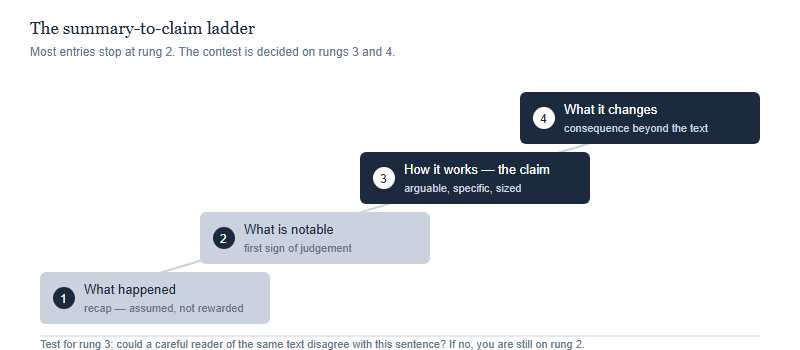
Before you submit, four questions. Can you say your claim in one sentence without using the words “explores”, “discusses” or “shows”? Could a careful reader of the same text disagree with it? Does your first two sentences contain the claim, or are they still clearing your throat? And is your longest block of text proof rather than recap?
One observation from our own drafting work, de-identified and per Hanlin, with the obvious caveat that results vary and nothing here is a predictor: students we have worked with have taken Honorable Mentions in the Summer Reading Contest. The pattern across those drafts was not vocabulary or ambition of topic. It was that the claim arrived early and the middle of the piece was spent defending it.
Frequently asked questions
Is summary ever allowed in a contest entry?
Yes — as context, in the smallest dose that lets a stranger follow your claim. Usually one clause, rarely a whole paragraph.
How do I write about a book the judge may not have read?
Assume nothing about their reading, but supply context inside claim sentences rather than in a separate set-up paragraph.
What if my claim turns out to be wrong?
An arguable claim is not a wrong one. Support it with specific evidence from the text and let the reader disagree — that is the point.
Where do I check the current word or character limit?
On the official Learning Network contest page. Limits and deadlines are set per contest and change year to year, so confirm before you draft.
This is an independent guide operated by Hanlin Education for China-based international-school students. We are not affiliated with, endorsed by, or sponsored by The New York Times Company or its Learning Network. Contest rules, word and character limits, eligibility and deadlines are set by the Learning Network and change from year to year — confirm current details on nytimes.com/learning before you enter. Any error reported to our editorial desk is corrected within 7 working days.