In a short contest entry, the counterargument is not a politeness ritual — it is the fastest way to show you understand the problem. Handle it in roughly 60 to 90 words: name the strongest opposing position in specific terms, concede the part that is genuinely true, then show why your claim survives anyway. Boilerplate like some may say burns words and proves nothing. Confirm each contest's length and rubric on the official Learning Network page before you plan.
Why a tightly capped entry still needs the other side
Short argumentative pieces fail in a specific way. The writer picks a defensible position, stacks three pieces of supporting evidence, and ends on a call to action. Nothing in it is wrong. Nothing in it is interesting either, because at no point does a reader meet resistance. An argument that never encounters an obstacle reads like a summary of an argument.
The counterargument fixes this in two ways at once. First, it is a credibility device: a reader who sees you state the opposing case accurately will trust your handling of your own case. Second — and this matters more when you are working inside a tight limit — it is a compression device. Anticipating the strongest objection forces you to drop the two weakest supporting points, because you can now see which of them would not survive contact.
Not every Learning Network contest is argumentative. The ones that are — or that contain an evaluative claim — reward this move most:
- Student Editorial. Explicitly argumentative. The opposing view is core, not decoration.
- Open Letters. You are writing to a specific reader who may already disagree, which makes the objection concrete rather than abstract. See our guide to the Open Letters Contest.
- Review. An evaluative claim invites disagreement: the counterargument is the reasonable reader who liked the thing you disliked.
- STEM Writing. Here the "opposing view" usually appears as a common misconception you correct rather than an opponent you refute.
Narrative contests work differently, and forcing a debate paragraph into a personal narrative is a reliable way to flatten it. If you are still deciding which contest suits your writing, start with our overview of the Learning Network contests, then read that contest's own brief and rubric on the official page — the criteria differ contest by contest and are updated each cycle.
Four counterargument moves, and what each one costs
Most students know one move — concede, then say "however" — and use it whether or not it fits. There are four, and they are not interchangeable. Choose by asking what is actually true about the objection.
| Move | Use it when | Rough word cost | How it backfires |
|---|---|---|---|
| Concede and narrow | The objection is true, but only of a subset of cases | 40–60 | You narrow so far that nobody would have disagreed with the surviving claim |
| Concede and outweigh | The cost the objection names is real, but smaller than the benefit | 60–90 | You assert "outweighs" without ever putting the two quantities next to each other |
| Reframe the question | Both sides are answering different questions and talking past each other | 70–100 | The reframe reads as a dodge because you never address the original question at all |
| Steelman and refute | The objection rests on one assumption you can genuinely break | 80–110 | You state the strong version and then cannot break it, and the reader agrees with your opponent |
The fourth move is the most impressive and the most dangerous. Steelmanning means stating the opposing case better than a casual opponent would state it — and if you do that without a real refutation ready, you have written a persuasive advertisement for the other side inside your own entry. Only reach for it when you can point at one load-bearing assumption and remove it.
To see how much the choice of move matters, take one objection and handle it two ways. Suppose you are arguing that your school should drop timed mental-arithmetic tests, and the strongest objection is that fluency built under time pressure frees up attention for harder problems later.
- Concede and outweigh: agree that fluency matters and that timing does build it, then argue the cost — students who freeze and conclude they are bad at mathematics — removes more capable students from the subject than the fluency gain adds. This works only if you then put the two effects side by side rather than announcing that one is bigger.
- Reframe the question: point out that the two sides are answering different questions. Your opponent is answering "does timed practice build fluency?" You are answering "is a graded timed test the right instrument for building it?" The reframe is legitimate here because you can then accept the fluency claim entirely and still win — untimed drilling would satisfy it.
Notice that the second version is more persuasive and also more honest, because it does not require you to dispute something you believe. That is the general rule: pick the move that matches what you actually think is true about the objection. Students who force every objection into concede-and-outweigh end up arguing against positions they privately agree with, and the strain shows in the prose.
Where the concession goes: a word budget that survives the limit
Students usually discover they have no room for the opposing view at the revision stage, when the draft is already full. Budget for it before you write. The split below is one workable version for a short argumentative entry — scale it to whatever limit your contest sets; adapt the proportions, not the principle.
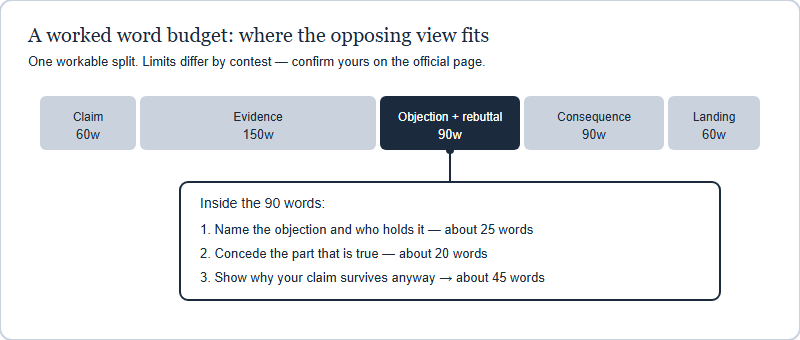
Two practical notes. The objection paragraph belongs after your strongest evidence, not before it — a reader who has not yet seen why you might be right cannot judge whether the objection matters. And the rebuttal should be longer than the concession. If your concession runs 40 words and your rebuttal runs 20, you have written a paragraph that argues for the other side.
In very short forms this changes shape entirely. In the very shortest narrative forms there is no counterargument paragraph; the tension lives inside the scene. In a short review, the opposing view is often a single sentence acknowledging what the work does well before you explain why it still fails.
Questions about the contests?
Scan the WeChat QR code — we help with contest registration, one-on-one topic coaching, and full guidance to the deadline.
Scan the WeChat QR code

Five failure patterns we keep seeing
These are our editors' notes from reading drafts by China-based international-school students — patterns, not official Learning Network statistics. All five are fixable in one revision pass.
- The straw opponent. The draft refutes a position no thoughtful person holds. Fix: write the objection as if the smartest person who disagrees with you were reading over your shoulder.
- The ghost opponent. "Critics argue" and "some people say" name nobody. Fix: attribute it to a real constituency with a real interest — school administrators managing a budget, parents worried about screen time, a policy the writer actually read.
- The costless concession. Conceding something irrelevant to your claim looks generous and changes nothing. Fix: concede something that genuinely constrains your position, then show the constrained version still holds.
- The late arrival. The objection appears in the last thirty words with no room to answer it, so the entry ends on the other side's point. Fix: move it into the budget above.
- The double surrender. The writer concedes so much that the original claim quietly disappears, and the conclusion asserts it again anyway. Fix: after conceding, restate your claim in its narrowed form and check that it is still worth arguing.
A 20-minute stress test for your second draft
Run this on a finished draft, not an outline. Each question takes about five minutes and has a pass condition you can check without a teacher.
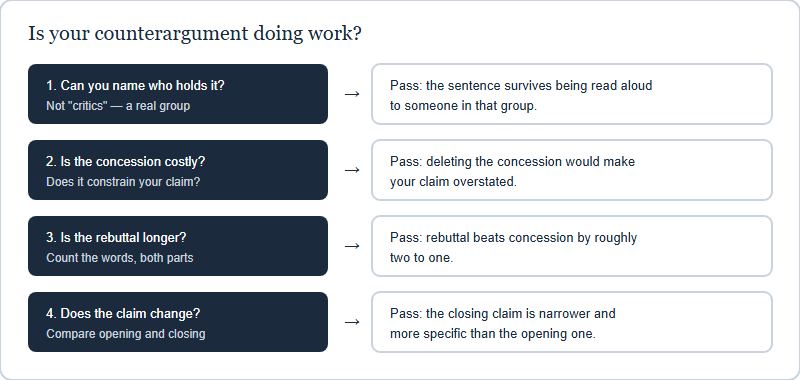
Question four is the one students skip and the one that separates a competent entry from a memorable one. In a strong short argument, the claim you end on is not identical to the claim you opened with — it has been sharpened by the objection. That visible movement is what makes a reader believe the thinking happened on the page rather than before it.
Fitting this into your season
Do the counterargument work at the second-draft stage. In a first draft you are still finding out what you think, and inviting an opponent too early usually produces a hedged, argument-free piece. Once the claim is stable, one dedicated pass on the objection is often the single highest-return revision you can make.
Three logistics points before you submit. Contest word limits and formatting rules differ and are set by the Learning Network each cycle — check the entry page for the contest you are entering rather than assuming last year's limit carries over. If you quote or paraphrase the opposing side, follow the contest's own citation and originality rules, including anything it says about AI assistance; these are published with each contest. And plan backwards from the deadline using the 2025-26 contest calendar, confirming every date on the official page, since dates shift.
Frequently asked questions
Does every contest entry need a counterargument?
No. Argumentative and evaluative entries benefit most. In personal narrative, forcing a debate paragraph usually flattens the story.
How many words should the opposing view take?
Around 20 percent of an argumentative entry works well in practice. Check your contest's exact word limit on the official Learning Network page.
Where should the counterargument go?
After your strongest evidence, never at the very end. A reader must see your case before judging whether an objection defeats it.
Is it risky to state the opposing case too well?
Only if you cannot answer it. Steelman an objection when you can break one assumption it depends on; otherwise choose a lighter move.
This is an independent guide operated by Hanlin Education for China-based international-school students. We are not affiliated with, endorsed by, or sponsored by The New York Times Company or its Learning Network. Contest rules, word limits, eligibility and deadlines are set by the organiser and change each cycle — confirm current details on nytimes.com/learning before you enter. Any factual error reported to our editorial desk is corrected within 7 working days.