A contest title has one job: make a reader who has just finished someone else's entry want to start yours. That means naming your angle, not your topic. "School Start Times" is a folder label; a title that carries a claim, a collision of two facts, or a named subject does actual work. If a contest asks for a title, check its entry page for whether the title counts toward your word limit — rules differ by contest and cycle.
What a title actually does in a reading queue
Entries are not read in isolation. They are read in sequence, often many in one sitting, by a reader whose attention is a depleting resource. Your title is the handover point between the entry before yours and yours. It sets an expectation, and the first line either honours that expectation or subverts it deliberately.
This is why topic-label titles cost you so much. "Social Media and Teenagers" tells a reader what folder your entry belongs in and nothing about what you will say. The reader arrives at your first sentence with no hypothesis to test, which means your opening line has to do the work of two lines. In an entry with a hard word cap you cannot afford that.
Two practical constraints before craft. First, not every Learning Network contest asks for a title in the same way, and some entry forms handle titles differently from others — read the entry form for the specific contest rather than assuming. Second, whether a title counts inside the word limit is a rules question, not a style question; confirm it on the official contest page. A useful hedge either way: keep titles under about ten words, so the answer never changes your entry.
The handover: how your title should meet your first line
Most weak titles are not weak in isolation. They are weak in combination with the sentence directly beneath them. Title and first line are a two-step handover, and there are only three ways to run it.
- Repeat. The first line restates the title in longer words. This is the default in student drafts and it wastes the most valuable sentence in the entry. If your title says the bell rings too early and your first line says school starts too early, one of them is doing nothing.
- Extend. The title names the situation and the first line moves into it — a scene, a number, a voice. This is the safe, professional default and works for almost every form.
- Subvert. The title sets an expectation and the first line deliberately breaks it. High risk, high reward, and only worth attempting when the rest of the entry earns the reversal.
The diagnostic takes fifteen seconds: read the title, then the first line, and underline every word that appears in both. More than one shared content word usually means you are repeating. Rewrite the line, not the title, because the title has to survive alone in a list while the first line never does.
One more consequence of the handover: because the title is read first and the first line second, the title can carry the context that would otherwise cost your opening sentence ten words. In a tight limit, a title that establishes place and stakes buys your first line the freedom to start in motion rather than in exposition.
Five title patterns, and where each belongs
Almost every strong short-form title is one of five shapes. Choosing the shape first is faster than staring at a blank line hoping for inspiration.
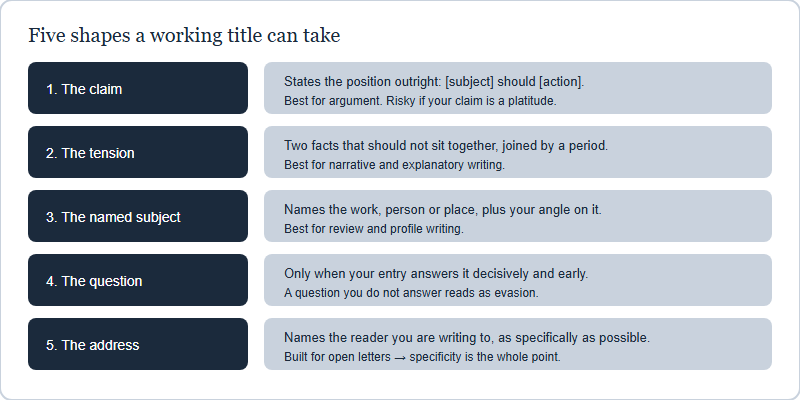
The address pattern deserves a note. An open letter written to "the world" or "society" is addressed to nobody, and the title exposes that immediately. Naming a real, reachable reader — an admissions office, a specific ministry, the version of yourself who started high school — forces the letter itself to be concrete. Our guide to the Open Letters Contest works through what that recipient choice does to the body of the piece.
Matching the title to the contest
The same title can be strong for one contest and wrong for another, because different contests ask a reader to expect different things.
| Contest type | What the title should signal | Patterns that fit | Common mismatch |
|---|---|---|---|
| Student Editorial | Your position, not your subject area | Claim, tension | Topic labels that could sit above any of a hundred entries |
| Review | The work under review plus the angle of your verdict | Named subject | A pun with no verdict inside it |
| STEM Writing | The phenomenon and why it is counterintuitive | Tension, question | Technical vocabulary that filters out the general reader |
| Personal Narrative | A promise of scene, not a summary of the lesson | Tension, image | Thesis titles that give away the ending before line one |
| Open Letters | Exactly who is being addressed | Address | An abstract recipient, which signals an abstract letter |
The narrative row is the one students argue with most. It feels safer to announce the meaning up front — "How Failure Taught Me Resilience." But a narrative title that states the moral removes the reason to read the story, because the reader now knows the destination and the route is just admin. Title the moment, not the meaning.
The map: specificity, voice, and four ways titles fail
Two properties predict most of a title's effect. Specificity is whether a reader can tell what this particular entry will say. Voice is whether the title sounds like a person rather than a form field. Nearly every failed title is a failure of one or the other:
Questions about the contests?
Scan the WeChat QR code — we help with contest registration, one-on-one topic coaching, and full guidance to the deadline.
Scan the WeChat QR code

- The folder label (no specificity, no voice). A noun phrase naming your topic. Diagnostic: could this title sit above five other entries in the same contest? If yes, it is a label.
- The pun with no content (voice without specificity). Wordplay is a bonus layer on top of a working title, never a substitute for one. If removing the joke leaves nothing, the title was never doing work.
- The overclaim (false specificity). "The Real Reason Nobody Talks About X" promises a revelation that a short contest entry almost never delivers, and a reader who feels oversold discounts everything after it.
- The borrowed voice (someone else's voice). A headline written in the cadence of a professional newspaper, sitting above a student entry in a completely different register. The seam is visible in the first line.
Plot your candidates on the two axes and the weakness usually becomes obvious.
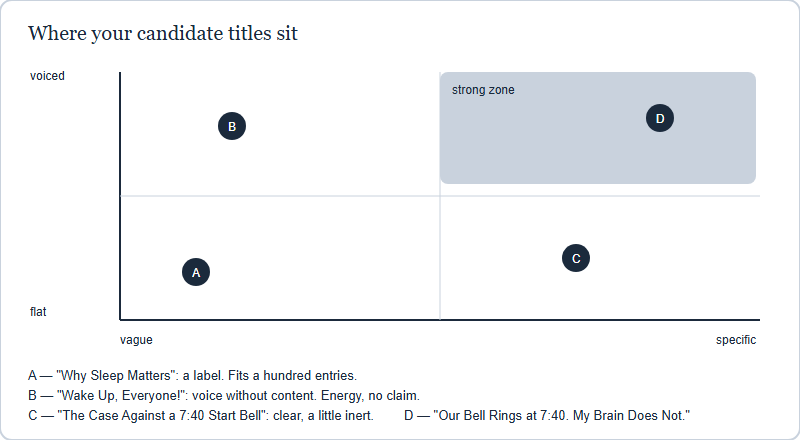
The order matters. Adding voice to a vague title produces B — loud and empty, which reads worse than plain C. Add specificity first: name the number, the bell, the place, the decision. Then, if the piece has a voice, let the title carry a sample of it.
A 10-minute titling routine
- Minutes 1–3: harvest. Reread your own entry and list every concrete noun and number in it. Titles almost always already exist inside the draft.
- Minutes 4–7: generate eight. Two claims, two tensions, two named-subject or address versions, two questions. Eight is the point where the obvious ones are exhausted and the good one appears.
- Minute 8: the substitution test. Swap in a different topic. If the title still works, it is a template, not a title — cut it.
- Minute 9: the read-aloud test. Say the title, then the first line. If the first line repeats the title, rewrite one of them.
- Minute 10: check the rules. Confirm on the official contest page whether a title is required, how it is entered, and whether it counts toward the word limit.
Step two is where students give up too early, so here is what eight looks like on one subject — an editorial arguing that a school should stop ranking students by exam average. The examples are written for this guide, not drawn from any contest.
- Our School Should Stop Publishing Rank (claim — plain, functional, forgettable)
- Rank Is a Number That Teaches Nothing (claim with an idea inside it)
- I Was Ranked 41st. I Still Do Not Know What I Was Bad At. (tension)
- Two Students, One Point Apart, Twelve Places Between Them (tension, statistical)
- What the Rank List Cannot See (named subject, slightly abstract)
- The Noticeboard Outside the Staff Room (named subject, concrete and physical)
- Who Is the Rank List Actually For? (question — usable only if answered)
- To the Committee That Approves the Rank List (address)
Numbers three, four and six only appeared because the writer kept going past the obvious ones, and all three are stronger than one and two. That is the entire argument for generating eight: the first candidates are your topic, and the later ones are your piece.
Do this after the final draft, not before. A title written first tends to become a promise the draft then obediently fulfils, which is how a piece ends up saying exactly what its author expected to say. If you are still choosing which contest to write for, start from our overview of the Learning Network writing contests, and plan submission dates against the 2025-26 calendar, verifying each deadline on the official page.
Frequently asked questions
Does the title count toward the word limit?
That is a rules question set per contest. Confirm on the official Learning Network entry page. Keeping titles under ten words makes the answer irrelevant.
Should a narrative entry have a thesis-style title?
Usually not. Announcing the lesson removes the reason to read the story. Title a concrete moment or image instead.
Are question titles a bad idea?
Only when the entry never answers them. If your piece settles the question decisively, a question title can work well.
How many title options should I write?
Eight. The first three are predictable, and the genuinely distinctive option usually appears at five or six.
This is an independent guide operated by Hanlin Education for China-based international-school students. We are not affiliated with, endorsed by, or sponsored by The New York Times Company or its Learning Network. Contest rules, title and formatting requirements, word limits and deadlines are set by the organiser and change each cycle — confirm current details on nytimes.com/learning before you enter. Any factual error reported to our editorial desk is corrected within 7 working days.