Skills transfer; drafts mostly do not. Months of contest writing sharpen compression, detail selection and endings — all of which make a personal statement better. But the argumentative shape that wins a short editorial is close to the worst shape for a statement, because one is about an issue and the other is about you. Reuse the material and the craft, not the file.
Two pieces of writing that look similar and are not
A contest entry and a college personal statement are both short, both first-person-capable, both judged by a stranger reading many of them. Students reasonably conclude the two are close cousins. They are not, and the difference is not length — it is who the writing is about and what the reader is deciding.
A Learning Network contest entry is read by someone assessing the writing. Your subject can be a bus timetable, a novel, an enzyme, a grandparent. Whether the reader learns anything about your character is irrelevant to whether the piece works.
A personal statement is read by someone deciding about the applicant. The subject is nominally whatever you write about, but the actual subject is always how you think and what you value. A brilliant, impersonal analysis of a public issue is a strong contest entry and a weak statement, because at the end of it the reader still cannot describe you.
To be clear about what this article is and is not: this is a craft guide about moving material between two forms. It makes no claim about admissions outcomes. No contest, award or publication guarantees admission anywhere, and any source telling you otherwise is selling something.
What transfers, and what actively hurts
| Habit built by contest writing | In a personal statement it is… | Why |
|---|---|---|
| Compression under a hard word limit | Transfers well | Statements are also capped. Writers used to cutting a long draft down to a hard contest cap do not panic at an application cap. |
| Choosing one proving detail over three general ones | Transfers well | The single specific detail is what makes a reader believe an applicant is real. |
| Ending without a summary or a moral | Transfers well | Both forms die on a tidy lesson in the last sentence. |
| Drafting stamina and taking edits | Transfers well | The single biggest predictor of a good statement is how many honest revisions it survived. |
| Thesis, three supports, call to action | Hurts | Produces an op-ed about an issue. The reader finishes knowing your position, not you. |
| Writing about a public problem as the centre | Hurts | The problem takes the space the reader needed for your reasoning and choices. |
| Newspaper register: "we as a society" | Hurts | Institutional voice is the opposite of the individual voice a statement needs. |
| Maximum economy on every line | Mixed | Statements need room to reflect. Extreme compression can strip out the thinking. |
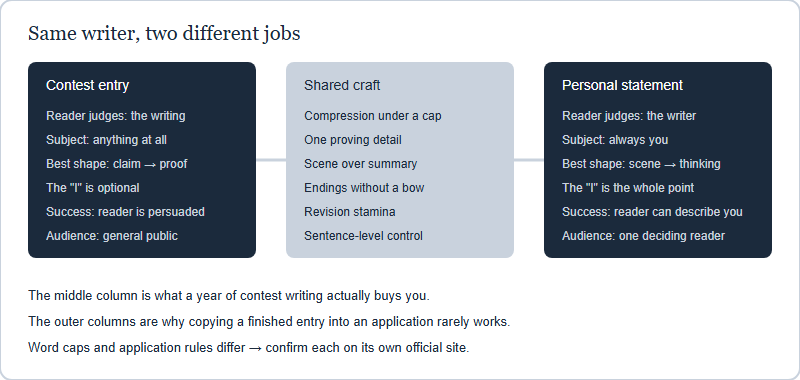
The four differences that break a straight copy-paste
1. The reader is deciding something different. A contest reader asks whether the piece is good. An admissions reader asks whether this applicant should be admitted. The second question needs evidence about judgement, curiosity and response to difficulty — evidence a well-argued editorial about a national policy simply does not contain.
2. The time horizon is different. Contest entries usually capture one moment or one argument. A statement generally has to show change: what you thought before, what happened, what you think now. Narrative entries transfer better than argumentative ones precisely because they already carry a before and after.
3. The extra words are not more room for the same thing. Moving from a tightly capped contest entry to a longer personal statement tempts students to add scene. The added space should mostly go to reflection — the part contest writing trains you to cut. Confirm the current word range on the application platform you are actually using, since limits differ by system and by year.
4. The "I" behaves differently. In an open letter, the first person is a rhetorical position: you speak as a student to an authority. Our Open Letters guide works through that stance. In a statement, the first person is the evidence itself. A voice that performs indignation beautifully in a letter can read as posturing when the reader is assessing the person behind it.
A six-step workflow for reusing material honestly
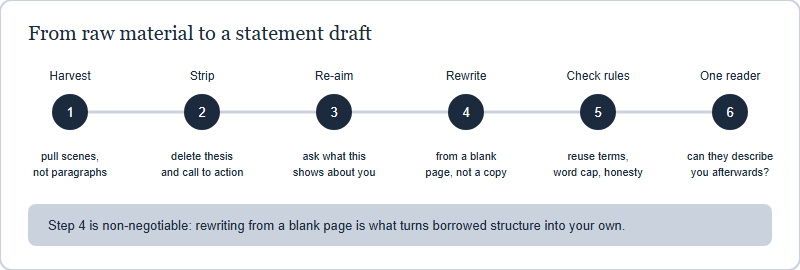
Harvest means opening every contest draft from the past year and listing the concrete moments inside them: the specific afternoon, the exact object, the sentence someone actually said. Those are portable. The arguments built on top of them are not.
Strip means deleting the machinery that made it a contest entry — the thesis sentence, the transitional signposting, the closing call to action. What remains is usually shorter than you expect and more useful than you expect.
Re-aim is the hinge. For each surviving moment, write one sentence answering: what does this show about how I think? If you cannot answer without generic virtue words like "passionate" or "resilient", the material is not yet earning its place.
Questions about the contests?
Scan the WeChat QR code — we help with contest registration, one-on-one topic coaching, and full guidance to the deadline.
Scan the WeChat QR code
Rewrite from a blank document. Do not edit the old file. Editing preserves the old shape by default, and the old shape is precisely the problem.
A worked version of step three, since it is the step most students perform badly. Say a review entry contained this moment: you spent two weeks arguing with a friend about a film you had both watched, and only on the third rewatch did you notice the detail that made her right. Three re-aim attempts, in ascending order of usefulness:
- "This shows I am open-minded." A virtue word. It describes a category, not a person, and every applicant claims it. Unusable.
- "This shows I can change my mind." Better, but still an assertion. The reader has to take your word for it.
- "This shows I need to see a thing three times before I trust my first reaction to it — and that I now build that delay into how I judge anything." Specific, slightly unflattering, and portable to how you would handle a lab result or a disagreement in a seminar. Usable.
The test is whether your sentence could plausibly be false of most applicants. "Open-minded" is true of everyone who claims it and therefore informative about no one. A habit with a mechanism attached — a delay, a rule you follow, a specific thing you check — is evidence. This is also the point where contest writing pays off most directly: choosing the proving detail is exactly the skill a year of hard word limits builds.
Rules and honesty before you submit anything
- Reuse and publication terms. If an entry was published or is under consideration, whether and how you may reuse the text elsewhere is governed by that contest's own terms. Confirm on the official contest page rather than assuming.
- Word limits. Confirm the current cap on the application platform you are using, and on any university-specific supplement. These differ by system and change.
- Originality and AI. Both contests and applications publish their own rules on outside help and AI assistance, and the two sets of rules are not identical. Read each on its own official site.
- Do not overstate a result. Describe what you actually did — entered, was published, was recognised — in plain language. Inflating a result is the one error a careful reader is guaranteed to catch.
If you have no contest material yet
Writing contest entries specifically as personal-statement raw material is a poor plan; the entries come out hedged and the statement comes out calculated. Write entries because a form interests you, then treat any transferable material as a by-product. Narrative and profile-style forms tend to leave the most usable residue, because they already deal in scene and consequence.
If you are starting from zero, our overview of the Learning Network contests explains what each form actually asks for, and the 2025-26 calendar shows how the year is spaced so you are not drafting an entry and a statement in the same fortnight. Confirm every date and rule on the official pages before you commit to a plan.
Frequently asked questions
Can I submit my contest entry as my personal statement?
Almost never advisable. It answers a different question for a different reader. Reuse the moments and craft, then rewrite from scratch.
Do published entries create a reuse problem?
Possibly. Reuse and publication terms are set by the contest. Confirm on the official Learning Network page before republishing text anywhere.
Which contest form transfers best?
Narrative and profile-style writing, because they already contain scene and change. Argumentative entries transfer the least usable material.
Will contest recognition help my application?
No award guarantees any admission outcome. Treat writing practice as the reliable benefit and any recognition as a bonus.
This is an independent guide operated by Hanlin Education for China-based international-school students. We are not affiliated with, endorsed by, or sponsored by The New York Times Company or its Learning Network, and we are not affiliated with any application platform or university. Contest rules, reuse terms, word limits and deadlines are set by their respective organisations and change each cycle — confirm current details on nytimes.com/learning and on the relevant application site before you submit. Any factual error reported to our editorial desk is corrected within 7 working days.