Two of the Learning Network’s most rewarding contests ask you to turn reporting into storytelling. The Profile Contest has you write about a real person based on an interview; the Coming of Age contest asks for a true moment of growing up. Both reward observation and honesty over invention. This independent guide explains the reporting behind a strong profile and how these contests differ from a personal narrative.
Quick facts (2026)
| Profile | Report and write about a real person, usually based on an interview |
| Coming of Age | A true narrative about a moment of growing up or changing |
| Core skill | Observation, listening and honest rendering — not invention |
| Who can enter | Students 13–19 worldwide · free |
| Official source | nytimes.com/section/learning |
A profile is reporting first, writing second
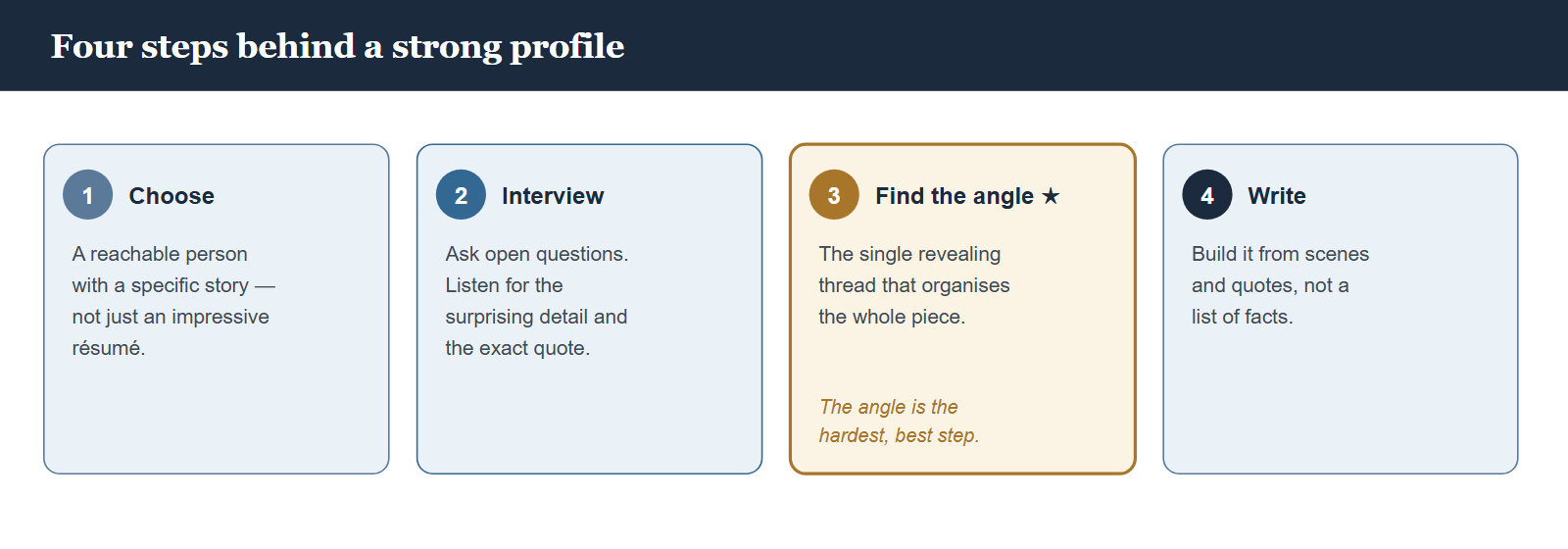
The mistake students make with a profile is to start writing too soon. A good profile is built on reporting: a real interview, real observation, and the patience to find the one angle that makes this person worth a reader’s time. You are not writing a CV of someone admirable; you are finding the specific, revealing detail — a habit, a contradiction, a turn of phrase — that lets a stranger feel they have met them. The reporting comes first, and the writing simply renders what you found.
Profile vs personal narrative
Students often confuse these. The difference is the camera’s position: a personal narrative points it at you and one moment of your own; a profile points it at someone else, built on reporting. Coming of Age sits between them — your own story, but specifically about a moment of change. Choosing the right one matters because the skills differ: narrative rewards introspection and scene-writing; profile rewards interviewing and the discipline of staying out of your subject’s way.
| Personal Narrative | Profile | |
| Subject | You, one moment | Another real person |
| Built on | Memory & reflection | Interview & observation |
| Wins on | Showing a moment precisely | Finding the revealing angle |
Your community is full of subjects
International students sometimes reach for a famous name. Resist it. The strongest student profiles are almost always of someone close and specific — a grandparent who ran a small shop, a school cleaner everyone greets but no one knows, a coach, a neighbour, a recent immigrant in your city. These people are reachable for a real interview, and their stories are genuinely new to a New York judge. A profile rooted in your own community is both easier to report and fresher to read than a distant celebrity. The same honesty applies to Coming of Age: a true, ordinary moment of change beats a dramatic one you have to embellish. For how these are judged, see what judges look for.
Frequently asked questions
What is the NYT Profile Contest?
It asks you to report and write about a real person, usually based on an interview. The aim is to find a specific, revealing angle that lets a reader feel they have met the person — not to list their achievements. Confirm the current format on the official Learning Network.
Questions about the contests?
Scan the WeChat QR code — we help with contest registration, one-on-one topic coaching, and full guidance to the deadline.
Scan the WeChat QR code

How is a profile different from a personal narrative?
A personal narrative is your own story, built on memory and reflection. A profile is about another person, built on interviewing and observation. Coming of Age sits between them: your own story, focused on a moment of change.
Who should I profile?
Usually someone close and specific you can actually interview — a relative, a neighbour, a worker in your community — rather than a distant celebrity. Reachable subjects give you real detail, and their stories are fresh to the judges.
Does the story have to be dramatic?
No. A true, ordinary moment rendered honestly beats a dramatic one that feels embellished. Specificity and honesty matter more than scale.
This site is an independent editorial guide to The New York Times Learning Network’s free student writing contests, operated by Hanlin Education for China-based international-school students. We are not affiliated with, endorsed by, or sponsored by The New York Times Company or its Learning Network. Contest formats and dates change by season — always confirm the current rules on the official NYT Learning Network. Confirmed errors are corrected within 7 working days.