The 2026-27 New York Times student contest calendar lists a new event: The STEM Interview: Our Informational Video Contest. It runs from January 6 to February 17, 2027. Students choose an interesting question from science, technology, engineering, math, or health and make a video of up to two minutes in which an industry expert answers that question. The calendar summary also gives example topics such as why ice is slippery and whether we need to say please and thank you to AI chatbots. At the time the summary was published, full rules and a step-by-step creation guide were still listed as forthcoming.
That pending detail matters. You cannot yet rely on a final rubric or a complete submission checklist. What you can do now is prepare the intellectual core of the entry: the question design. This article focuses on that prior step. It assumes you will find an expert and handle production; for that part, see The NYT STEM Interview Video Contest (2027): How to Find an Expert, Run the Interview and Cut It to Two Minutes. A strong STEM Interview entry usually depends on whether the student asks questions that produce clear, short, usable answers.
The Two-Minute Box: Why Broad Science Questions Fail on Camera
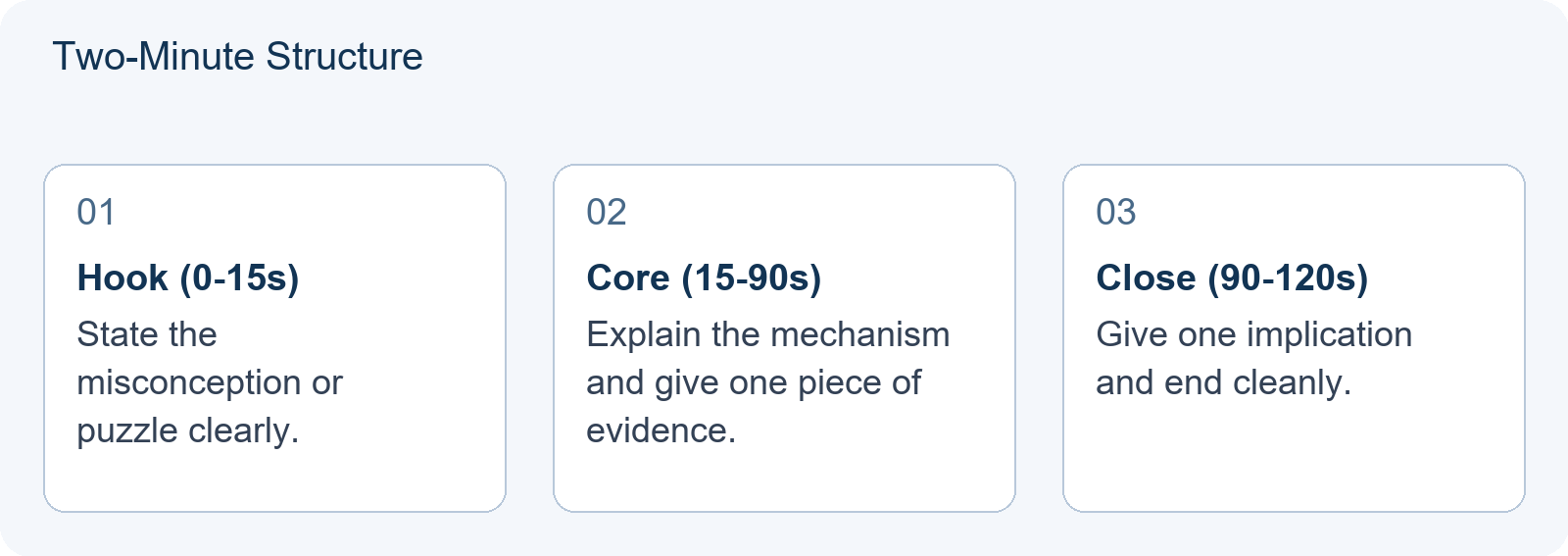
A two-minute limit is not generous. If you allocate thirty seconds for an introduction and outro, you have ninety seconds for the expert’s explanation. At a normal speaking pace, that is roughly 200 to 250 words. Every pause, tangent, or throat-clearing moment spends budget you cannot recover.
Broad questions fail because they invite lectures rather than answers. A question like ‘How does AI work?’ invites history, ethics, technical architecture, and speculation. An expert answering it may speak for three minutes before reaching a usable point. For the NYT STEM Interview Video Contest 2027, you are not making a documentary. You are making an informational clip. Your goal is extraction: get the expert to state the specific mechanism, key variable, or surprising fact that answers your chosen question.
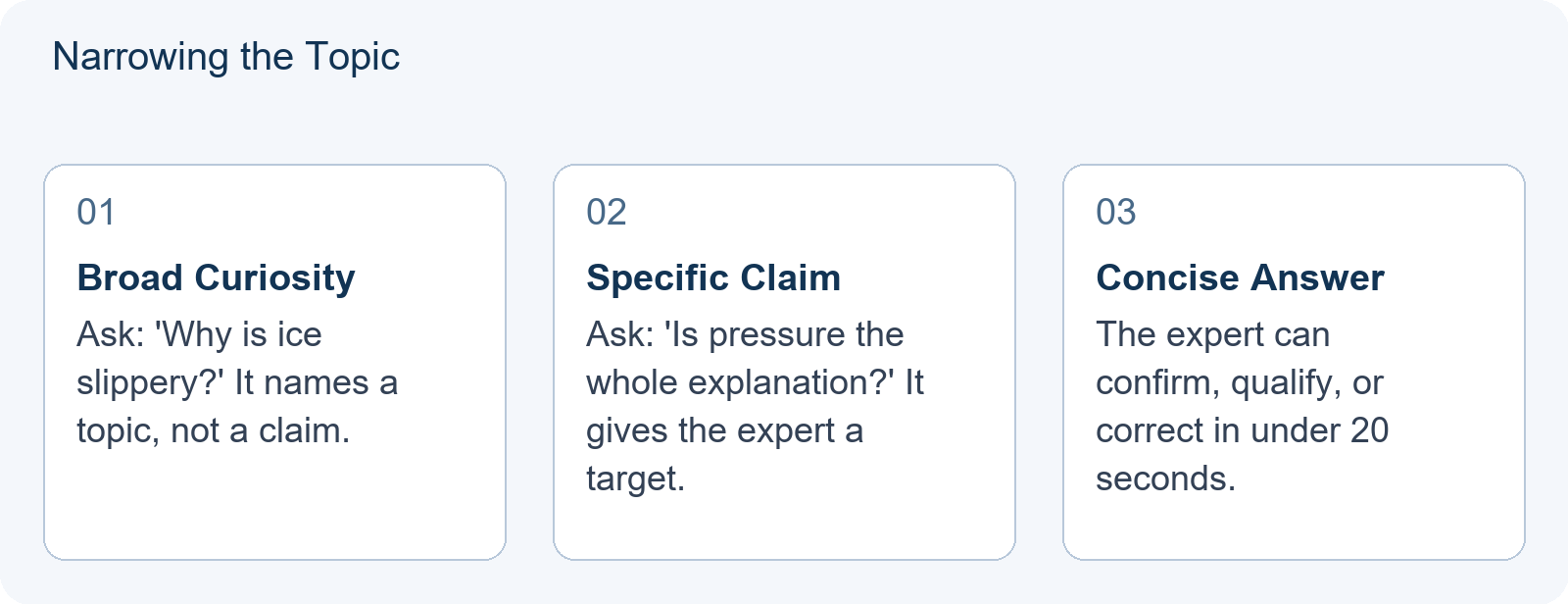
Consider the difference between asking, ‘Why is ice slippery?’ and asking, ‘What has to happen at the surface of ice for it to feel slippery?’ The first question invites a general story. The second gives the expert a target. The answer can be shaped into a sentence or two. Before you contact an expert, narrow your topic to a single claim that can be explained in under twenty seconds.
This is also where many students waste their expert’s time. They ask the expert to ‘explain the topic’ and then hope to find a short segment in the edit. A better approach is to decide in advance what kind of answer the video needs. Does the video need a correction? A definition? A comparison? A cause-and-effect chain? Once you know the answer type, you can phrase a question that makes that answer likely.
From Curiosity to Interview Question: Narrowing One Claim
The contest’s own examples are starting points, not final interview questions. ‘Why is ice slippery?’ is a topic. ‘Do we need to say please and thank you to AI chatbots?’ is a debate. Both are too large for a single two-minute interview unless you narrow them into a testable, answerable claim.
Take the AI politeness example. The broad version is social and philosophical. To make it more suitable for a STEM interview, find the technical angle. You might ask whether polite phrasing changes how a language model responds at all, or whether the effect depends on the model and the task. The point is not to answer that question here. The point is to design a question that an AI researcher or engineer can answer with a specific explanation rather than a general opinion.
Apply the same logic to the ice example. Instead of asking why ice is slippery in general, ask whether a common explanation is complete. For example: ‘Many people hear that pressure explains slippery ice. Is pressure the whole story?’ This is not a trick question. It gives the expert room to confirm, qualify, or correct the common explanation. That creates a clear narrative beat: expectation, complication, resolution.
Your preparation should involve writing at least ten possible sub-questions for your main topic. Then select the one that has the best chance of a short, definite answer. If you cannot imagine the expert answering in under thirty seconds, the question is too broad. If you can imagine three different experts giving three unrelated answers, the question is too vague. If the question requires a diagram longer than five seconds, it may not fit the format.
Question Ladder: Opening, Mechanism, Example, Implication
Once you have a narrowed claim, structure the interview as a ladder. This keeps the expert oriented and ensures the final video has a beginning, middle, and end. You do not need to ask all four questions on camera if time is tight, but you should prepare them.
Rung 1: The Opening. Ask a question that establishes the puzzle or common belief. ‘Many people think ice is slippery mainly because of pressure. Is that the full explanation?’ This gives the viewer a reason to keep listening. It also tells the expert where to start.
Rung 2: The Mechanism. Ask for the actual explanation in plain language. ‘If pressure is not the whole story, what should we understand about the surface of ice?’ The expert’s answer here becomes the core of your video. Ask them to avoid jargon unless they can define it in one sentence.
Rung 3: The Example or Comparison. Ask for a familiar comparison. ‘How would you compare this to another surface people know?’ This gives viewers a mental image and helps the editor find B-roll or text overlays.
Rung 4: The Implication. Ask why the explanation matters. ‘Where does this matter outside a skating rink?’ This turns trivia into a story with a takeaway. It also gives your video a natural ending.
When an expert’s answer surprises you, do not simply move on. Use a follow-up question that asks for clarification or an example. Our piece on NYT Interview Follow-Up Questions: Moving Beyond the Answer You Expected explains how to move beyond the answer you expected without losing control of time.
Worked Teaching Illustration: A Script Outline for ‘Why Is Ice Slippery?’
Note: This is a hypothetical teaching illustration based on the contest’s example topic. It is not an official script, a guaranteed winning entry, or a statement of the contest’s judging preferences.
Imagine a student preparing for the NYT STEM Interview Video Contest 2027 using the topic ‘Why is ice slippery?’ The student does not need to know the expert’s answer in advance. Instead, the student designs questions that require a short, clear answer type. The table below shows the question plan, not the scientific conclusion.
| Time Slot | Student Question | What the Answer Must Accomplish |
|---|---|---|
| 0:00-0:15 | ‘Many people hear that pressure explains slippery ice. Is pressure the whole story?’ | A correction or qualification, delivered in one or two sentences. |
| 0:15-0:45 | ‘If pressure is not the whole story, what happens at the surface of ice?’ | A mechanism explained in plain language, with no more than one technical term. |
| 0:45-1:15 | ‘How would you compare this to another familiar surface?’ | A comparison that helps a general viewer picture the idea. |
| 1:15-1:45 | ‘Where does this matter outside a skating rink?’ | One practical implication that gives the video a reason to exist. |
This outline ensures that every part of the interview serves a narrative function. The student does not need to improvise follow-up questions during the recording because the initial questions already ask for specific answer types. If the expert gives a statistic, check it carefully before putting it on screen; our guide to Writing With Numbers: How to Use a Statistic in a Short NYT Contest Entry Without Getting It Wrong (2026) explains how to avoid common errors.
Questions about the contests?
Scan the WeChat QR code — we help with contest registration, one-on-one topic coaching, and full guidance to the deadline.
Scan the WeChat QR code

Editing Expert Answers Without Distorting Meaning
Even with precise questions, experts may pause, repeat themselves, or go off-topic. Editing is where the two-minute limit becomes real. Cutting audio requires care. You cannot splice sentences together if the result changes the expert’s meaning.
For example, if an expert says, ‘That explanation is incomplete, but it does capture part of what happens under certain conditions,’ and you cut the second half to save time, you leave the viewer with a misleading impression. Always preserve the qualifier. If you must cut, look for natural pauses where the speaker breathes. Use jump cuts sparingly. Instead, use B-roll or text overlays to cover the gap while keeping the audio continuous.
Another strategy is to record the expert answering the same core question twice: once freely, and once constrained to one sentence. Use the free version for context and the constrained version for the final edit. This gives you options without forcing the expert to perform unnaturally during the main take. It also respects the expert’s time, because you are not asking for repeated full interviews.
Finally, keep a simple edit log. Note which take you used, why you cut a particular phrase, and whether the cut preserved the expert’s qualification. This log is not required by the calendar note, but it helps you explain your process if you are asked about originality. The 2026-27 contest calendar states that creation-process documents count in judging across the contests, so keeping a clear record is a sensible habit.
Pre-Interview Checklist for Students and Their Expert
Before hitting record, ensure both parties are prepared. This checklist is practical advice, not an official rule list.
- Topic confirmation: Has the expert agreed to answer the specific narrowed question, not just the general topic?
- Technical test: Have you tested microphone levels and lighting? Background noise ruins informational clarity.
- Consent: Do you have permission to use the expert’s likeness and voice for the contest and for any later portfolio use?
- Script review: Have you sent the question ladder to the expert beforehand so they can prepare concise answers?
- Backup plan: What happens if the expert goes over time? Agree on a signal to wrap up.
Preparing the expert is crucial. Many professionals are used to long-form interviews. Tell them explicitly: ‘This is a two-minute educational clip. Please keep answers under twenty seconds each.’ This framing shifts their mindset from storytelling to information delivery. It also makes your edit faster.
Course-Fit and Resource Request Preparation
If you are seeking coaching for this contest, focus your consultation on question design and editing workflow rather than general video production. The contest asks for an interview with an expert, so the student’s own thinking should remain visible. A coach can help you refine your scientific inquiry, but the strongest entries usually keep the questions and final script under the student’s authorial control.
When contacting a preparation service, specify that you need help with:
- Narrowing a broad STEM topic into a testable interview question.
- Structuring a four-part question ladder for a two-minute runtime.
- Editing techniques that preserve scientific accuracy while meeting time limits.
The contest is run by The New York Times Learning Network. Hanlin International Education is an independent education provider, not the contest organizer. If you use independent coaching, make sure it helps you improve your own questions and edit rather than supplying content. The 2026-27 calendar also states a zero-tolerance generative-AI ban across the contests, so AI tools should not be used to generate questions, scripts, or interview answers.
FAQ
Can I use AI tools to generate my interview questions?
No. The 2026-27 contest calendar states that generative AI cannot be used at any stage of the contests. That includes brainstorming, drafting questions, scripting, and editing. Your questions and script should be human-created.
Does the expert need to be a famous scientist?
No. The calendar says an ‘industry expert.’ For planning, relevant expertise might come from a local engineer, a university professor, a museum curator, or another professional who can accurately answer your specific question. The key is relevant expertise, not celebrity.
What happens if my video is longer than two minutes?
The calendar describes the video as ‘up to two minutes.’ Treat two minutes as a hard ceiling for planning and editing. For enforcement details and final submission rules, wait for the full official rules, which were listed as forthcoming when the calendar summary was published.
What to Do This Week
You do not need to wait for the full rules to begin preparing. Choose one topic from the contest’s broad areas. Write ten possible questions. Eliminate any question that invites a lecture. Narrow the remaining question until an expert could answer it in under thirty seconds. Then draft a four-rung question ladder and send it to a potential expert. That preparation alone will put you ahead of students who begin by turning on a camera.
For a two-minute format, clarity matters more than coverage. A two-minute video cannot explain an entire field. It can explain one good question through one expert’s focused answer. Design for that constraint, and the editing will be much easier.
Frequently Asked Questions
Can I use AI tools to generate my interview questions?
No. The 2026-27 contest calendar states that generative AI cannot be used at any stage of the contests. That includes brainstorming, drafting questions, scripting, and editing. Your questions and script should be human-created.
Does the expert need to be a famous scientist?
No. The calendar says an ‘industry expert.’ For planning, relevant expertise might come from a local engineer, a university professor, a museum curator, or another professional who can accurately answer your specific question. The key is relevant expertise, not celebrity.
What happens if my video is longer than two minutes?
The calendar describes the video as ‘up to two minutes.’ Treat two minutes as a hard ceiling for planning and editing. For enforcement details and final submission rules, wait for the full official rules, which were listed as forthcoming when the calendar summary was published.