The STEM Interview is a new Learning Network contest on the announced 2026-27 calendar: an informational video of up to two minutes built around an interview with an expert, open 6 January to 17 February 2027 for students aged 13 to 19. Its complete rules appear when it opens, but the slowest step — finding and booking a willing expert — can start this autumn. Here is a plan that works from China.
What is announced for The STEM Interview, and what is not
The details below come from the 2026-27 calendar the Learning Network announced, as relayed to us in September 2026. This is a new contest, so there is no earlier rules page to study, and we have not seen one for this year either: the complete rules appear when the contest opens on 6 January. Anything more specific you read before then — who qualifies as an expert, whether the interview must be in English, what files to upload — is a guess unless it cites the posted rules.
| Item | What the announced calendar gives | What to check on 6 January |
|---|---|---|
| Format | An informational video of up to two minutes, interviewing an expert | Who counts as an expert; whether titles and credits count toward the limit |
| Window | 6 January to 17 February 2027 | Opening and closing times |
| Who can enter | Ages 13 to 19, as listed for the whole calendar | Any further eligibility conditions |
| Language | Not listed | Whether a non-English interview with English subtitles is accepted |
| Teams | Not listed | Whether a friend can film or co-produce |
| Permission | Not listed | Whether a consent or release form is required from the expert |
| Recording dates | Not listed | Whether footage recorded before the window opens is eligible |
| Files and judging | Not listed | Upload method, file format, criteria |
| AI | The republished 2026-27 policy bans AI-generated video, audio and text, AI editing and AI translation | What process documentation the form asks for |
One clarification, because students search for it. The STEM Writing contest, which asked for a written explainer, does not appear on the announced 2026-27 list. We are not reading that as a cancellation, and you should not either — check the Learning Network’s contest page if you were planning around it. What is clear is that The STEM Interview is a different task. A written explainer tests whether you can make an idea clear on the page. An interview video tests whether you can find the right person, ask the right question and cut their answer into something a stranger understands in two minutes.
It also sits in a relay. On the same calendar, the Open Letters contest opens on 17 February, the day this one closes. A student entering both should finish the video before starting the letter, not run them in parallel.
Why January is the recording month for students in China
Put the window on a Chinese school calendar and its shape changes. Spring Festival 2027 falls on 6 February, a month after the contest opens and eleven days before it closes. In the weeks around it, universities and labs slow down, experts travel, and so do most families. Many international schools also set end-of-semester assessments in January. The real recording window, for most China-based students, is roughly the three and a half weeks from 6 January to the end of the month.
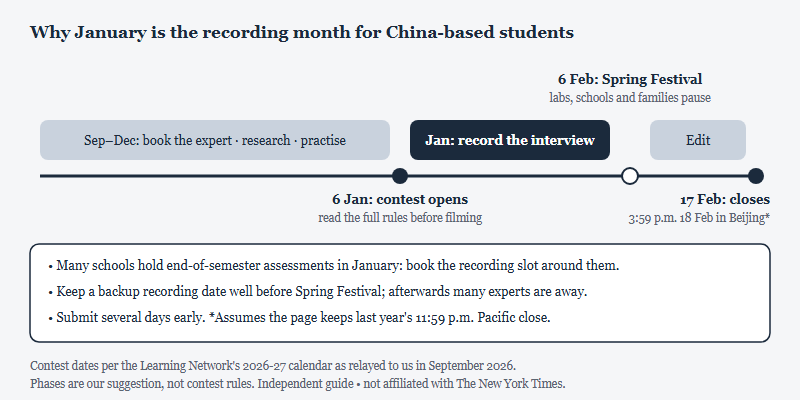
The practical consequence: do the slow, rule-independent work before 6 January. Find the expert, agree a date in the second or third week of January, research their field, and practise filming a friend so the real session is not your first attempt. Then read the posted rules on 6 January before you record anything final, because the rules may say something about recording dates, language or consent that changes the plan. Edit in the days around the holiday, and submit several days before the close. Republished rules from the 2025-26 season closed entries at 11:59 p.m. U.S. Pacific time; if this contest keeps that clock, 17 February becomes 3:59 p.m. on Thursday 18 February in Beijing.
Finding an expert from China, and asking the right way
An expert, for a contest like this, is most usefully understood as someone who works in a STEM field and can speak from that work: a university researcher, a hospital clinician, an engineer, a data scientist, a science-museum educator. Until the rules define the term, choose someone whose expertise is obvious from their job, not someone who is merely enthusiastic about a subject.
Students in China tend to have more access than they think. Useful routes include your school’s alumni, especially graduates now studying or working in science; parents’ professional networks, approached through a teacher rather than by you directly; university open days and public lectures; local science museums and maker spaces; and the authors of an article, textbook chapter or talk that made you curious in the first place. Start with the question, not the person. “I want to interview a scientist” produces vague requests that are easy to decline. “I want to ask why batteries lose capacity in the cold” tells you exactly who to look for.
| Your first message should say | Why it matters |
|---|---|
| Who you are: student, school, grade | Experts decide quickly whether a request is genuine |
| What the contest is, with a link to the Learning Network page | They can check it is real without replying to ask |
| The one question you want answered | A specific question signals that you have done the reading |
| How long you need: about 30 minutes | A clear, modest time request is easier to accept |
| Format: a video call, or in person with a teacher or parent present | It sets expectations and keeps the meeting safe |
| How the footage will be used: up to two minutes in a public contest entry | Informed permission, before anyone is on camera |
| Proposed dates in January, plus a backup | A concrete slot turns interest into a booking |
If you are under 18, involve a parent or teacher in arranging the meeting, meet by video call or in a public or school setting, and do not share your home address. Get the expert’s permission to record and publish in writing — a reply to your message that clearly agrees is a good minimum — whether or not the rules end up requiring a form.
Planning an interview that survives the cut
Two minutes is very little. The interview has to be designed so that its best moments can be lifted out and still make sense on their own. Five habits do most of that work:
- Build the interview around one question. Choose a question a curious 15-year-old would actually ask, then write six to eight open follow-ups. Avoid anything that can be answered with yes or no.
- Ask for the answer in full sentences. Explain at the start that your voice may be cut, and ask the expert to include the question in their answer: “Batteries lose capacity in the cold because…” rather than “Because…”.
- Ask for an example, a number and a surprise. “Can you give me an example?” “Roughly how much?” and “What do people usually get wrong about this?” produce the three kinds of clip that hold attention.
- Do a ten-minute pre-interview. A short call a week before lets you hear which topics make the expert animated. Plan the recorded questions around those.
- Record the room, not just the face. Film the lab bench, the instrument or the whiteboard, with permission, and record thirty seconds of silence in the room. Both make editing far easier.
On language: whether an interview conducted in Chinese, with English subtitles, is acceptable is not in the announced details. Plan an English-language interview as the safe default until 6 January. If the rules do allow subtitles, write the English translation yourself. The republished 2026-27 policy rules out Google Translate, DeepL and any AI tool for translating an entry, and automatic subtitle translation falls on the same side of that line.
Questions about the contests?
Scan the WeChat QR code — we help with contest registration, one-on-one topic coaching, and full guidance to the deadline.
Scan the WeChat QR code
A finished entry also matters beyond the contest. For a student heading toward science or engineering, it corroborates what an activity list and essays claim: that you can approach a working expert, ask a precise question and explain the answer to someone outside the field. It guarantees nothing on its own; it is one more piece of evidence that agrees with the rest of the file.
From 30 minutes of footage to 120 seconds
The arithmetic is the first thing to accept. A 30-minute interview cut to two minutes keeps under 7 percent of what you recorded, so most of what the expert says, including good material, will not appear.
| Recorded interview | Share kept in a two-minute video | What that means in practice |
|---|---|---|
| 20 minutes | 10.0% | Tight, but leaves little choice if an answer rambles |
| 30 minutes | 6.7% | A workable balance for most interviews |
| 45 minutes | 4.4% | More options, and noticeably more logging time |
| 60 minutes | 3.3% | Usually more than a two-minute video can use |
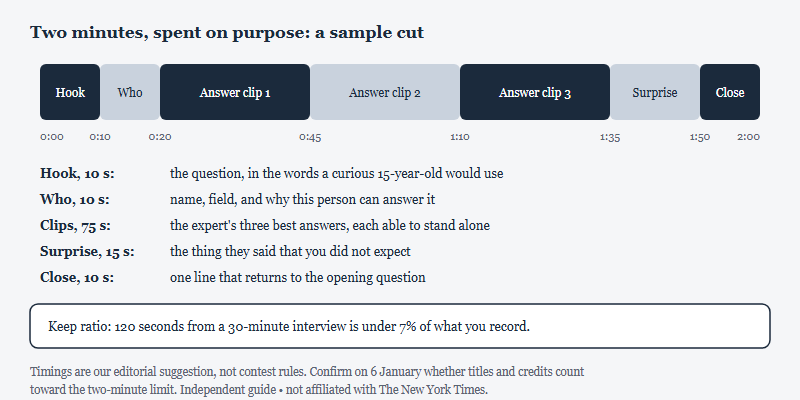
Log the footage by hand before you touch the editor. Watch the recording once without stopping, then again with a notebook, writing down the time and a few words for every usable answer. It takes longer than an automatic transcript, but auto-transcription and auto-captioning are AI speech-to-text features, and the cautious reading of the policy is to keep them out of an entry. Type any on-screen captions yourself.
Many students in China edit in Jianying, the Chinese version of CapCut, which now bundles many AI features: automatic captions, text-to-speech voices, AI “enhance”, smart cutting and generated background music. Use it, if you like, as a plain timeline editor, and leave those features switched off. Narrate in your own voice, if you narrate at all. For music, the safest choice is none, or a track you or a friend performed; check the posted rules on music before adding anything else. Finally, keep your process record: the original recordings with their file dates, your handwritten log, and the script or question list in a document with version history. If the rules ask how you made the video, you will be able to show them.
If this is your first Learning Network contest, our overview of what the NYT writing contests are explains how the contests work in general, and the contest calendar page, which is being updated for 2026-27, shows where this one sits in the school year.
Frequently asked questions
When is the NYT STEM Interview contest open?
Per the Learning Network’s announced 2026-27 calendar, 6 January to 17 February 2027, for ages 13 to 19. Confirm on the contest page.
How long can the video be?
Up to two minutes, per the announced calendar. Keep any titles inside that limit unless the full rules say otherwise.
Can I interview the expert in Chinese?
That is not in the announced details. Plan for English until the rules are posted, and never use AI or Google Translate for subtitles.
What time does it close in Beijing?
If the page keeps last year’s 11:59 p.m. Pacific close, it is 3:59 p.m. on Thursday 18 February 2027 in Beijing.
This is an independent guide operated by Hanlin Education for China-based international-school students. It is not affiliated with, endorsed by, or sponsored by The New York Times Company or its Learning Network. Contest dates, rules, eligibility and AI policies are set by the Learning Network and change from year to year — confirm current details on nytimes.com/learning before you plan or submit. Errors are corrected within 7 working days of being reported.