“What It’s Like to Grow Up in 2026” is a new visual art contest on the Learning Network’s announced 2026-27 calendar, open 28 October to 9 December 2026 for students aged 13 to 19, with an artist’s statement required. The complete rules appear when it opens. Use the six weeks before 28 October to find a specific subject and test materials, then finish the image and the statement against the posted rules.
What the calendar says, and what is not posted yet
Everything in this article about the contest itself comes from the 2026-27 calendar the Learning Network announced, as relayed to us in September 2026. We have not seen a rules page for this contest, because there is not one yet: the complete rules appear when the contest opens on 28 October. That matters more for a brand-new contest than for a returning one. There is no previous year’s page to learn from, so any specific number you read about it before 28 October — a statement word limit, a file size, an image count — is not confirmed by a posted rules page.
Here is the honest split between what is announced and what you should check on the day it opens.
| Item | What the announced calendar gives | What to check when the contest opens |
|---|---|---|
| Name and theme | “What It’s Like to Grow Up in 2026” | The exact prompt wording and any guiding questions |
| Window | 28 October to 9 December 2026 | Opening and closing times |
| Who can enter | Ages 13 to 19, as listed for the whole calendar | Any further eligibility conditions |
| What you submit | A visual artwork plus an artist’s statement | Statement length, title field, number of images |
| Accepted media | Not listed | Whether drawing, painting, photography, digital work or collage are all accepted |
| Files and format | Not listed | File type, size and how the work is uploaded |
| Teams | Not listed | Whether entries must be individual |
| Judging | Not listed | Criteria and recognition categories |
| AI and process | The republished 2026-27 policy bans AI-generated images and AI help with text | Whether the form asks you to document your process, and how |
Two dates frame the whole plan. My Tiny Memoir, the 100-word narrative contest, runs 16 September to 28 October on the same calendar, so it closes on the day this contest opens. And republished rules from the 2025-26 season closed entries at 11:59 p.m. U.S. Pacific time. If this page keeps that clock, 9 December becomes 3:59 p.m. on Thursday 10 December in Beijing, because the United States will be on standard time by then. Treat that as a working assumption until the page is live. If you are new to the Learning Network’s contests in general, our overview of what the NYT writing contests are is the place to start.
The theme is broad; your subject cannot be
A theme like “growing up in 2026” invites the same five pictures from a great many other entrants: a teenager lit by a phone, a stack of textbooks, a face split between two worlds, a chatbot window, a clock. None of those is wrong. The problem is that a viewer has seen each of them before your work arrives, so the image spends its first look confirming an expectation instead of showing something.
The fix is to change the unit you are working with. Stop looking for a symbol of your generation and look for one moment, one place or one object that could only exist this year, in your life. A symbol explains; a specific moment lets the viewer notice. Three questions help you check whether you have one:
- Could this image have been made in 2016? If yes, it is about adolescence in general, not growing up in 2026. Keep going.
- Is there a detail only you would know to include? The exact time on the screen, the brand of the canteen card reader, the note on the fridge in two languages. Details carry the claim so the statement does not have to.
- Can a stranger tell what they are looking at within a few seconds? Ambiguity can be powerful, but confusion is not the same thing. If three friends describe the scene in three unrelated ways, the composition needs work, not a longer statement.
The observation log in the plan below exists for exactly this reason. Ideas that arrive in the first hour of thinking are almost always the shared ones. The specific ones tend to turn up on day nine, when you notice something you have walked past every morning.
A 12-week plan from mid-September to the Beijing deadline
The contest window is six weeks long, and so is the gap between today and its opening. That symmetry is useful. The first six weeks are for thinking and testing, which needs no rules page. The second six are for making and writing, which should happen after you have read the rules.
| When | Dates (2026) | Work | What you should have at the end |
|---|---|---|---|
| Weeks 1–2 | 16–29 September | Keep an observation log: note, photograph or sketch three ordinary moments a day that feel specific to this year | About 40 raw observations |
| Weeks 3–4 | 30 September–13 October | Turn the strongest observations into 15 to 20 thumbnail compositions; at many schools the National Day break falls inside these two weeks | Three shortlisted ideas |
| Weeks 5–6 | 14–27 October | Make two small studies of your top idea in two different media; write three rough sentences on why it belongs to 2026 | One direction and a page of notes |
| Opening day | 28 October | Read the full rules: prompt wording, media, files, statement limit, teams, process documentation | A plan adjusted to the real rules |
| Weeks 7–10 | 28 October–24 November | Make the final piece; photograph each stage with the date visible in the file | A finished image and a process record |
| Weeks 11–12 | 25 November–9 December | Draft and cut the statement; test it on a reader who has not seen the image; submit with days to spare | A submitted entry, not a last-night upload |
Two calendar clashes are worth planning around now. Grade 12 students will be finishing early applications in November, when many U.S. colleges set their early deadlines, so the making weeks should not depend on evenings you do not have. And if you are also entering My Tiny Memoir, finish that entry before 28 October rather than running both at once. The shape of the rest of the school year is on our contest calendar page, which is being updated for 2026-27.
Making the image without breaking the AI rule
The 2026-27 AI and translation policy, as republished by the Learning Network, is short and strict: no chatbot drafting, no AI editing or polishing, no AI-generated images, audio, video or text, and no AI tools or Google Translate to translate an entry into English. Violations are disqualified, and most contests will ask entrants to document their process, for example with a document version history. For a visual entry, that has practical consequences beyond “do not use an image generator”:
- Watch the features built into ordinary software. Photo apps, drawing apps and phone galleries increasingly include generative fill, background replacement, object removal and one-tap “enhance” tools. A working rule of thumb: if a feature invents pixels you did not make, leave it out. If you are unsure whether a tool counts, check the posted rules before you use it, not after.
- Your own reference photos are yours; other people’s are not. Painting from a photograph you took is normal practice. Tracing or closely copying someone else’s photograph or artwork is not your original work, whatever the medium.
- Ask before you picture people. If a classmate, sibling or grandparent is recognisable in your image, ask their permission first, and ask a parent if the person is a younger child. This is good practice whatever the rules end up saying.
- Keep the process record as you go. Photograph the sketch, the underpainting and each major change on the day it happens. Reconstructing a record in December is both harder and less convincing.
The statement needs its own trail. Draft it somewhere that keeps a version history. If Google Docs is unreliable on your network, Microsoft Word saved to OneDrive, WPS cloud documents and Tencent Docs all keep earlier versions. Some of these tools now include built-in AI writing assistants; switch them off or ignore them completely while you work on the entry.
Questions about the contests?
Scan the WeChat QR code — we help with contest registration, one-on-one topic coaching, and full guidance to the deadline.
Scan the WeChat QR code
Writing the artist’s statement
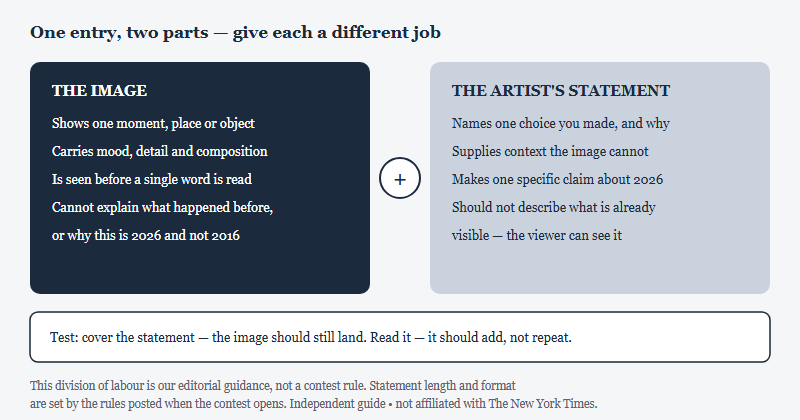
This is the part of a visual contest where students who think in words have an advantage, and where visual-first students often lose ground they won with the image. An artist’s statement is not an essay about your feelings and not a caption. It is a short piece of writing that tells a viewer what you were doing, so they can see the work more precisely. Four moves, in order, cover almost every good one.
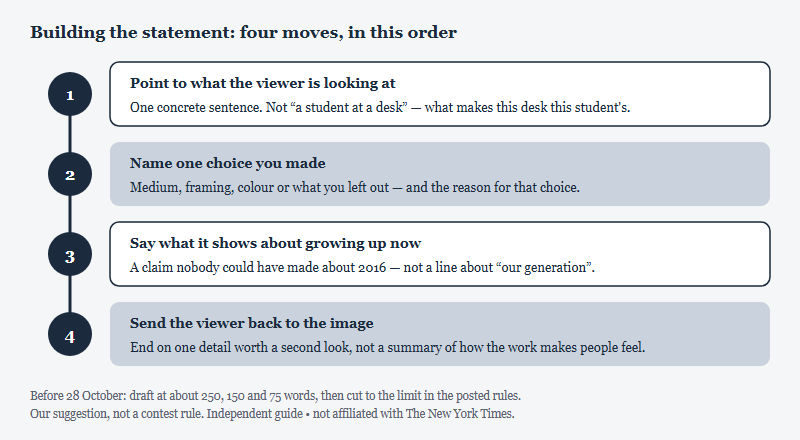
Because the statement limit is not posted yet, write in tiers. A version of roughly 250 words lets you find out what you actually think. A 150-word version forces you to choose. A 75-word version shows you which sentence is doing the most work. On 28 October you will cut to whatever the rules give, and you will be choosing between sentences you have already tested rather than writing under pressure.
Five patterns weaken statements again and again, and each has a straightforward fix:
- Describing the visible. “In the picture there is a boy on a bus.” The viewer can see the bus. Tell them the one thing they cannot see: that it is the 6:40 school shuttle and he has been on it since he was eleven.
- Borrowed art vocabulary. Words like “juxtaposition” and “dichotomy” usually replace a plain claim you have not yet made. Write the plain claim.
- Speaking for everyone. “Every teenager today feels lonely” is unprovable and flattens your own image. “In my class, the group chat is louder than the classroom” is yours.
- Explaining feelings the image does not show. If the statement has to tell the viewer the work is sad, the work is not yet sad.
- Biography instead of work. Your age, school and years of art lessons belong in the entry form fields, if the form asks. The statement is about the piece.
If you think in Chinese, it is fine to make your notes in Chinese. The English statement, though, must be written by you: the policy rules out Google Translate, DeepL and any AI tool for translating an entry. Translating your own notes sentence by sentence usually produces stiff English. It works better to close the notes and write the English version from memory, then check it against them for anything you left out. The Open Letters guide on this site covers the same discipline of making one clear point to a real reader, in a different form.
Frequently asked questions
When does the NYT ‘What It’s Like to Grow Up in 2026’ contest open and close?
Per the Learning Network’s announced 2026-27 calendar, 28 October to 9 December 2026. Confirm times on the contest page when it opens.
How long should the artist’s statement be?
The limit is not posted yet. Draft a long and a short version now, then cut to the figure the rules give when the contest opens.
Can I use AI tools for the image or the statement?
No. The republished 2026-27 policy bans AI-generated images and AI drafting, editing or translation of text. Breaches are disqualified.
What time is the deadline in Beijing?
If the page keeps last year’s 11:59 p.m. Pacific close, it is 3:59 p.m. on Thursday 10 December in Beijing.
This is an independent guide operated by Hanlin Education for China-based international-school students. It is not affiliated with, endorsed by, or sponsored by The New York Times Company or its Learning Network. Contest dates, rules, eligibility and AI policies are set by the Learning Network and change from year to year — confirm current details on nytimes.com/learning before you plan or submit. Errors are corrected within 7 working days of being reported.