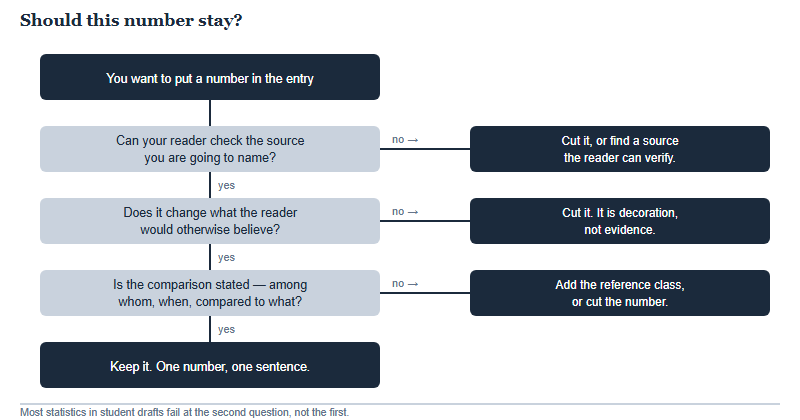
A number earns its place in a short contest entry only when it changes what the reader would otherwise believe. Most statistics in student entries fail that test: they are borrowed authority, dropped in to sound researched. Worse, a misframed number is one of the few errors that can discredit an otherwise strong piece outright. Here is how to choose one, frame it, attribute it, and check it before you submit.
What a number is actually for
In a capped entry you can usually afford one or two numbers, sometimes none. That scarcity is clarifying: each one has to be doing a job you could not do another way. There are three legitimate jobs.
- Establishing scale. The reader cannot picture how big or rare something is, and a number fixes it. This is the most common good use.
- Defeating an intuition. The reader already believes something, and the number contradicts it. This is the most powerful use, because the number is doing argumentative work no adjective could do.
- Anchoring a comparison. Two figures side by side make a relationship visible — before and after, here and there, expected and actual.
And one illegitimate job, which accounts for most statistics in student drafts: signalling seriousness. A number included to show that research happened is decoration. It costs words, invites scrutiny, and adds nothing the sentence around it was not already asserting. If deleting the figure leaves your point standing unchanged, the figure was never evidence.
Five ways a number goes wrong — and the parts that prevent it
These are the failure patterns worth memorising. All the examples below are invented to illustrate the mechanics — never take a figure from an article like this one into your own entry.
| Error | What it looks like | What went wrong | The repair |
|---|---|---|---|
| Percent vs percentage point | “Support rose 50 per cent” when a share moved from 4% to 6% | A 2-point move became a 50 per cent claim; both are arithmetically defensible and one badly misleads | State the two figures: “from 4 per cent to 6 per cent” |
| Rate vs count | “More cases here than anywhere else” | The biggest place usually has the biggest count of almost everything | Use the rate, or say plainly that you are comparing totals |
| Chosen baseline | “Down sharply since 2019” | The starting year was an unusual peak, so the fall is an artefact of where you started counting | Show the trend, or justify the baseline in the same sentence |
| Correlation as cause | “Schools that did X had better outcomes, so X works” | The schools that adopted X may have differed already in ways that explain the outcome | Say “is associated with”, then argue the causal case separately |
| Sample overreach | “Teenagers think…” from one survey of one group | The reference class in the sentence is far wider than the one in the data | Name the actual group: who was asked, where, and when |
Two of these — percentage points and baseline choice — are, in our experience, the ones most likely to survive into a finished entry, because both produce a sentence that reads perfectly well. They are only visible if you go back to the source. That is precisely why the check has to be deliberate.
A bare figure is not a fact. It becomes one when the reader can see what it counts, among whom, when, and on whose authority. In a short entry that has to happen inside a single sentence, which sounds harder than it is once you know what the slots are.
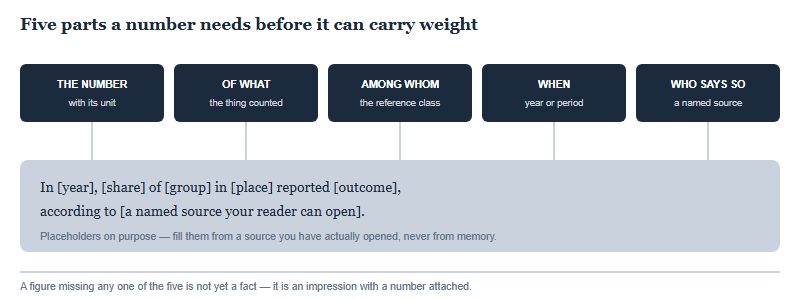
You will not always name all five explicitly — if the whole entry is about your own city this year, “in [place]” and “in [year]” may already be established. The test is not whether the words appear, but whether a sceptical reader could answer all five questions from the entry as written.
Attribution when you have no room for a citation
Short forms rarely have space for formal referencing, and the rules on sources and originality are set by the contest, not by convention — read the current guidance for your contest on the official Learning Network page before you decide how to handle it. What follows is craft advice that sits inside whatever those rules require.
The workable move in a short piece is in-sentence attribution: name the source as part of the sentence, in as few words as it takes to make it checkable. “A city transport survey” is weak. Naming the actual body that published it is strong, and usually costs two or three words more.
Three rules that hold across forms:
- Name a source, never a vibe. “Studies show” and “experts say” are the two phrases most likely to make a reader stop trusting the paragraph. They signal that you did not go to the source yourself.
- Go to the original. If you found the number in a news article, that article got it somewhere. The figure you quote should come from the place that produced it, not from the third piece to repeat it. Numbers drift as they are re-reported, and the version circulating on social platforms is frequently the drifted one.
- Attribute in proportion to the load. A number carrying your whole argument needs a source in the same sentence. A minor figure can lean on context. If you find yourself unable to attribute the load-bearing one compactly, that is usually a sign the argument should rest on something else.
A specific problem for writers based in China. Your best evidence may sit in a domestic source that a general reader abroad cannot open or read — a Chinese-language report, a platform-hosted dataset, a municipal notice. This is a real constraint, not a fatal one. Options, in order of preference: find whether the same figure appears in a source your reader can reach; name the issuing body clearly enough that it can be searched for even if the reader cannot read the page; or drop the number and use first-hand observation instead, which is often stronger anyway. What you should not do is present an unverifiable figure as though it were common knowledge. Entries that lean hard on evidence — the argument-driven forms, including the Open Letters Contest — are where this bites hardest; our overview of the contests sets out which forms depend most on outside evidence and which reward observation instead.
When to drop the number entirely
Some of the strongest short entries contain no statistics at all. A number is a claim about a population; a detail is a claim about one thing you can see. In a very short piece the detail frequently wins, because it does not require the reader to trust anyone.
Questions about the contests?
Scan the WeChat QR code — we help with contest registration, one-on-one topic coaching, and full guidance to the deadline.
Scan the WeChat QR code

Prefer the detail when:
- The number would need a sentence of setup before it means anything.
- You are writing a narrative, a memoir-style piece, or a personal response, where an aggregate breaks the register you have established.
- Your figure is roughly what the reader already assumed — it confirms rather than moves.
- You cannot verify it to the standard above in the time you have.
Prefer the number when scale is genuinely the point, when you are contradicting a common belief, or when one figure can replace three sentences of description. The strongest combination in short-form writing is usually one number and one detail: the figure gives the scale, the detail makes it land on a person.
Note that verification takes time you have to plan for. Tracing a figure to its original source can take an evening, and doing it the night before a deadline is how unverified numbers end up in submitted entries. If you are mapping your writing year, our contest calendar guide shows how the season is usually shaped; build checking time into the plan rather than the last day.
A pre-submission numbers check
Five minutes per figure. Do this on the near-final draft, when the number is settled.
- Open the source again. Not your notes — the source. Confirm the figure, the year, and the group it describes. A surprising share of errors are transcription, not reasoning.
- Read your sentence against the source sentence. Ask whether your wording claims anything wider than the source does. Widening happens quietly: a survey of one district becomes “in the city”.
- Say the ‘compared to what’ out loud. If you cannot answer it, the reader cannot either, and the number is not yet meaningful.
- Check the arithmetic of any change you describe — especially anything expressed as a rise or fall in per cent.
- Ask what a hostile reader would do with it. If the obvious counter is “that only shows the bigger place is bigger”, fix it now.
- Count your numbers. More than two in a short entry usually means at least one is decoration.
What we see with China-based students (per Hanlin; de-identified observations, and individual results vary). Students with strong science and economics training are typically excellent at sourcing and poor at restraint — the common pattern is four correctly cited figures where one would persuade. The single most useful edit is usually deleting three numbers and giving the survivor a full sentence with its reference class intact. Second most common: a figure quoted accurately from a news article that had already lost the original’s qualification. Going one link further back fixes it, and takes ten minutes.
Frequently asked questions
How many statistics should a short contest entry contain?
Often one, sometimes none. If a figure could be deleted without weakening your point, it was decoration rather than evidence.
Do I need a formal citation or bibliography?
That depends on the contest. Check the current sourcing guidance on the official Learning Network page; in-sentence attribution is the usual craft solution in short forms.
Can I use a Chinese-language source my reader cannot read?
Prefer a reachable source. If not, name the issuing body precisely so it can be searched, or use first-hand observation instead.
Which numerical error do you see most often in student entries?
Confusing a change in percentage points with a percentage change — it reads fluently and is only caught by returning to the source.
This is an independent guide operated by Hanlin Education for China-based international-school students. We are not affiliated with, endorsed by, or sponsored by The New York Times Company or its Learning Network. Contest line-ups, prompts, eligibility rules, word limits and deadlines are set by the Learning Network and change from year to year — confirm current details on nytimes.com/learning before you plan or submit. Factual errors are corrected within 7 working days of notice.