Most short contest entries are not lost at the first line or the last one. They are lost somewhere in the middle, where the writing stops moving and becomes a block of competent sentences arranged by topic. This guide covers the part almost nobody edits deliberately: how many paragraphs a short entry should have, what order they go in, where the breaks fall, and what your entry looks like on a screen before anyone reads a word of it.
Why the middle dies: a paragraph is a unit of attention
It helps to write for the least patient plausible reader. Assume they give your opening a real chance, then form an early impression. From that point on they are not deciding whether to start — they are deciding, repeatedly, whether to continue. Every paragraph transition is another one of those decisions, and the middle of an entry contains all of them.
Openings get written five times. Endings get agonised over. The middle usually gets written once, in the order the ideas happened to arrive, and then only line-edited. That is why so much of it reads like a well-behaved list: point, evidence, point, evidence, point, evidence — each paragraph true, none of them creating a reason to read the next.
The fix is not more style. It is sequence. A short entry has room for only a handful of paragraphs, which means paragraph order is one of the highest-leverage decisions available to you, and one of the cheapest to change.
School writing teaches the topic model: one paragraph, one idea, topic sentence at the front, developed evenly. That model is legible, and in a capped entry it is also why every paragraph ends up the same length and the same temperature.
In short-form writing a paragraph does a different job. It is a unit of attention — a single push, ending at the moment the reader most wants the next thing. That has three practical consequences:
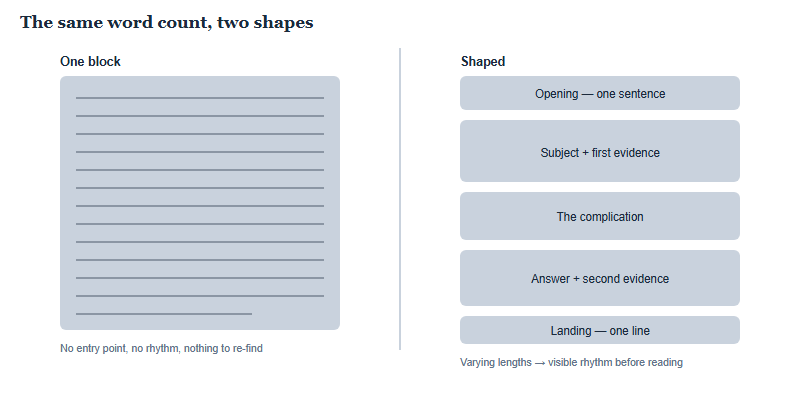
- Paragraphs should vary in length, because the pushes vary in size. A run of four paragraphs of near-identical length reads as flat before a single word is processed.
- A paragraph may contain one sentence. Used sparingly, a one-sentence paragraph is the strongest emphasis device available in a short entry, precisely because it costs so little space. Used three times, it becomes a tic.
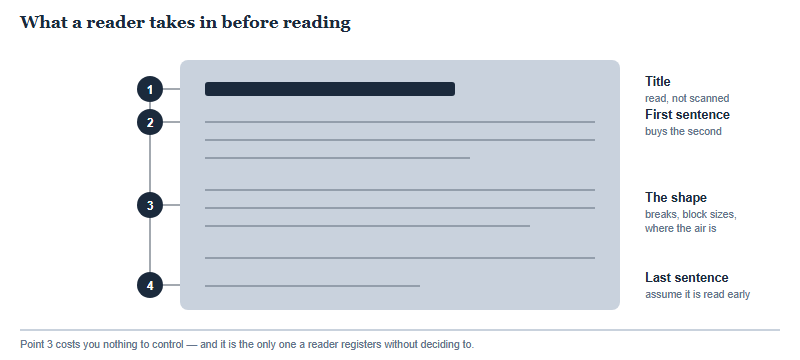
- The last sentence of a paragraph matters more than the first. The topic sentence tells the reader where they are; the closing sentence decides whether they go on. In the drafts we review, students routinely improve their paragraph openings and never touch the closes.
A working order for the middle
There is no single correct structure, and the right shape depends on which contest you are entering — a narrative moves differently from an argument, and a review differently again. Our overview of the Learning Network contests sets out how the forms differ. But across all of them, one ordering principle holds: put the complication early, and answer it late.
Weak middles present evidence in descending order of strength, which means the entry gets progressively less interesting. Strong middles create a problem the reader wants resolved, then resolve it. Compare the two sequences:
| The list middle (common) | The tension middle (better) | |
|---|---|---|
| Paragraph 2 | Strongest reason for my position | The specific thing I noticed, in detail |
| Paragraph 3 | Second reason | Why the obvious explanation for it fails |
| Paragraph 4 | Third reason | What is actually going on, with evidence |
| Paragraph 5 | Brief acknowledgement of the other side | The strongest objection, taken seriously |
| Reader’s state | Informed, and free to stop at any point | Holding an open question, unwilling to stop |
| Ending job | Summarise what was listed | Land the consequence — nothing to repeat |
The tension middle costs no extra words. It is the same material, resequenced so that each paragraph creates the appetite the next one satisfies. It also solves the ending problem for free: when the middle has built a question, the last paragraph has something to do besides restate.
Two practical cautions. First, do not manufacture false suspense — withholding a fact the reader needs is irritating, not gripping. The complication should be genuine. Second, in argument-driven forms the objection paragraph is doing real work and needs room; if it is one apologetic sentence, the reader notices. Our guide to the Open Letters Contest shows how a concession sits inside a piece written to a named reader.
Where the breaks go
Paragraph breaks are the only formatting a short entry reliably has. Use them as timing marks:
Questions about the contests?
Scan the WeChat QR code — we help with contest registration, one-on-one topic coaching, and full guidance to the deadline.
Scan the WeChat QR code

- Break where the thought turns, not where the topic changes. A turn is a “but”, a consequence, a shift in who is speaking or when something happened. Breaking on topic gives you tidy blocks; breaking on turns gives you pace.
- Never break mid-argument to make the page look lighter. Cosmetic breaks split a single push into two weak halves, and readers feel the seam.
- Put your best sentence at the end of a paragraph, not buried inside it. The position immediately before white space is the second-strongest position in the whole entry, after the last line.
- Beware of the four-equal-blocks default. If your paragraphs are all within a line or two of each other, that is almost always an artefact of drafting rather than a decision.
- Subheadings are usually wrong here. In a piece this short they announce structure the prose should be carrying, and they eat words. Unless the contest guidance indicates otherwise, let the paragraphs do it.
What may not survive the submission box
A point students rarely think about until it goes wrong: the version you polished in a word processor is not necessarily the version that gets read. Entries are often composed in one place and submitted in another, and formatting does not always travel.
Do not check the specifics against this article — check them against the actual entry form and any submission guidance on the official Learning Network page for your contest, because the mechanics differ by contest and are restated each cycle. What is worth doing in every case is this:
- Do not let meaning depend on formatting. If your argument only works because a phrase is in italics or bold, rewrite it so the sentence carries the emphasis. Emphasis that lives in styling can vanish; emphasis that lives in word order cannot.
- Avoid smart quotation marks and dashes doing structural work. They usually paste fine. “Usually” is not a good foundation for a piece you cannot resubmit.
- Assume paragraph breaks are your only reliable device, which is another reason to spend real revision time on them.
- Preview before you commit. If the form shows you your entry after pasting, read the whole thing there, not in your document. This is where students discover their careful paragraphing has collapsed.
- Keep your own copy exactly as submitted, so you can see later what a reader actually saw.
A five-minute shape check
Run this after your content is settled and before your final line edit. It requires no rewriting, only looking.
- Squint at it. Zoom out until the words blur. You should see blocks of clearly different sizes. If you see a brick, you have a rhythm problem no sentence-level editing will fix.
- Read only the last sentence of every paragraph, in order. They should form a rough spine that still makes sense — and each should make you want the next. This is the single fastest diagnostic in this article.
- Count your one-sentence paragraphs. Zero is a missed opportunity in most forms; three or more is a mannerism.
- Find your longest paragraph and ask what it is hiding. Overlong middle paragraphs are usually two pushes fused, or one push plus material you were reluctant to cut.
- Check the join between paragraphs two and three. In drafts we review this is the most common place a reader disengages, because it is where a writer typically stops developing and starts listing.
What we see with China-based students (per Hanlin; de-identified observations, and individual results vary). Shape is one of the few areas where students writing in a second language are not at a disadvantage at all — it requires no idiomatic fluency, only decisions. In practice, resequencing a middle and rebuilding paragraph closes tends to produce a larger jump in how an entry reads than another round of vocabulary polishing, and it takes less time. Students who have been drilled to write evenly weighted body paragraphs usually need explicit permission to make one paragraph much shorter than the others.
Frequently asked questions
How many paragraphs should a short contest entry have?
There is no rule. Enough that the shape varies and each break marks a turn — in very short forms that is often four or five.
Is a one-sentence paragraph acceptable?
Yes, used once or twice for genuine emphasis. Repeated often it stops being emphasis and becomes a stylistic habit readers notice.
Should I use subheadings to organise my entry?
Usually not in a short piece — they cost words and announce structure the prose should carry. Follow any guidance on the official contest page.
Does formatting like bold or italics survive submission?
Do not rely on it. Build emphasis into sentence structure, and check the actual entry form and current guidance before you submit.
This is an independent guide operated by Hanlin Education for China-based international-school students. We are not affiliated with, endorsed by, or sponsored by The New York Times Company or its Learning Network. Contest line-ups, prompts, eligibility rules, word limits and deadlines are set by the Learning Network and change from year to year — confirm current details on nytimes.com/learning before you plan or submit. Factual errors are corrected within 7 working days of notice.