The habits that earn marks in an IB, AP or A-Level essay — a signposted introduction, a restated thesis, a careful impersonal register — are usually the same habits that make a contest entry forgettable. School writing exists to prove you understood a syllabus. A contest entry has to be worth reading on its own. This guide covers what to unlearn, what genuinely transfers, and how to spot the difference in your own draft.
Two different jobs, two different grammars
Nothing here is a criticism of school writing. An IB essay, an AP free-response answer and an A-Level coursework piece are all assessed writing: a marker has to locate evidence that you understood a concept, applied a method and considered alternatives. Making that evidence easy to find is not padding — it is the task. Signposting, defined terms and explicit structure are how a candidate cooperates with a marker.
A Learning Network contest entry is a different object. It is best written for a reader who owes it no patience, alongside a great many other entries, at a length the contest fixes rather than one you choose. Nobody is hunting for evidence that you understood something. The entry has to be the thing itself.
That single difference cascades into almost every sentence-level decision. School writing optimises for legibility of process. Contest writing optimises for the experience of reading it. Students who move between the two without noticing tend to produce entries that are competent, orderly and completely inert.
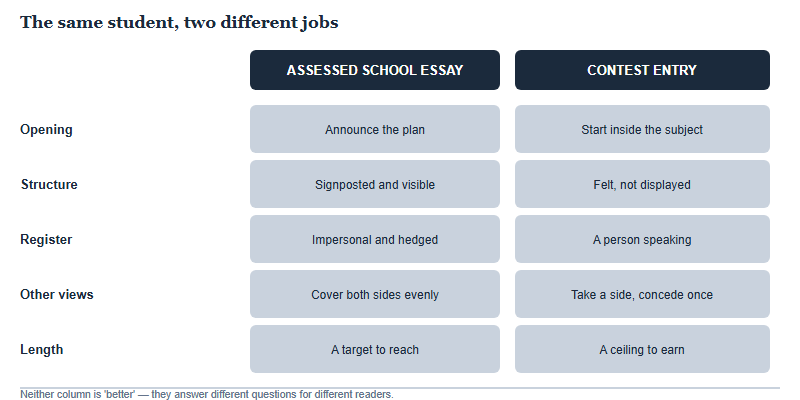
| Dimension | What assessed school writing rewards | What a short contest entry needs |
|---|---|---|
| Opening | Announce the scope and the line of argument so the marker can follow | Begin inside the subject; earn the second sentence |
| Structure | Visible and labelled — the reader should see the skeleton | Present but felt; the reader should notice only the momentum |
| Register | Impersonal, cautious, hedged for objectivity | A recognisable person thinking, without losing precision |
| Other views | Cover perspectives evenly to show range | Hold one position; concede the strongest objection once, honestly |
| Terminology | Deploying syllabus vocabulary is itself evidence of learning | Any term you use must do work a plain word could not |
| Length | A target to reach; short answers look thin | A ceiling to earn; every sentence is competing for space |
Six habits to unlearn
- 1. The announced introduction. Sounds like: “This essay will examine the extent to which…” A marker needs that map. A contest reader experiences it as a delay before the writing starts. Instead: put the first real sentence of the subject where the announcement was. If your draft still makes sense when you delete the first two sentences, they were scaffolding.
- 2. The restatement ending. Sounds like: “In conclusion, as has been demonstrated…” Assessed writing rewards you for confirming that you did what you promised. A short entry has no room to say anything twice, and a summary ending tells the reader the piece stopped growing.
- 3. Defensive hedging. Sounds like: “It could arguably be suggested that this may perhaps indicate…” Hedging is drilled into you because unsupported certainty loses marks. But four hedges stacked in one clause do not read as rigour; they read as nobody being present. Instead: keep one accurate qualifier and delete the rest. “This probably explains…” is honest. The stack is just anxiety.
- 4. Symmetrical both-sidesing. Coursework often rewards even coverage of competing perspectives. A short contest entry that gives equal space to every view ends up asserting nothing. Instead: hold a position, and give the single strongest objection real space and a real answer.
- 5. Terminology as evidence. In a syllabus essay, using the technical term correctly is part of the mark. In a contest entry, a term earns its place only if no plain word does the same job. Ask of every piece of specialist vocabulary: is this the precise word, or the impressive one?
- 6. Writing to a floor instead of a ceiling. School word counts are usually minimums you must reach; contest limits are maximums you must fit. That inversion changes the whole revision task. Padding habits — restating the question, long wind-ups, listing what you will not discuss — are not neutral in a capped form. They are spending money you do not have. Check the current limit for your contest on the official Learning Network page before you plan the shape of a draft; limits differ by contest and are restated each year.
What genuinely transfers (keep these)
Students often over-correct after reading advice like this and throw away the parts of their training that are actually rare and valuable. Four things transfer almost perfectly.
- Evidence discipline. The habit of asking “where did this claim come from?” is exactly what separates a strong entry from a confident-sounding one. Contest entries live or die on whether their specifics hold up.
- Counterargument thinking. The reflex you built in history, TOK-style and economics essays — steelmanning the other side before answering it — is the raw material for a good concession. You need less of it, not none of it.
- Close reading. If you have been trained to notice how a single word choice changes a text, you already have the skill that makes a review or a response to a reading feel earned rather than summarised.
- Command-term precision. Being trained to notice that analyse, evaluate and describe demand different work is unusually useful when reading a contest prompt. Most weak entries answer a slightly different question from the one asked, and command-term habits are the best defence against that. Read the current prompt wording on the official page carefully rather than working from what a contest asked last year.
If you are new to the contests and want to see how the individual competitions differ before choosing where to aim, our overview of the Learning Network student writing contests lays out the landscape, and the contest calendar shows how a year is usually shaped.
A diagnostic: read the draft twice, then rewrite one paragraph
This takes about fifteen minutes and works on any draft in any of the contests.
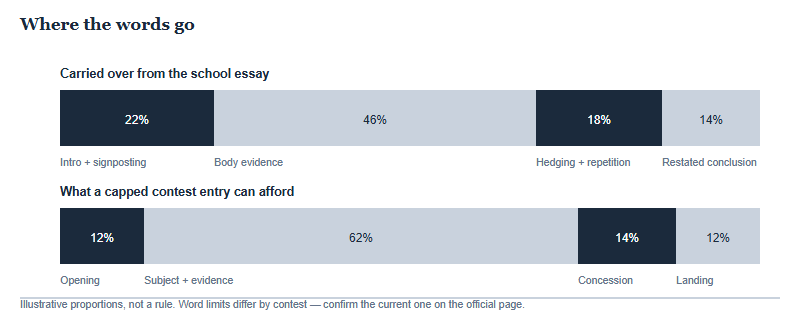
Pass one — read as a marker. Highlight every sentence whose only job is to tell the reader what you are doing, what you already did, or what you will not be covering. Do not fix anything yet; just count them. In drafts we see from students strong in IB and A-Level coursework, that count is frequently four or more in a piece written to the kind of cap these contests set. Those sentences are not bad writing. They are correct writing for a different form.
Pass two — read as a stranger. Now read the draft as someone with no obligation to continue, and stop at the first moment your attention drops. Mark that spot. In the school-trained drafts we review it usually lands in the same two places: immediately after the announced introduction, and at the point where a second perspective is introduced with no commitment to either.
Then apply three quick tests:
- The first-30-words test. Cover everything except your opening 30 words. Does a stranger learn anything specific — a person, a place, a number, a moment — or only what topic you selected?
- The who-is-talking test. Pick any paragraph in the middle. Could it have been written by any competent student on the same prompt? If yes, the register has gone impersonal by reflex.
- The deletion test. Delete each highlighted scaffolding sentence and reread. If nothing breaks, it was never load-bearing — and you have just bought words for the part of the entry that was actually short.
Now a worked example. Here is a made-up paragraph written to show the pattern, not a real entry. First, the school-trained version:
“This piece will consider the issue of food waste in school canteens. It could be argued that food waste represents a significant environmental and economic problem. Various perspectives exist on this matter. Some argue that students are responsible, whereas others suggest that institutional factors are more important. This essay will examine both viewpoints before reaching a conclusion.”
Questions about the contests?
Scan the WeChat QR code — we help with contest registration, one-on-one topic coaching, and full guidance to the deadline.
Scan the WeChat QR code

Nothing there is wrong. It is orderly, balanced and appropriately cautious — and it has spent a substantial share of a short entry without saying one specific thing. Now the same idea, in contest register:
“The bins outside our canteen are emptied twice at lunch, and both times they are full of rice. Not scraped plates — untouched portions, still in their shape. Our canteen serves one size. That is the whole policy, and it is why the bins look like that.”
The second version takes a position, arrives inside the subject, and gives a reader something they can see. It is also shorter. Notice what it kept from the training: a specific observation, a causal claim, and an implied counterargument (that students are to blame) which the next paragraph can now answer honestly rather than list.
Argument-driven contests reward this shift most sharply. If you want to see how a piece that must address a named reader handles position and concession, our guide to the Open Letters Contest works through that form in detail.
If you are still being marked on the school version
You almost certainly are, and you should not sabotage your coursework in the name of contest craft. The goal is not to replace one register with another; it is to become deliberate about which one you are in. Practically:
- Do not import contest habits into assessed work. A marker who cannot find your line of argument will not reward you for the elegance of your restraint. Signpost your coursework.
- Practise the switch on purpose. Once a week, take a paragraph from your own coursework and rewrite it in contest register — same claim, no scaffolding, one concrete image. Fifteen minutes. This is the single most efficient rep we know for students in your position, and it costs no new material.
- Keep a ‘scaffolding list’. Your padding phrases are personal and repeat. Write down the five you use most, and search for them before you submit anything.
- Check the rules yourself, every cycle. Contest line-ups, prompts, eligibility and length limits are set by the Learning Network and restated annually. Never plan a draft around a rule you remember from last year — confirm it on the official Learning Network page first.
What we see with China-based students (per Hanlin; de-identified, and individual results vary). Students arriving from a strong IB or A-Level writing background usually need very little work on evidence, logic or accuracy — those are already trained. Almost all the early gain comes from register and from the opening. The most common single change that improves a first contest draft is deleting the first two sentences and promoting the third. That is a training artefact, not a talent ceiling, and it tends to correct within a few drafts once a student can see it.
Frequently asked questions
Does writing for contests hurt my IB or A-Level marks?
No, provided you keep the registers separate. Signpost assessed coursework as your syllabus expects; save the stripped-back register for contest drafts.
Should I ever use a thesis statement in a contest entry?
You need a clear position, but rarely an announced one. Let the position emerge from the first specific thing you show the reader.
Is formal English safer for a non-native writer?
Not usually. Formality hides voice without improving accuracy. Short, precise, plain sentences read as controlled rather than cautious.
How do I know which register a contest wants?
Read the current prompt and any published guidance on the official Learning Network page — the framing is restated each year and differs by contest.
This is an independent guide operated by Hanlin Education for China-based international-school students. We are not affiliated with, endorsed by, or sponsored by The New York Times Company or its Learning Network. Contest line-ups, prompts, eligibility rules, word limits and deadlines are set by the Learning Network and change from year to year — confirm current details on nytimes.com/learning before you plan or submit. Factual errors are corrected within 7 working days of notice.