When students first plan their The NYT STEM Interview Video Contest (2027): How to Find an Expert, Run the Interview and Cut It to Two Minutes, they often script a neat chain of questions and imagine the expert will deliver exactly the insight needed. In practice, the interview almost never goes that way. The real skill is not asking the first question well; it is deciding what to ask next when the answer you get is not the answer you expected. This article works through two contrasting teaching illustrations to show how follow-up questions shape the final cut.
Why the First Answer Is Never the Whole Story
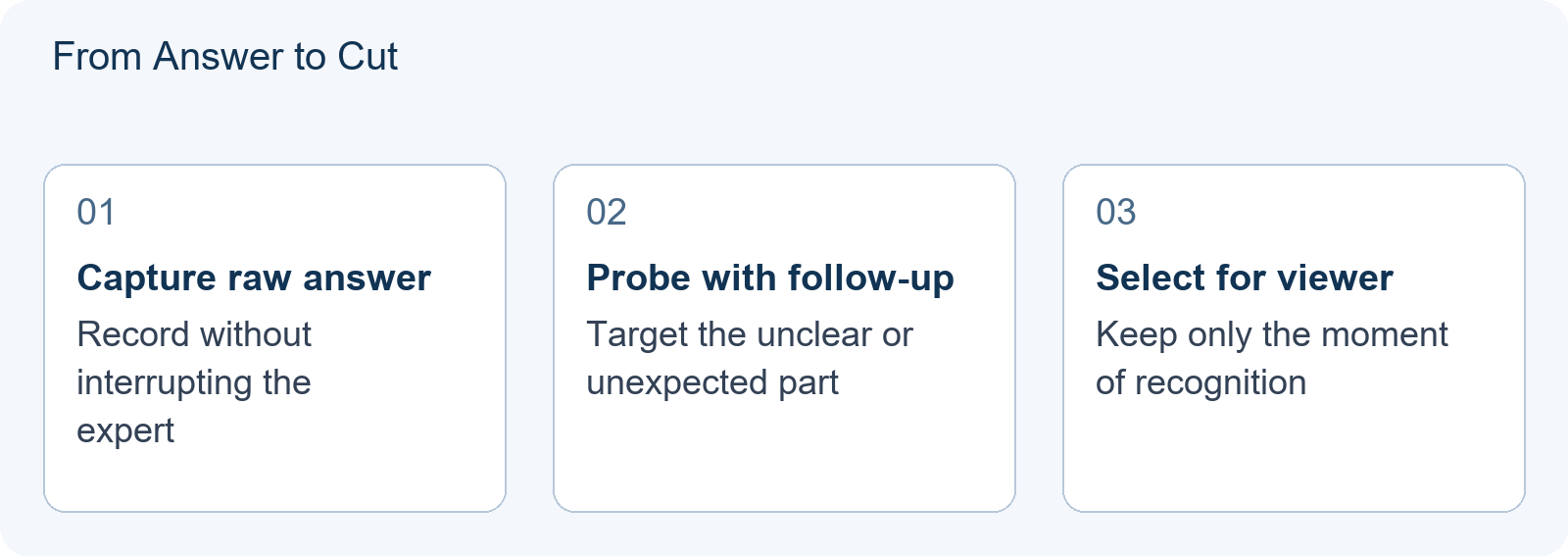
The New York Times Learning Network limits the STEM Interview to two minutes. That constraint makes every second valuable, yet many students spend their preparation time researching the topic and neglecting the conversation itself. A prepared list of questions is only a starting point. The moment the expert speaks, new information appears: a half-finished thought, an unexpected caveat, a casual example that turns out to be more vivid than the main point. The follow-up question is the tool that captures this unexpected value.
The difficulty is that follow-up questions cannot be fully scripted. They must be built in real time from what the expert actually says. This requires a shift in preparation. Instead of rehearsing questions, students need to rehearse listening for the gap between what was said and what remains unclear or interesting.
Teaching Illustration One: When the Expert Is Too General
The Setup
Suppose a student is interviewing a materials scientist about why ice is slippery. The student opens with a clear question: “What makes ice slippery compared to other solid surfaces?” The expert answers: “It’s a complex phenomenon involving surface melting and friction dynamics.” This is accurate but unusable in a two-minute video. It contains no image, no moment of recognition for the viewer, and no story.
The Diagnostic Step
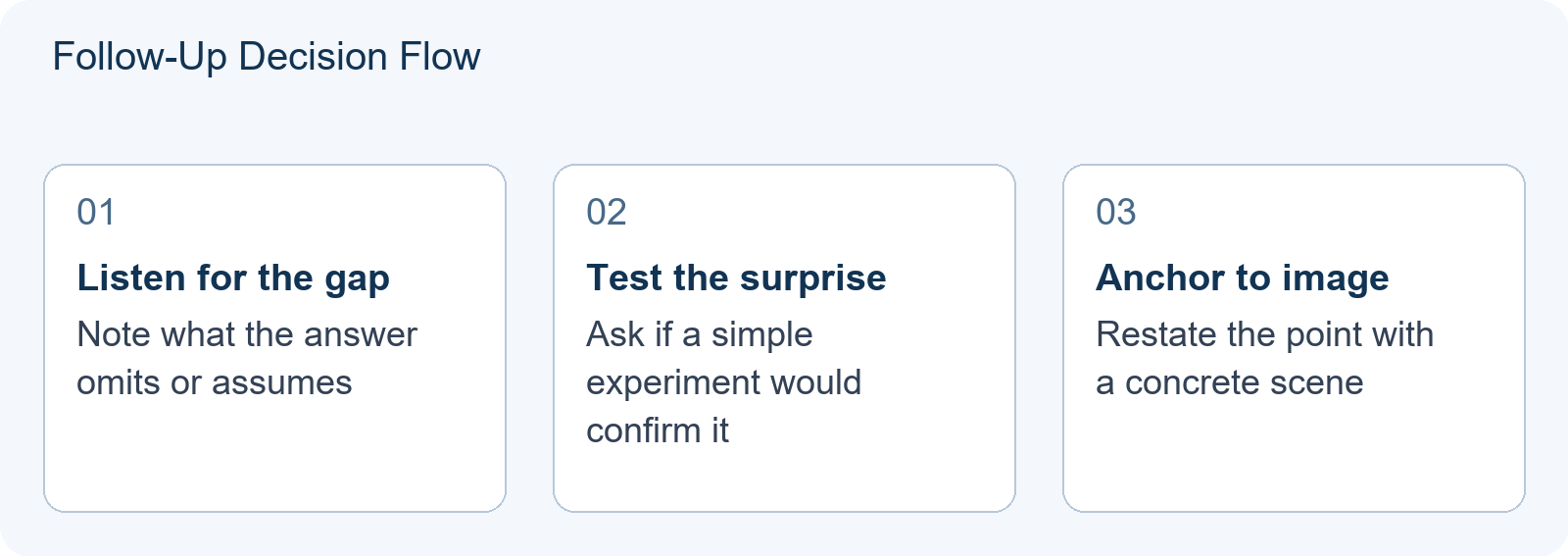
The student notices the gap. The expert named two mechanisms but gave no way to picture them. The follow-up question should ask for a concrete instance where one mechanism dominates. The student asks: “If I slide a hockey puck across a frozen lake at minus ten degrees versus just below freezing, would the same explanation hold?”
This follow-up works because it:
- Fixes a specific variable (temperature)
- Forces a comparison that reveals the limits of the first answer
- Creates a visual scene the video can show
The Result
The expert now explains that the surface-melting theory weakens at very low temperatures, and that friction itself produces a thin liquid layer. The student has moved from a generic statement to a testable claim with a clear boundary condition. The video now has tension: the viewer learns not just that ice is slippery, but under what conditions each explanation applies.
Teaching Illustration Two: When the Expert Surprises You
The Setup
A different student interviews a food chemist about why Cheetos lose their flavor intensity over time. The student expects a discussion of oxidation or moisture absorption. Instead, the expert says: “The real problem is your nose, not the Cheeto.”
The Diagnostic Step
The first answer is unexpected and potentially good, but it is also half-complete. The student must decide whether this surprise is a detour or a better path. The follow-up question tests this: “So if I held my nose while eating a fresh Cheeto and a stale one, the difference would disappear?”
This follow-up:
- Turns the surprising claim into an experiment the viewer can imagine
- Exposes whether the expert is speaking precisely or loosely
- Gives the video a memorable demonstration
The Result
The expert confirms the hypothetical and adds that, in this scenario, flavor perception is largely olfactory—according to the expert’s claim in this teaching illustration. The student now has a stronger narrative than the original oxidation angle: the video becomes about how taste is constructed by the brain, using a snack food as the entry point. The follow-up question turned an accident into structure.
Diagnostic Table: Choosing Your Next Question
| What the expert did | What to ask next | What the video gains |
|---|---|---|
| Gave a general principle | Ask for a specific case where it fails or varies | A boundary condition and visual clarity |
| Used technical jargon | Ask how they would explain it to a younger sibling | Accessible language and personal voice |
| Surprised you with a claim | Ask for the simplest test that would prove or disprove it | Narrative tension and viewer participation |
| Gave a long, wandering answer | Ask which single part matters most | A clear focus for the two-minute cut |
Common Follow-Up Mistakes to Avoid
Even students who understand the concept of follow-up questions often make predictable errors. One frequent mistake is asking a follow-up that merely restates the first question in different words. This wastes time and irritates the expert. Another error is leaping to a new topic instead of exploring the current one; the two-minute limit punishes breadth over depth. A third mistake is accepting jargon without challenge—if the expert says “surface plasmon resonance” and the student nods along, the video loses its audience. The follow-up should always translate, test, or concretize.
Questions about the contests?
Scan the WeChat QR code — we help with contest registration, one-on-one topic coaching, and full guidance to the deadline.
Scan the WeChat QR code
Students also sometimes follow up too aggressively, turning the interview into a cross-examination. The goal is not to catch the expert out but to build a bridge between specialized knowledge and viewer understanding. A useful habit is to phrase follow-ups as requests for help: “Could you help me picture that?” or “What would I see if I watched this happen?” This framing keeps the expert generous and the tone collaborative.
A Practice Sequence
Students preparing for the STEM Interview contest can rehearse follow-up skills before any camera rolls. Here is a three-step sequence:
Step one: Record a mock interview with a teacher or family member playing expert. Restrict yourself to exactly three prepared questions. After each answer, you may ask only one follow-up. Review the recording to see whether the follow-ups produced new information or merely confirmed what you already knew.
Step two: Repeat the exercise with the same topic but a different “expert” who has been instructed to be deliberately vague or contrarian. This trains rapid adjustment when the conversation goes off script.
Step three: Listen to your final recording with the sound off, watching only for moments where your face or voice shows genuine curiosity. Those moments usually follow a successful follow-up question. Mark them for inclusion in the final cut.
What to Demonstrate Next
A student who has worked through these teaching illustrations should be able to: identify the gap in an expert’s first answer within five seconds; choose between deepening the current thread or pivoting to a clearer one; and phrase a follow-up that contains a testable or visualizable element. This skill is not specific to the NYT contest. It transfers to any interview-based project, from podcasting to research journalism. For the immediate purpose of the STEM Interview, it means entering the conversation prepared to be surprised, and prepared to build something better than the script you brought.
Connecting to Related Skills
Follow-up questions are only one part of a successful interview. Finding the right expert, managing the technical setup, and editing to length all require separate preparation. Students who have mastered the conversational dynamics in this article can turn to The NYT STEM Interview Video Contest (2027): How to Find an Expert, Run the Interview and Cut It to Two Minutes for help with those structural elements. Those working on other NYT contests may find parallel challenges in NYT Visual Art Contest Artist Statement: Writing the Required Text When You Are Not a Writer or NYT Contest Google Docs Workflow: Keeping a Clear Record of Your Own Writing for contests that require documentation. For students adjusting to the new Summer Reading format, NYT Summer Reading Contest 2027: How the Three-Round Format Changes Your Preparation Strategy offers relevant timing guidance.
Frequently Asked Questions
Can I prepare follow-up questions in advance if I don’t know what the expert will say?
You can prepare categories of follow-ups, such as asking for an example, a comparison, or a simple test. The exact wording should respond to the specific answer you receive. Rehearsing with mock interviews builds the habit of forming these questions quickly.
What if the expert gives a very short answer and there seems to be nothing to follow up on?
Short answers often hide assumptions. Try asking what conditions would change the answer, or how they would explain the same idea to someone without technical background. These prompts usually reopen the conversation.
How do I know when a surprise answer is worth pursuing versus when I should redirect back to my original plan?
Ask yourself whether the surprise can be tested or visualized within your two-minute limit. If yes, it likely strengthens the video. If it leads to another layer of abstraction, return to your original thread with a bridging question.