For students preparing for New York Times Learning Network contests, the challenge often lies not in generating ideas, but in refining them. The strict word limits—such as 100 words for the My Tiny Memoir or 250 words for Summer Reading—demand precision. However, a common pitfall during revision is stripping away the unique “voice” of the writer in an attempt to be concise. This article addresses the specific problem of cutting repetition without flattening your personal expression.
The Core Difficulty: Conciseness vs. Authenticity
Many students believe that “concise” means “dry.” They remove adjectives, metaphors, and rhythmic sentence structures, resulting in a piece that meets the word count but fails the evaluation criteria for originality and personal connection. The Where a Writing-Contest Result Goes in Your Application – and What It Corroborates (2026) emphasizes that judges seek fresh angles and genuine engagement. Therefore, revision must target structural redundancy and vague filler, not stylistic flair.
The specific reasoning failure occurs when students cannot distinguish between two types of excess: structural repetition (redundant phrases, passive constructions, filler words) and stylistic voice (personal metaphors, rhythmic patterns, specific sensory details). Structural repetition bloats word count without adding meaning. Voice elements may seem inefficient but carry the emotional weight that distinguishes a contest entry from a generic response. The revision task is surgical: remove the first, preserve the second.
Hypothetical Case Study 1: Successful Tightening
Teaching illustration—hypothetical draft for the 100-word Personal Narrative Contest.
A student wants to describe waiting for a bus in the rain.
Draft: “I stood there on the wet pavement. It was raining very hard. I felt cold and uncomfortable. I wanted to go home. The bus was late. I looked at my watch again. I was so tired of waiting.”
(29 words; repetitive structure, low impact)
Revision Strategy: Combine sensory details into active verbs and remove passive constructions like “I felt” or “It was.”
Revised: “Rain lashed the pavement as I shivered, watching the empty street. Each minute stretched longer than the last. Home seemed impossibly far.”
(20 words; higher impact, preserved voice)
This revision cuts nine words but increases emotional resonance. The voice remains anxious and observant, but the delivery is sharper. The student preserved the specific sensory image of watching the empty street and the emotional core of distance from home. What was removed was structural redundancy: the sequence of short sentences all beginning with “I,” the passive “I felt cold,” and the explicit statement “I was so tired of waiting” which the revised version implies through “Each minute stretched longer than the last.”
Hypothetical Case Study 2: The Failed Shortcut
Teaching illustration—hypothetical Summer Reading response about an article on urban gardening.
Questions about the contests?
Scan the WeChat QR code — we help with contest registration, one-on-one topic coaching, and full guidance to the deadline.
Scan the WeChat QR code

Draft: “The article showed how community gardens bring people together. I liked this because it shows hope. We need more green spaces in cities. It makes me feel connected to my neighborhood.”
(32 words)
Failed Revision: “Community gardens foster social cohesion and urban sustainability.”
(8 words)
Why it fails: While extremely concise, this revision sounds academic and detached. It loses the “personal connection” that contest judges reward. The judge cannot see the student’s genuine reaction or specific insight. The voice has been erased, replaced by generic jargon. The student confused removing repetition with removing subjectivity. The draft’s weakness was vague phrasing (“it shows hope,” “it makes me feel”), not the presence of personal feeling. A better revision would keep the personal stake but make it specific: “My neighborhood’s garden grew tomatoes and trust between strangers who previously never spoke.” This keeps voice while cutting vague abstraction.
Diagnostic Table: What to Cut vs. What to Keep
| Element | Action | Reason |
|---|---|---|
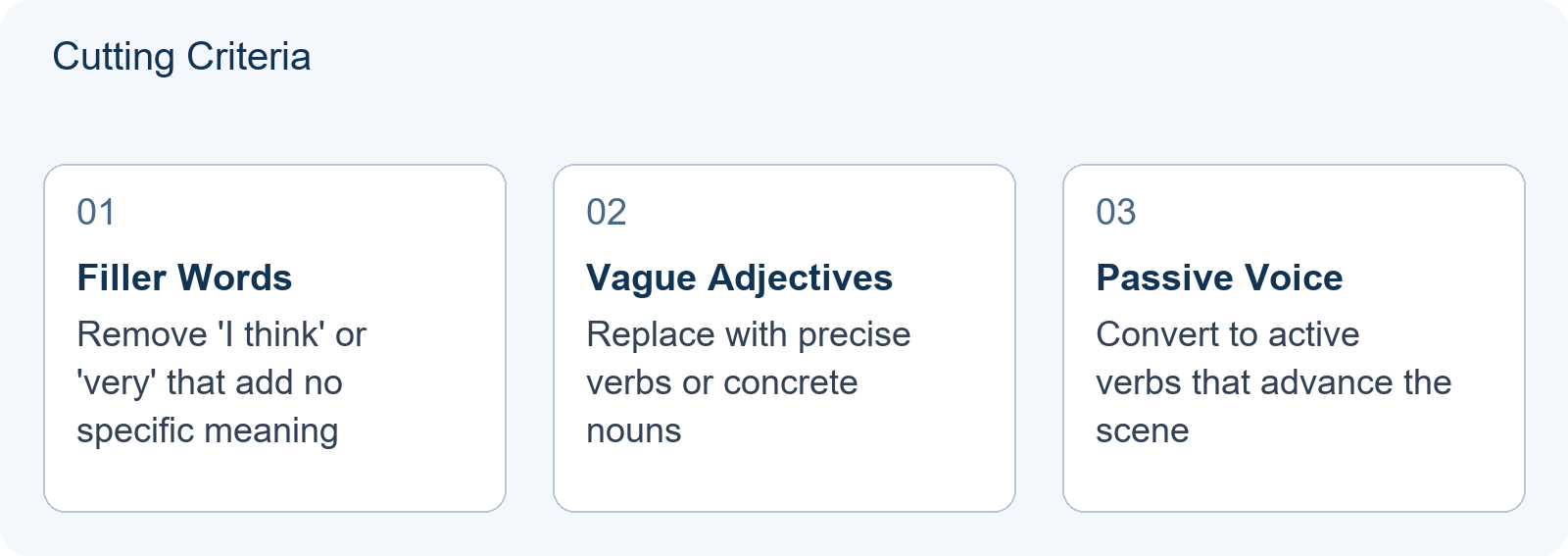
| Filler phrases (e.g., “In my opinion,” “I think”) | Cut | Redundant; the essay itself implies opinion. |
| Vague adjectives (e.g., “nice,” “good,” “very”) | Replace | Use precise verbs or specific nouns instead. |
| Unique metaphors or similes | Keep | Essential for demonstrating creative voice. |
| Personal anecdotes tied to the prompt | Tighten | Remove setup details, keep the emotional core. |
| Repetitive sentence structures | Vary | Combine sentences to improve flow and rhythm. |
Targeted Practice Sequence
To master this balance, follow these steps during your next drafting session:
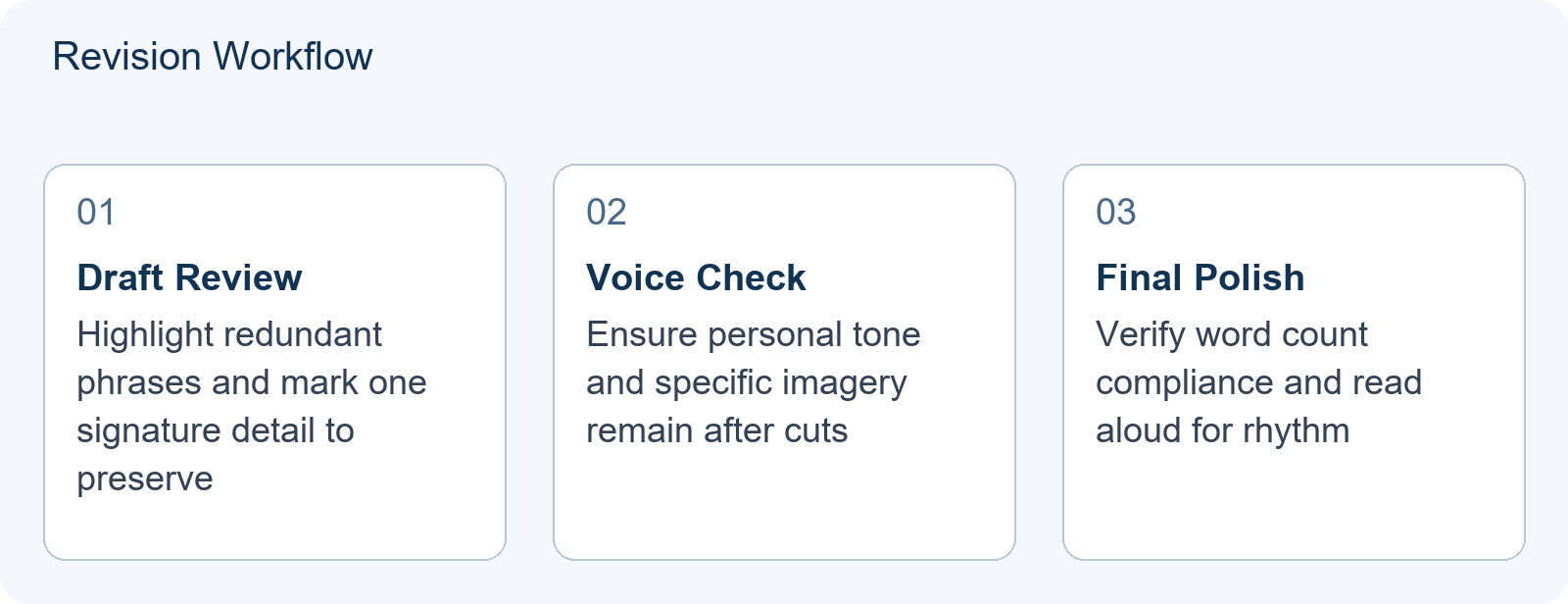
- Identify Redundancy: Highlight any phrase that repeats information already stated in the previous sentence. Common patterns include restating the subject (“The article… The article showed…”), emotional labels without evidence (“I felt sad”), and generic intensifiers (“very,” “really,” “extremely”).
- Strengthen Verbs: Replace “was/were + adjective” constructions with strong action verbs. Instead of “The room was noisy,” write “Laughter clattered off the cafeteria walls.” This typically reduces word count while increasing specificity.
- Preserve One Signature Detail: Ensure at least one specific, personal image or metaphor remains untouched to anchor your voice. Before cutting anything, mark this detail and build around it. If revision threatens this element, reconsider your cuts.
- Read Aloud: If the text sounds robotic, add back a small fragment of natural speech pattern. Voice lives in rhythm and unexpected word choices. If your revision has eliminated all irregularity, you have cut too deeply.
Remember, the goal of NYT writing contests is to showcase your ability to communicate complex feelings clearly. Cutting repetition should make your message louder, not quieter. For guidance on documenting your revision process transparently, see our article on NYT Contest Google Docs Workflow: Keeping a Clear Record of Your Own Writing. For strategies on writing artist statements when words feel scarce, see NYT Visual Art Contest Artist Statement: Writing the Required Text When You Are Not a Writer.
Frequently Asked Questions
Does cutting words always mean losing points?
No. Judges value clarity and impact. Removing filler improves readability, but removing unique stylistic elements can hurt scores on originality.
How do I know if my voice is too informal?
Read your piece aloud. If it sounds like you speaking naturally to a friend, it likely retains voice. If it sounds like a textbook, it may be too stiff.
Can I use AI to help revise my writing?
Current NYT rules strictly prohibit generative AI in any stage of creation or revision. All work must be human-generated and verifiable via document history.