The New York Times Visual Art Contest asks students to create work about growing up in 2026. But the submission is not complete with the image or video alone. Every entry must include an artist statement that documents the creative process and explains how the work responds to the three core questions about the experience of being a teenager today (Hanlin, Sept. 2026). For visual artists who think in color, composition, and movement, this written component can feel like a separate competition entirely.
What the Artist Statement Actually Does in Judging
The artist statement is not decorative text that judges skim after admiring your visual work. It performs specific work in the evaluation process. The statement provides context that the image or video cannot fully convey on its own. It answers questions that visual work raises but does not resolve: why you chose your particular medium, how you narrowed from the broad theme to your specific subject, and what decisions you made during the process that are not visible in the final piece.
Accepted media forms for the contest include photography, painting, comics, charts, screenshots, short films, and sculpture (Hanlin, Sept. 2026). Each of these forms presents different challenges for the accompanying statement. A sculpture cannot show its own construction process. A short film may contain editing choices invisible to viewers. The statement is where you make these invisible elements visible to judges.
The Three Required Moves
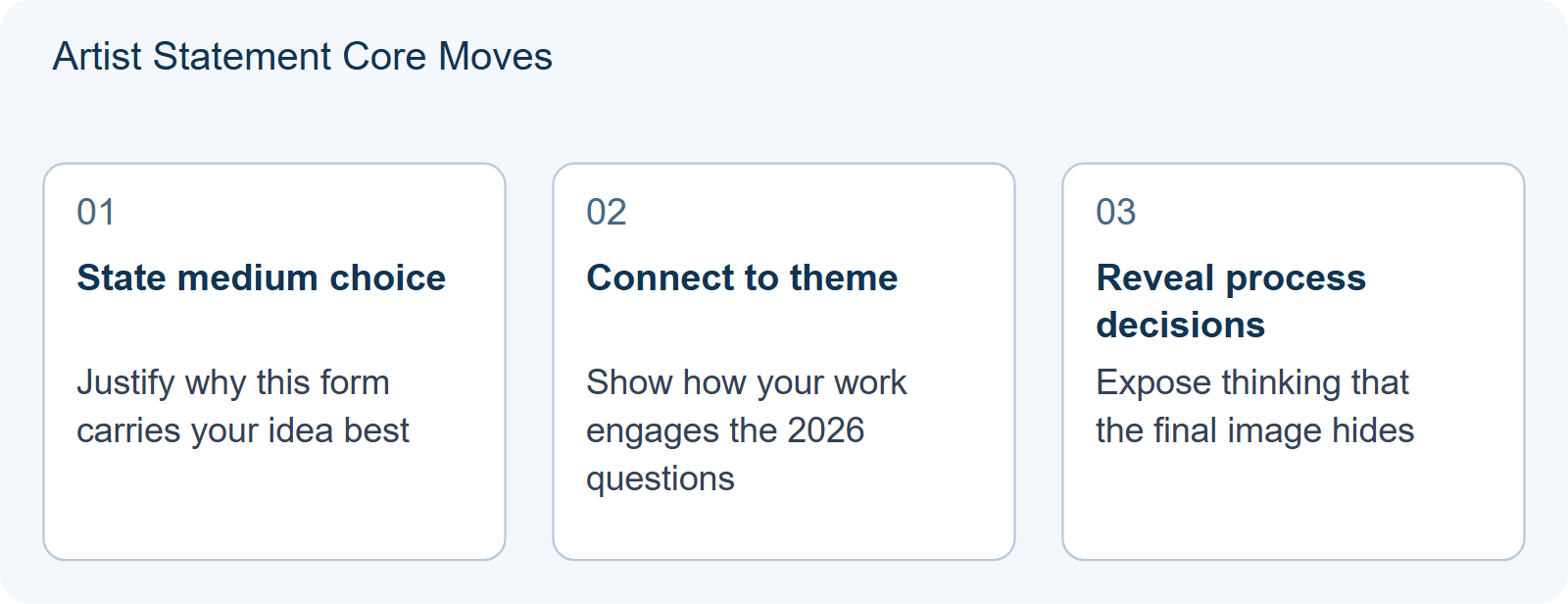
Every effective artist statement for this contest accomplishes three things. Missing any of these leaves judges with unanswered questions.
State Your Medium Choice
Explain why your chosen form was the right vehicle for your specific idea. This is not a list of materials. It is a justification. If you chose photography over video, what did the still image allow you to do that motion could not? If you made a sculpture rather than a painting, what did three-dimensional form add to your concept?
Connect to the Contest Theme
The 2026-2027 theme asks what it is like to grow up in 2026, what unique difficulties this generation faces, and what opportunities the present moment offers (Hanlin, Sept. 2026). Your statement must show how your specific work engages with these questions. This requires more than mentioning the theme in your first sentence. It requires demonstrating that your visual choices were shaped by your understanding of the theme.
Reveal Process Decisions
Judges want to see evidence of thinking. What did you try and abandon? What constraint became a creative opportunity? What surprised you during the making? The statement should reveal a mind at work, not just a finished product.
Translating Visual Decisions Into Words
Visual artists often struggle with this translation because the vocabulary of art education can feel like a trap. Terms like juxtaposition, liminal space, or interrogating can make a statement sound borrowed rather than lived. The goal is not to avoid all specialized language but to use only terms that accurately describe what you actually did.
A practical approach: describe your work as you would to someone who cannot see it, then check each description against your actual process. If you wrote that you explored the tension between public and private, ask yourself what concrete visual decision enacted that exploration. Did you shoot through windows? Did you crop faces out of frame? The specific action belongs in the statement. The abstract framing can stay or go depending on whether it clarifies or obscures.
Common Failures and How to Avoid Them
Over-Explaining the Obvious
Do not describe what a viewer can already see. If your photograph shows a crowded subway, stating that it depicts urban density wastes words. Instead, explain why you chose that particular moment, that angle, that decision to include or exclude the train’s destination sign.
Under-Explaining the Intentional
Conversely, some artists assume that clever visual choices speak for themselves. They do not, especially in contest judging where evaluators view hundreds of entries. If you desaturated part of an image while leaving one element in color, that decision needs explanation. It was not accidental, and its meaning is not self-evident.
The “This Represents” Trap
The phrase this represents or this symbolizes often signals that the artist is interpreting their own work rather than explaining their process. It turns the statement into art analysis rather than artist testimony. Instead of writing the broken glass represents fragility, write I photographed broken glass because I wanted to show what I could not photograph directly: the moment before a friendship ended. The second version keeps you in the realm of decision and intention.
Structure Templates by Length
The contest does not specify a fixed word count for the artist statement, but practical constraints apply. These templates assume different possible lengths; adjust based on official requirements when published.
Questions about the contests?
Scan the WeChat QR code — we help with contest registration, one-on-one topic coaching, and full guidance to the deadline.
Scan the WeChat QR code
| Length | Structure | Example Opening |
|---|---|---|
| 150 words | One paragraph: medium + single theme connection + one process decision | “I made a two-minute short film because…” |
| 250 words | Two paragraphs: medium and theme in first, process and surprise in second | “I started with photography, but the still image felt wrong because…” |
| 400 words | Three paragraphs: medium choice with specific constraints, theme engagement with personal stake, process evolution with concrete turning point | “The first sculpture I attempted collapsed because…” |
These are suggested structures, not official requirements. The right length depends on how much your particular work requires explanation. A straightforward photograph may need fewer words than a multi-layered comic sequence.
Why Writer Friends May Steer You Wrong
Visual artists often ask friends who write well to review their statements. This can backfire. Writers who do not make visual work may push for more elaborate prose, more explicit thematic statements, or a narrative arc that suits written work but misrepresents visual process. They may also overcorrect toward literary language that sounds impressive but does not match how you think about your own practice.
A better first reader is another visual artist who has faced the same translation problem, even if they are less confident with written language. They can spot when your statement accurately reflects process and when it drifts into borrowed language.
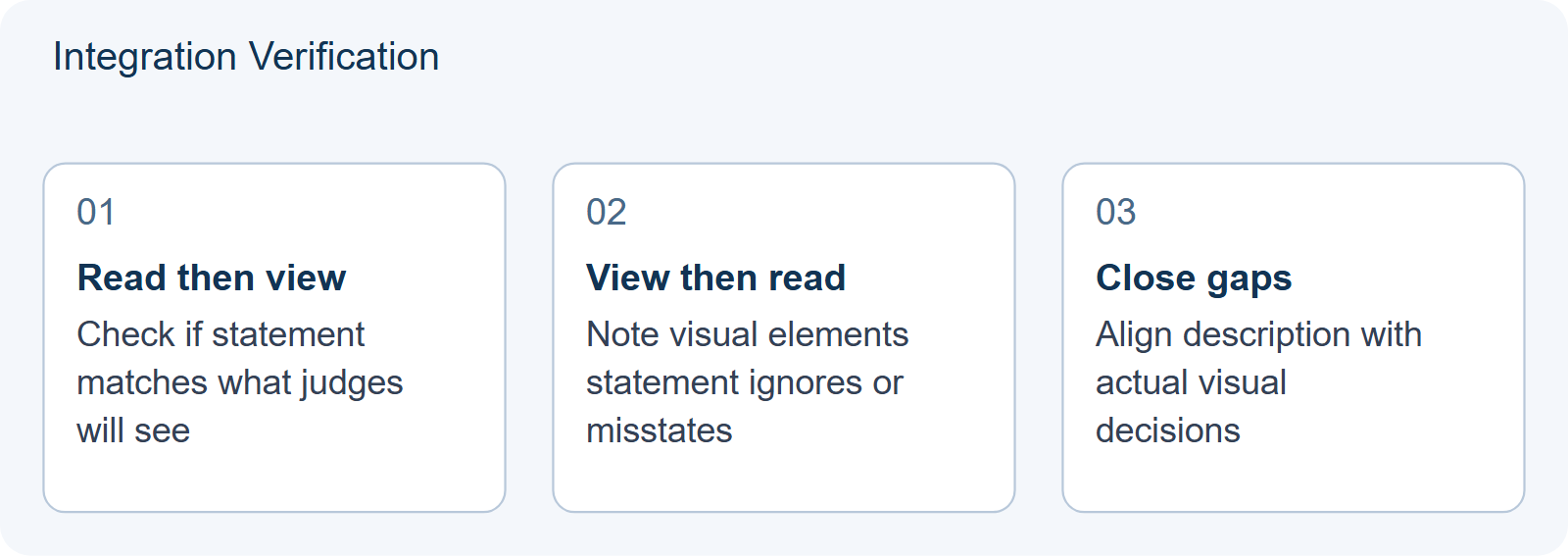
The Integration Check: Does Your Statement Match What Judges See?
Before submitting, perform this specific verification: read your statement, then view your work without reading. Then reverse: view your work, then read the statement. In each case, note gaps. Does the statement mention a color choice that is not actually prominent? Does the visual work contain an element the statement ignores? The strongest entries show tight alignment between what judges see and what they read.
This alignment matters because the contest evaluates both components together. The statement does not exist to compensate for weak visual work, nor does strong visual work excuse a vague statement. Each must support and complicate the other.
Preparing for Consultation
If you are considering working with a mentor on your contest submission, prepare efficiently by gathering: your draft visual work or documentation of it, even if incomplete; any rough notes or sketches from your process; and a first attempt at the artist statement, however rough. This material allows consultation to focus on the specific gap between your visual intentions and your written explanation, rather than starting from generic advice.
For broader context on the contest requirements and timeline, see our coverage of how to prepare for the 2026 Visual Art Contest theme. Students also preparing for other New York Times contests may find relevant preparation strategies in our guide to the Summer Reading Contest and our overview of the full competition calendar.
The New York Times Learning Network hosts this contest independently. This article reflects Hanlin preparation perspectives and does not represent official contest guidance.
Frequently Asked Questions
Does the artist statement count equally with the visual work in judging?
The contest requires both components, and the statement performs specific work that visual work cannot. It documents process and explains thematic engagement. Weak statements leave judges with unanswered questions about decisions visible in the work. Strong statements make invisible choices visible.
How do I avoid sounding like I am writing an art history paper?
Describe concrete decisions you made rather than interpreting finished meanings. Replace phrases like 'this represents' with explanations of what you tried, what failed, and what you chose instead. Test your draft by asking whether each sentence could only have been written by someone who made your specific piece.
What if my work changed during the process and the final piece differs from my original plan?
This is often the most valuable material for a statement. Judges want to see evidence of responsive thinking. Explain what you first attempted, why it failed, and how that failure led to the final form. The change itself demonstrates the creative process the contest asks you to document.