If you are writing from Shanghai, Shenzhen or Chengdu and your subject is your own street, your own school or your own grandmother, the hard part is usually not your English. It is calibration — deciding how much a reader who has never been there needs to be told. Explain too little and the piece is opaque. Explain too much and it reads like a guidebook. Four moves fix it.
Calibration is a different problem from language
It is worth separating two things that get confused. Language competence is whether your sentences are accurate and idiomatic. Calibration is whether a stranger can follow your world — the objects, routines, institutions and relationships your story assumes.
A student can have flawless grammar and still lose a reader in the second sentence because the piece assumes everyone knows what a class monitor does, what the gaokao means to a family, or why a particular week in June rearranges an entire household. Equally, a student with rougher sentences can be perfectly clear because every unfamiliar thing arrives with just enough scaffolding.
Judges reading for a general readership are not testing your cultural knowledge. They are reading to see whether the writing takes them somewhere and makes them feel the stakes. That is a craft problem with a craft solution, and it is worth solving deliberately before your next entry — whichever contest on the 2025–26 contest calendar you are aiming at.
The two failure modes: the brochure and the encyclopedia
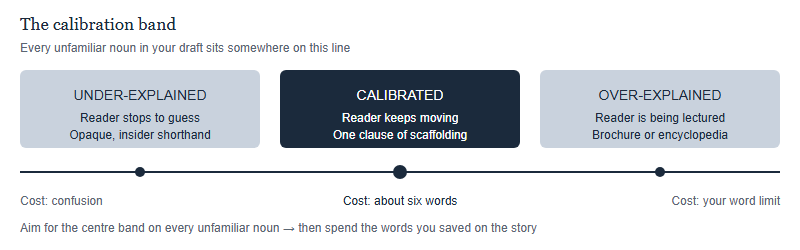
Almost every mis-calibrated draft fails in one of two directions.
The brochure. The writer senses the reader is foreign and starts performing. The result is a piece that presents its own life as scenery — lanterns, ancient traditions, bustling markets, a culture described from the outside as though the writer were a visitor to it. The tell is adjectives doing the work that detail should do. Nothing here is technically false, but the writer has stopped being a person with a specific life and become a tour guide.
The encyclopedia. The opposite instinct. The writer decides the reader needs background, and the piece stalls into explanation: three sentences defining an exam system, a paragraph on the history of a festival, a clause explaining what a dumpling is. In a short entry with a tight word limit, this is fatal — the explanation eats the words your actual story needed.
Both failures come from the same root: treating the reader’s unfamiliarity as an obstacle to be handled up front, rather than something you dissolve as you go.
Four calibration moves
1. The one-clause gloss. An unfamiliar noun does not need a definition. It needs a clause that tells the reader what role it plays in the sentence it is already in. Not a paragraph on the residency system, but: my hukou, the household registration that decided which city I could sit exams in. The reader now knows enough to keep going, and you spent nine words.
2. Specificity instead of explanation. This is the counter-intuitive one. When a reader is confused, the instinct is to add background; usually the fix is to add detail. Concrete particulars are self-explaining in a way that abstractions never are. “A traditional breakfast” explains nothing and sounds like a brochure. “Rice porridge the temperature of bathwater, with the pickled radish my grandmother refuses to buy pre-cut” requires no cultural footnote at all. The reader does not need to have eaten it to understand the grandmother.
3. The universal anchor. Attach the unfamiliar thing to a human situation any reader already owns — being late, being watched, wanting a parent’s approval, dreading a result. You are not simplifying your culture; you are giving the reader a handhold. A ranking list posted on a classroom wall needs no explanation once the reader understands that everyone walks past it on the way to lunch.
4. Translate the stakes, not the noun. The most common calibration error is explaining what a thing is when the reader actually needs to know what it costs you. A reader does not need the structure of an exam to feel a family holding its breath. Spend your scarce words on consequence, not on definition.
Weak to calibrated: five rewrites. Every sentence below is invented for this guide. Read the middle column first — naming the failure is the skill that transfers, and it transfers faster than any individual fix.
Questions about the contests?
Scan the WeChat QR code — we help with contest registration, one-on-one topic coaching, and full guidance to the deadline.
Scan the WeChat QR code

| Draft sentence | What goes wrong | Calibrated rewrite |
|---|---|---|
| “In China, the gaokao is a national college entrance examination taken by millions of students each June, and it determines university placement.” | Encyclopedia. Twenty-six words of background before the story starts; the reader learns a fact, not a stake. | “My cousin had one exam left, and the whole building had agreed not to drill, argue or play music until it was over.” |
| “Our ancient city is full of bustling markets and rich traditions passed down for generations.” | Brochure. Adjectives standing in for observation; could describe anywhere. The writer has left their own life. | “The vegetable seller on our corner has priced coriander from memory for eleven years and has never once been wrong.” |
| “As the ban zhang, I was responsible for many duties in the class.” | Under-explained. An untranslated role plus a vague summary; the reader guesses and keeps guessing. | “As class monitor — the student who writes down whoever talks while the teacher is out — I was, briefly, the most unpopular person in the room.” |
| “Chinese parents traditionally place a very high value on education, which creates pressure on students.” | Generalisation about 1.4 billion people. Unverifiable, impersonal, and it could have been written by someone who has never been to China. | “My mother kept my mock-exam scores in a notebook she never showed me and never threw away.” |
| “During Spring Festival, which is the most important holiday in Chinese culture, families gather together to celebrate the new year.” | Both failures at once: brochure framing plus an explanation the story does not need. | “For four days in February the lift in our building smells of vinegar, and nobody complains.” |
Notice what the right-hand column never does: it never apologises for its own context, and it never pauses to teach. It trusts detail to carry meaning — which is also what makes it sound like a person rather than a submission.
Which local subjects travel — and how to calibrate by contest
Not every local subject is equally portable, and choosing badly costs you before you write a line. A rough test: subjects travel when the reader can feel the consequence without holding a fact-sheet.
| Travels well | Travels only with work | Rarely travels in a short entry |
|---|---|---|
| A relationship under strain — a grandparent, a sibling, a teacher | An institution with an unfamiliar structure (a school system, a registration rule) | A dispute that requires historical background to even state |
| An object with a history (a bicycle, a rice cooker, a phone with a cracked screen) | A holiday, if you skip the summary and enter through one small ritual | An in-joke or internet trend that needs three sentences of setup |
| A daily routine that reveals a value without stating it | A local policy, if you enter through the person it changed | A general claim about “Chinese students” or “Western students” |
The middle column is where most good entries actually live. The move is always the same: enter through a person, then let the structure emerge behind them.
Calibrating by contest. The principle is constant; the pressure changes with the form. Contest-specific rules, word limits and deadlines vary and are posted on each contest’s own page — confirm current details on nytimes.com/learning before you draft.
- Personal narrative. Highest tolerance for the unfamiliar, because scene does the explaining. Resist background entirely; enter in the middle of an action.
- Editorial and argument. Lowest tolerance for unglossed terms, because a reader who stalls on a noun cannot follow a claim. Gloss early, then argue.
- Open letters. Calibration is partly solved for you: you have a named recipient, so the shared knowledge between you and that person sets the level. If you are addressing someone inside your world, the reader is permitted to overhear. See our guide to the Open Letters Contest.
- Review and criticism. Your local vantage point is the asset. Watching something from a place its makers were not imagining is a genuine critical position — say so plainly rather than hiding it.
- Responses to something you read in The Times. The published piece supplies shared ground, so you can spend nearly all your words on your own angle. The Summer Reading Contest runs to 14 August 2026 and accepts writing or a short video; check the current window’s prompt and its exact cutoff on the official page (the Learning Network sets its deadlines in U.S. Pacific time).
A four-question calibration check
Run this after your last content revision and before your final proofread.
- The stranger test. Give the draft to someone who has never visited your city and ask them to mark, without commenting, the first place they slowed down. Fix that one place.
- The adjective sweep. Highlight every adjective describing your culture, city or family as a category (traditional, bustling, strict, ancient, close-knit). Delete each one and see whether a detail can be put in its place.
- The generalisation sweep. Search for “Chinese people”, “in China”, “Asian parents” and “we always”. Each is a claim about millions of people; almost always the sentence gets stronger and more accurate when narrowed to one person you have actually watched.
- The cost test. Ask of your central unfamiliar thing: has the reader been told what it cost someone? If not, you have explained rather than written.
None of this is about making your life legible to a foreign reader by flattening it. The opposite: precise, particular, unapologetic local detail is the most portable material you have, and it is the one thing a writer somewhere else cannot produce. If you are choosing which contest to aim it at, start with our overview of the Learning Network writing contests.
Frequently asked questions
Should I avoid Chinese words entirely in my entry?
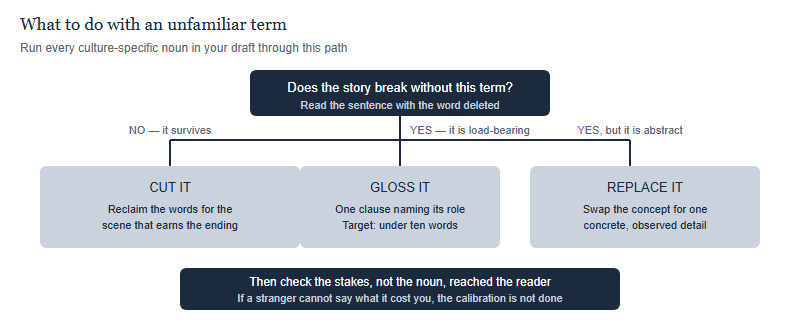
No. Keep the ones that are load-bearing and gloss them in a clause. Cut the ones that are decoration.
Will judges find my subject too unfamiliar?
Unfamiliarity is not the risk; opacity is. A well-calibrated local subject is an advantage, not a handicap.
Is it safer to write about a universal topic instead?
Usually not. Generic topics attract the most entries and the least distinctive writing. Specific beats safe.
How many words should a gloss take?
Aim for under ten. If a term needs a sentence, consider whether a concrete detail could replace it entirely.
This is an independent guide operated by Hanlin Education for China-based international-school students. We are not affiliated with, endorsed by, or sponsored by The New York Times Company or its Learning Network. Contest rules, word limits, eligibility and deadlines change each season — confirm current details on nytimes.com/learning before entering. Errors reported to our editorial desk are corrected within 7 working days.