For students preparing for New York Times Learning Network writing contests, particularly the My Tiny Memoir (100-word personal narrative) or the Summer Reading Contest, a common stumbling block is the reliance on abstract adjectives rather than concrete sensory details. A judge reading “It was a sad day” sees a conclusion; a judge reading “The rain blurred the windowpane as I folded the letter twice before putting it in my pocket” sees a scene. This article addresses the specific skill of replacing vague impressions with grounded, observable moments.
The Core Challenge: Abstraction vs. Observation
In short-form writing, every word must earn its place. When a student writes that an event was “memorable” or “impactful,” they are telling the reader what to feel. The NYT contest criteria emphasize personal connection and material close reading. To demonstrate this, writers must show the physical reality of their experience. The difference between a vague impression and a specific scene lies in the shift from internal judgment to external observation.
This distinction matters especially for the My Tiny Memoir contest, running September 16 through October 28, 2026, where 100 words must carry complete emotional weight. It also matters for the Summer Reading Contest, where students explain what interested them in a Times article and why—responses that gain force when grounded in specific reaction details rather than generic praise.
Hypothetical Case Study 1: The Successful Shift
Teaching illustration—original hypothetical example, not an official contest prompt or winning entry.
Consider a student attempting to describe the anxiety of waiting for exam results.
- Vague Draft: “I was extremely nervous while waiting for my grades. It felt like forever. I hoped for a good result.”
- Specific Revision: “My thumb hovered over the refresh button, trembling slightly. The clock on the wall ticked louder than usual, each second stretching into a minute. I didn’t blink until the page loaded.”
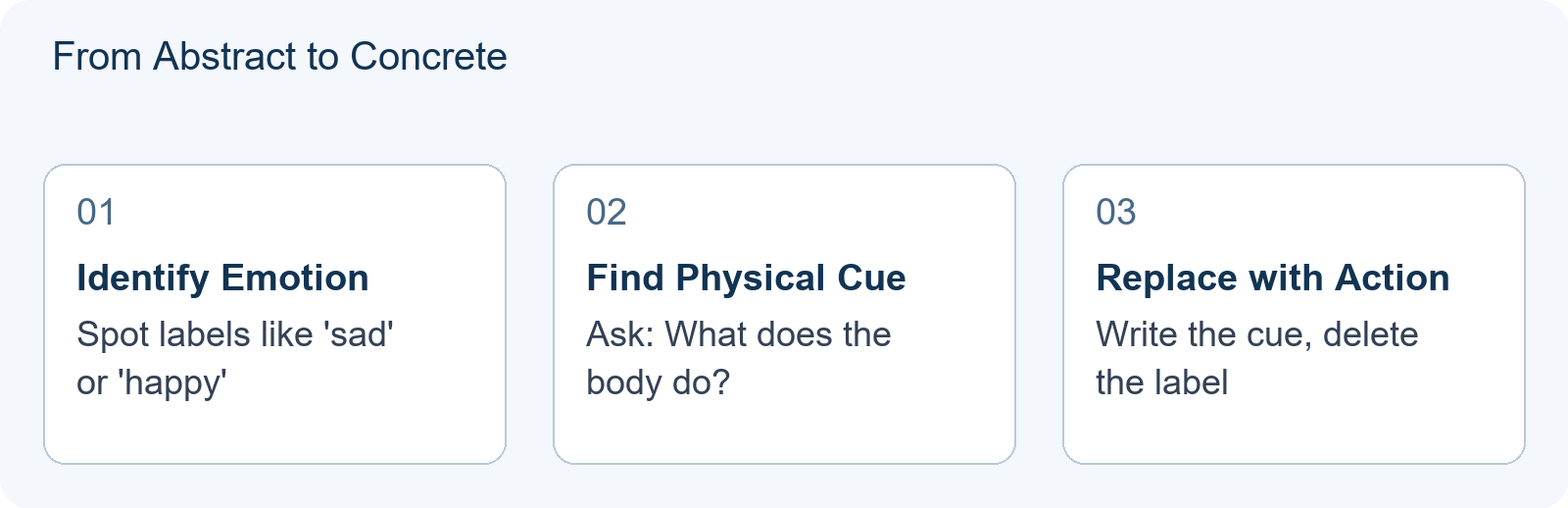
The revision removes the label “nervous” and replaces it with physiological actions (trembling thumb), auditory focus (loud ticking), and behavioral changes (not blinking). This allows the reader to infer the emotion through evidence. The writer trusts the reader to feel the anxiety without being told to feel it.
Hypothetical Case Study 2: Where the Shortcut Fails
Teaching illustration—original hypothetical example, not an official contest prompt or winning entry.
A common mistake is adding random sensory details without narrative purpose.
- Flawed Attempt: “I walked into the room. It smelled like old books. The carpet was blue. I felt happy because I won the prize.”
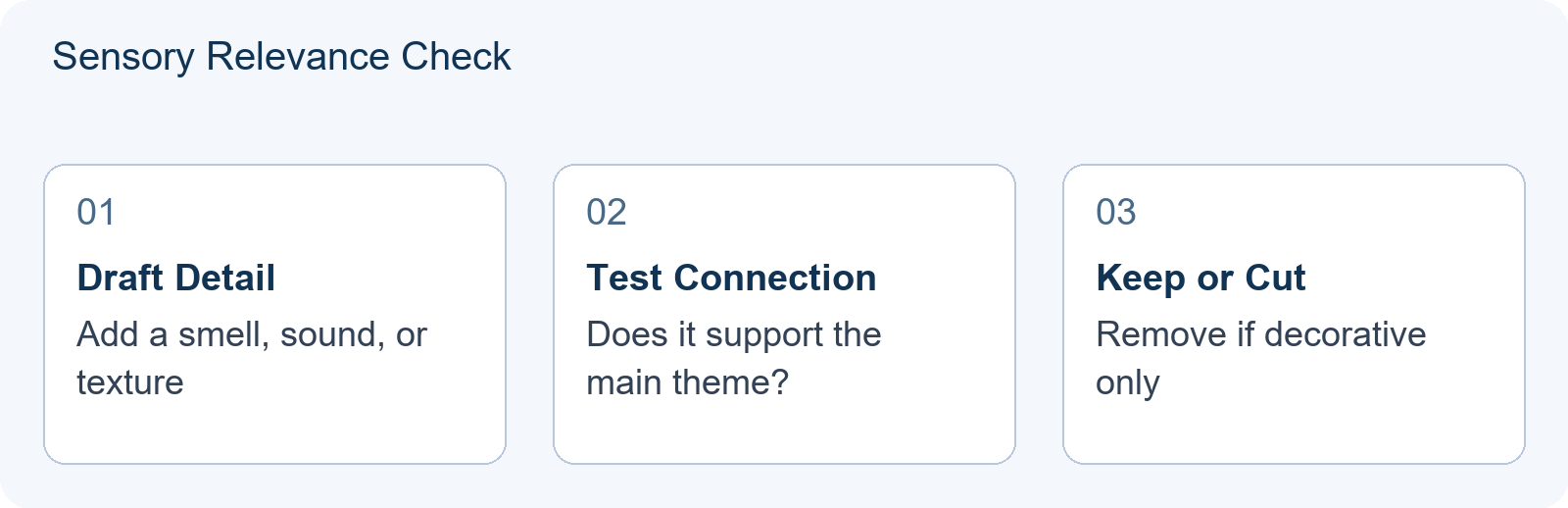
Here, the writer has included smell and color, but these details do not connect to the emotional arc. The “blue carpet” is irrelevant unless it contrasts with something else or triggers a memory. The statement “I felt happy” remains abstract. Effective sensory detail must serve the theme. If the theme is nostalgia, the smell of old paper matters; if the theme is victory, the physical sensation of holding the trophy matters. Random decoration dilutes the impact.
Questions about the contests?
Scan the WeChat QR code — we help with contest registration, one-on-one topic coaching, and full guidance to the deadline.
Scan the WeChat QR code

The error here is treating sensory detail as ornament rather than engine. The detail must do work—establishing setting, revealing character, or advancing emotion. When it merely decorates, it consumes precious words without advancing the reader’s understanding.
Diagnostic Table: Identifying Weak Details
| Weak Element | Why It Fails | Stronger Alternative |
|---|---|---|
| Abstract Adjective (e.g., “beautiful”) |
Tells the reader what to think; lacks uniqueness. | Specific Visuals (e.g., “light fractured through the prism”) |
| Generic Action (e.g., “walked quickly”) |
Does not convey urgency or character. | Bodily Reaction (e.g., “shoes slapped against the pavement”) |
| Emotional Label (e.g., “felt scared”) |
Distance from the immediate experience. | Physical Symptom (e.g., “stomach tightened into a knot”) |
Apply this table during revision, not just drafting. First drafts naturally lean on abstraction; the diagnostic pass transforms them into concrete experience.
Targeted Practice Sequence
To build this skill, students should engage in focused exercises rather than full drafts initially.
- The Five-Sense Audit: Take a paragraph describing an event. List one detail for sight, sound, touch, taste, and smell. Delete any that do not advance the story’s mood.
- Show, Don’t Tell Rewrite: Write three sentences using only nouns and verbs. No adverbs or adjectives allowed. See if the meaning remains clear.
- Contextual Linking: For guidance on structuring the required artist statement text, see NYT Visual Art Contest Artist Statement: Writing the Required Text When You Are Not a Writer. To understand how contest entries are documented and verified, review NYT Contest Google Docs Workflow: Keeping a Clear Record of Your Own Writing. For placing contest results in context with your broader application, see Where a Writing-Contest Result Goes in Your Application – and What It Corroborates (2026).
Demonstrating Competence
A learner has mastered this skill when they can take a prompt like “Describe a moment of change” and produce a 100-word piece where the emotion is never named directly, yet clearly understood by the reader through action and environment. This aligns with the NYT preference for fresh entry points and material close reading, moving beyond predictable responses to create genuine engagement.
The transformation from vague impression to specific scene is not merely a stylistic preference. In the evaluation framework used across NYT contests, it directly supports the criteria of originality (fresh entry points), personal connection (demonstrated through concrete experience), and language and completion (precise, economical expression). Students who internalize this shift position themselves to meet what judges actually reward.
Frequently Asked Questions
Do I need to use all five senses in every sentence?
No. Use only the senses that strengthen the specific moment. Overloading text with unnecessary smells or sounds distracts from the core narrative.
Is this technique required for the Summer Reading Contest?
While the Summer Reading Contest focuses on why an article interested you, using specific details about your reaction helps demonstrate the ‘personal connection’ criterion more effectively than general statements.
Can I use metaphors instead of literal sensory details?
Metaphors are powerful but risky in very short formats like the 100-word memoir. Literal, observed details are often clearer and more impactful for judges looking for authenticity.