Most students preparing for NYT Student Writing Scene Transitions focus on the opening, the closing, or the sensory detail inside a single scene. The middle often gets less attention. That is where a personal narrative can collapse into a list: I woke up, I took the bus, I sat in class, I came home. In a short contest entry, especially the My Tiny Memoir contest (Sept. 16-Oct. 28, 2026), which has a 100-word limit, every sentence has to carry narrative weight. A transition that merely says what happened next can waste words and flatten emotion. The goal is to move between two moments without making the reader restart their mental map. This guide treats scene transitions as a micro-craft problem: how to bridge time, place, and mood inside a tight word budget.
Why Scene Transitions Fail in Short Contest Entries
In a longer essay, transitional phrases such as subsequently, in contrast, or three days later can be useful signposts. In a 100-word memoir, those phrases are expensive. The 2026-27 calendar describes My Tiny Memoir as a 100-word personal narrative contest inspired by the Modern Love column, so compression is not an editing preference; it is the form. The most common failure is what teachers often call And Then syndrome. The writer records events in order instead of curating moments. The reader gets information but not continuity. For example, a draft might move from a tense classroom to a quiet kitchen by writing: The bell rang. I went home. I felt better. The words are clear, but the emotional bridge is missing. The reader knows the location changed, but not why the change matters. In a short entry, that missing bridge costs momentum. The judge has no reason to feel the relief with the narrator. A successful transition does two jobs at once: it tells the reader where they are now, and it carries forward the feeling, question, or tension from the previous moment.
Technique 1: The Sensory Anchor Bridge
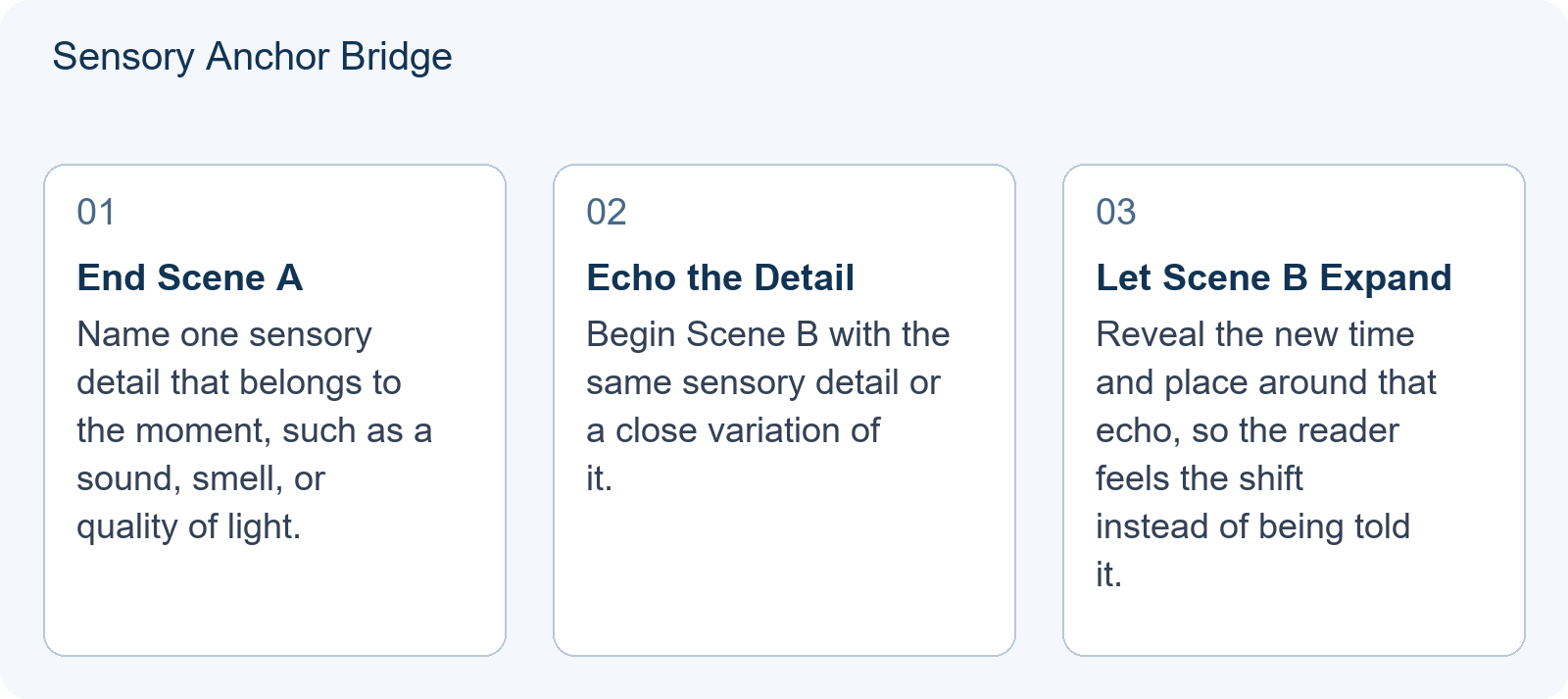
A sensory anchor uses a repeated sound, smell, texture, or quality of light to link two separate moments. Instead of announcing the time jump, you let a sensory detail echo across it. The reader feels the shift because the sensory world changes around a familiar thread. Teaching illustration, not a contest entry: imagine a student moving from an exam hall to a bedroom. A weak version might say, The exam ended. I went home and felt relieved. A stronger version might end the exam scene with the ticking of the clock and begin the bedroom scene with the ticking of a kitchen clock. The echo creates continuity, while the different setting creates movement. Another example uses sound: the fluorescent buzz of a classroom can be answered by the refrigerator hum of a home kitchen. The buzz and hum are not identical, but they belong to the same family of ordinary mechanical noise. The reader understands that the narrator has moved from institutional pressure to domestic quiet without a full sentence explaining the trip home. This technique extends the work of NYT Student Writing Sensory Detail: Replacing a Vague Impression With a Specific Scene from within-scene description to between-scene connection. The key is selectivity. Do not repeat every detail. Choose one sensory element that can carry emotional meaning. If the exam clock suggests time pressure, the kitchen clock can suggest a different kind of time: ordinary, slow, or emptied out. The transition becomes thematic rather than merely spatial.
Technique 2: Object Continuity and Symbolism
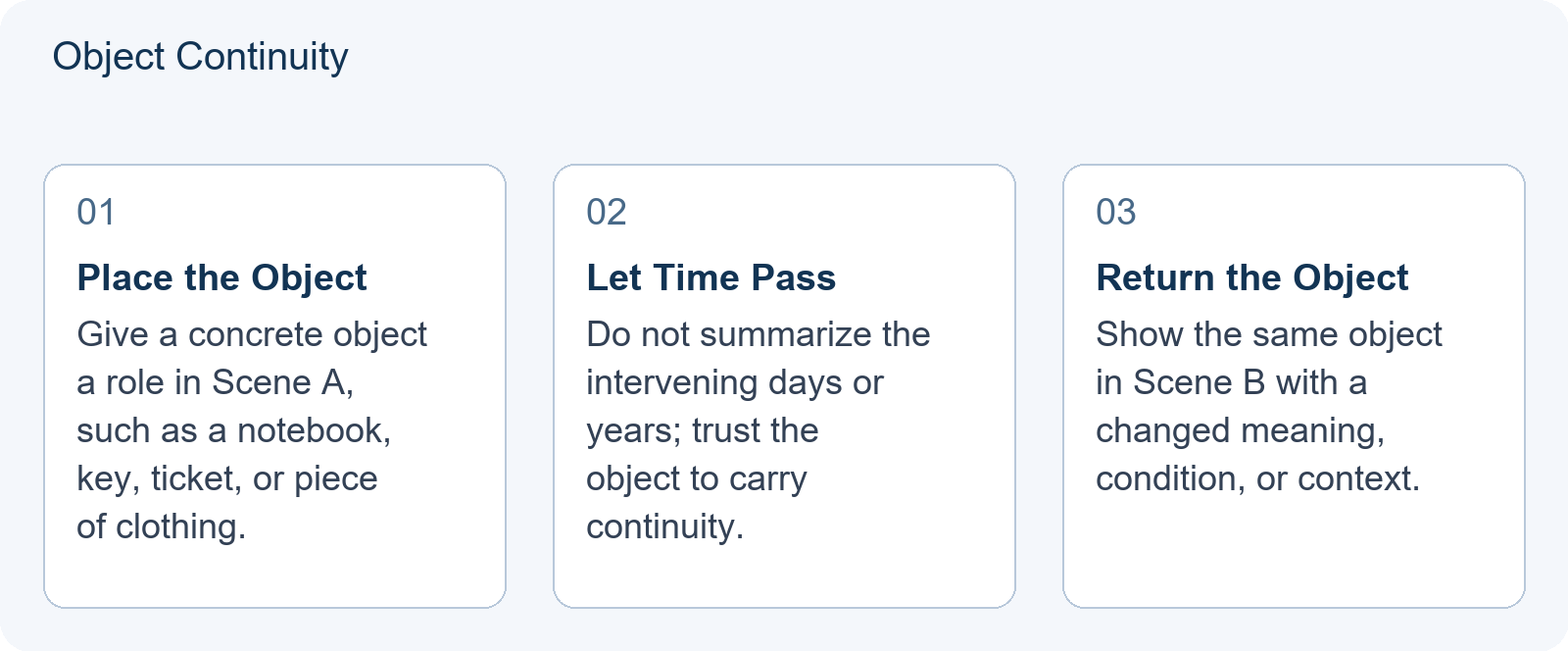
Objects can act as batons passed from one scene to the next. If an object appears in Scene A and reappears in Scene B, the reader instantly accepts that time has passed and that the same person is still at the center of the story. This is especially useful when the time jump is large but the word count is small. Teaching illustration, not a contest entry: in Scene A, a grandmother ties a red thread around the narrator’s wrist before a journey. In Scene B, years later, the narrator sees the faded red thread while sitting in a hospital room. The object bridges the gap. The writer does not need to summarize the intervening years because the thread carries memory, love, and loss. The reader understands that the narrator has changed, but something from the past has survived. Object continuity works best when the object changes meaning across scenes. A house key can mean security in one moment and exile in another. A bus ticket can mean escape in one moment and return in another. A notebook can mean ambition in one scene and grief in the next. In the 2026-27 personal narrative context, where reflection matters, an object can also prevent the ending from becoming an abstract lesson. Instead of writing I learned that home is not a place, the writer can show the object and let the reader infer the idea. The object does not replace reflection. It gives reflection something concrete to stand on.
Technique 3: Temporal Markers vs. Hard Cuts
Not every transition should be smooth. Sometimes the reader should feel a jolt. A hard cut ends one paragraph at a point of tension and begins the next paragraph in a different time or place without a connecting phrase. This can mimic the way memory actually works: sudden, fragmented, and emotionally uneven. Teaching illustration, not a contest entry: Scene A ends with the narrator hearing a door slam. The next paragraph begins: Morning. Snow on the car. The reader must infer that hours have passed. If the next sentence supplies a context clue, the hard cut can be powerful. If it does not, the reader is simply lost. Explicit temporal markers are safer. Phrases such as Two weeks later or By winter give immediate clarity. But they also consume words and can make the prose feel mechanical. The choice depends on the contest and the emotional task. The Open Letters contest (Feb. 17-March 31, 2027) is an opinion-writing contest with a 500-word limit. Its transitions should usually be logical pivots: from problem to solution, from objection to answer, from personal stake to public argument. Hard cuts may disrupt the argument unless they are clearly purposeful. The STEM Interview Video Contest (Jan. 6-Feb. 17, 2027) asks for a video of up to two minutes. Its transitions between question, expert answer, and follow-up should be logical and accessible, because the viewer cannot reread a confusing jump. The Audio Stories Podcast Contest (March 31-May 12, 2027) asks for an original podcast of up to five minutes. There, sound itself can become the transition: a pause, a change in ambient noise, or a music bed can mark a shift without words. For written personal narratives, a hard cut can work when the emotional state changes abruptly. Use it sparingly. Too many hard cuts make the piece feel chaotic; too many explicit markers make it feel slow.
Editing for Flow: The Reader Confusion Test
To test scene transitions, read the draft aloud. Pause at every paragraph break. Ask: Do I know exactly where and when I am right now? If you have to look back at the previous paragraph to answer, the transition failed. Another method is to highlight only the first and last sentences of each paragraph. Read them in sequence. Do they create a logical chain? If the first sentence of Paragraph B seems unrelated to the last sentence of Paragraph A, you need a bridge. You can also mark every time phrase in the draft. If the piece is crowded with later, then, after that, and soon, you may be relying on connectors instead of craft. Try replacing one connector with a sensory echo or an object. If the meaning survives, the transition is stronger. This micro-level editing complements the macro-structural advice in The Shape of a Short Contest Entry: Paragraph Order, Breaks and the Middle That Loses Readers (2026). That article addresses paragraph order and the middle that loses readers; this one addresses the seams between moments within that middle. In a 100-word memoir, a seam can be a single word, a repeated object, or a line break. The reader should never have to work to understand the basic geography of the story. Save their effort for the emotional meaning.
Questions about the contests?
Scan the WeChat QR code — we help with contest registration, one-on-one topic coaching, and full guidance to the deadline.
Scan the WeChat QR code

Applying Transitions Across Different NYT Contests
Different NYT contests demand different transition strategies. In My Tiny Memoir, the 100-word limit means transitions should often be implicit. A sensory echo or a returning object can do the work of a full sentence. In the Summer Reading Contest, which has three 2027 windows: June 4-11, July 2-9, and July 30-Aug. 6, the writer responds to the question of what interested them most in The Times this week and why. The transition between source material and personal reaction must be clear. Do not blend summary and opinion until the reader cannot tell which is which. Use a pivot: The article explains X. What stayed with me was Y. In the Open Letters contest, the pivot is rhetorical: from the problem to the demand, from the personal story to the public audience. In the STEM Interview Video Contest, the pivot is informational: from the question to the expert’s explanation to the implication. In the Audio Stories Podcast Contest, the pivot can be sonic: a change in room tone, a pause, or a shift in speaker. The common principle is that a transition should match the genre’s primary burden. Personal narratives need emotional continuity. Opinion writing needs logical continuity. Informational video needs conceptual clarity. Audio needs audible orientation. When the transition style fits the form, the reader or viewer stays oriented without noticing the machinery.
Conclusion: Mastering the Micro-Craft
Scene transitions are the invisible architecture of a short narrative. They hold the reader’s attention during the most vulnerable parts of a story: the shifts in time and place. By using sensory anchors, object continuity, and strategic hard cuts, you can transform a list of events into a cohesive emotional journey. Remember that in short-form contests, economy is essential. Every transition must do double duty: moving the story and deepening the theme. As you refine your drafts, pay attention to how your final transition leads into the ending. The last move should feel inevitable, not abrupt. The guide on NYT Student Writing Endings: Finish With a Change in Understanding can help you connect the final bridge to a change in understanding. Practice these techniques on your current drafts and test them aloud. If a reader always knows where they are and why it matters, your transitions are doing their job.
Frequently Asked Questions
How many words should a transition take in a 100-word memoir?
Ideally none beyond the words already doing story work. Use a sensory echo, a repeated object, or a line break to imply the shift, and reserve explicit time markers for moments when clarity would otherwise fail.
Is an explicit time marker safer than a hard cut?
Yes, an explicit marker is usually safer for clarity. Use a hard cut when the emotional shift is sudden or when fragmented memory is part of the effect, but give the reader a context clue in the first line of the new scene.
Can one object carry more than one time jump?
Yes, if the object changes meaning each time it appears. A repeated object can link several moments, but avoid overloading it with too many symbolic duties in a very short entry.