When a judge finishes your My Tiny Memoir (100 words) or Open Letters entry (500 words), the final sentence should answer a single question: what do you understand now that you did not at the start? This is not the same as writing a strong last line. A strong last line can be merely clever; a change in understanding is structural. It means the act of writing has altered the writer’s perception, and the reader witnesses that alteration. This article provides a reproducible method for building such endings, with checked worked illustrations, a contrasting failure mode, and a concrete decision for your next revision session.
Why a Change in Understanding Wins
NYT Learning Network contests evaluate originality, personal connection, close reading, and public significance. An ending that restates the introduction violates all four criteria: it is unoriginal, disconnected from the writer’s own evolution, shows no deeper engagement with the source material, and offers no larger meaning to a general reader. The 2026-2027 contest calendar includes seven contests, from the 100-word memoir to the five-minute podcast, but the shortest forms make the ending mechanism most visible because there is nowhere to hide. In a 100-word piece, the final third of the text must carry the transformation.
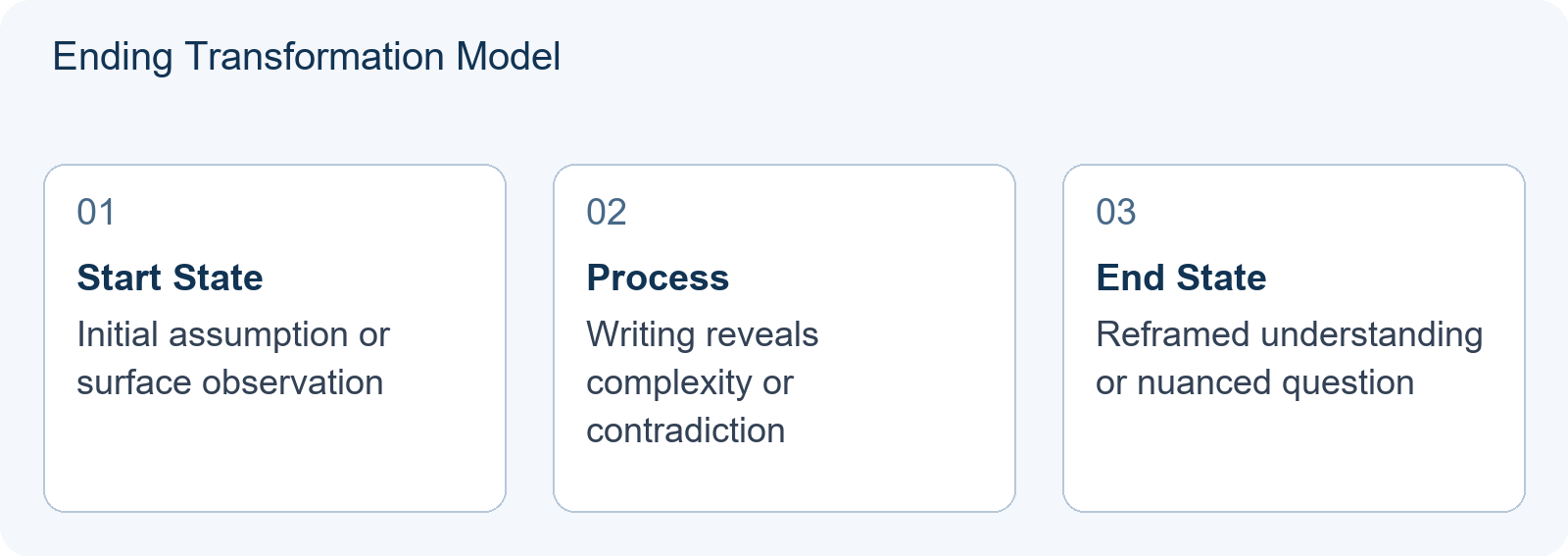
The mechanism is a specific gap: the distance between an initial assumption and a revised understanding. The writer does not need to contradict the opening, but must complicate it. If the opening presents a certainty, the ending should introduce a nuance, a doubt, or a reframe that the writer could not have articulated before drafting.
However, this is one craft technique among several valid approaches. Restatement can work when it adds resonance or emotional weight; emotion is not inferior to cognition. There is no universal rule that discovery always wins, application always loses, or the last third must contain a transformation across all genres. The memoir genre, for instance, requires truthful actual experience, and an ending that deepens emotional truth rather than cognitive insight can be equally effective.
Worked Teaching Illustration: The Micro-Memoir Shift
[Teaching illustration: hypothetical example constructed for craft analysis, not a contest submission.]
Prompt context: My Tiny Memoir. A student writes about her grandmother’s hands, which she once found embarrassing for their roughness.
Opening state (first sentence): “My grandmother’s hands were maps I did not want to be traced by.”
Weak ending (summary): “Now I love her hands because they show hard work.” This restates the plot and adds a moral. The reader learns nothing new.
Strong ending (change in understanding): “The last time she pressed my palm, I felt the ridge of her scar not as history but as prediction—my own hands are already learning that shape.”
Verification: The ending introduces a concept absent from the opening: the scar as “prediction” rather than “history.” The writer’s understanding has shifted from rejection (not wanting to be traced) to recognition of inevitable inheritance. The arithmetic of the shift: opening = distance from grandmother; ending = identification with grandmother. The gap is the change.
Contrasting Case: The False Shift
A superficially similar approach fails when the ending adds emotion without adding insight. Consider this attempted ending for the same memoir:
False shift: “Those hands taught me that love is deeper than appearances, and I will always carry that lesson.”
This sounds reflective but performs no work. “Love is deeper than appearances” is a generic claim the writer could have stated in the first sentence. There is no gap between opening and closing; only a sentiment has been added. Judges encounter this pattern frequently in school-influenced entries, where students have been trained to conclude with a moral. The result reads as performance rather than discovery.
The diagnostic difference: in the worked illustration, the writer discovers something during the piece (the scar as prediction). In the false shift, the writer applies a pre-existing belief (love matters most). Discovery is contest-winning; application is not.
Three Valid Endings for Different Purposes
Different contest forms and personal objectives call for different ending strategies. Here are three valid approaches with selection guidance:
Ending A: The Cognitive Reframe (Change in Understanding)
Best for: Open Letters, Summer Reading Contest, analytical pieces where the writer began with a fixed position.
How to choose: Use when your drafting process genuinely complicated your view. If you started certain and ended uncertain, or started narrow and ended expansive, this ending serves the material.
Ending B: The Emotional Resonance (Deepened Feeling)
Best for: My Tiny Memoir, personal narratives where the experience itself is the subject and the writer’s emotional truth is the discovery.
How to choose: Use when the piece’s purpose is to make the reader feel rather than think, and when the ending amplifies a specific sensory or emotional detail introduced earlier without merely repeating it.
Ending C: The Generative Question (Opened Inquiry)
Best for: STEM Interview reflections, artist statements, pieces where the writer wants to invite continued thinking rather than deliver a conclusion.
How to choose: Use when the material resists closure, when the honest position is uncertainty, and when the question itself represents the intellectual progress.
Select based on what actually happened during your drafting, not what you think judges prefer. A forced cognitive reframe in a memoir that actually yielded emotional truth will read as inauthentic.
Diagnostic Application: The First-Last Gap Test
Apply this test to any draft before submission:
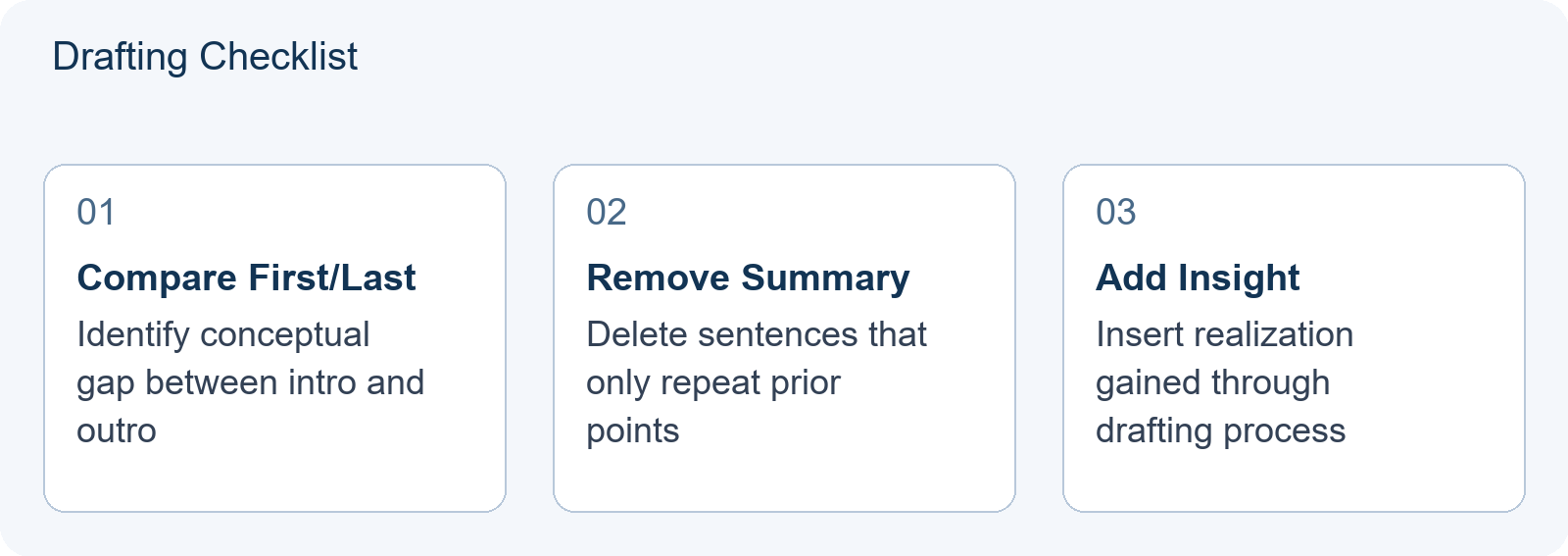
Step 1: Isolate the first sentence and the last sentence.
Step 2: Ask: does the last sentence contain a concept that the first sentence could not have been written to include?
Step 3: If yes, verify that the concept is not merely emotional (“I felt sad”) but cognitive (“I realized,” “I now see,” “the question became”).
Questions about the contests?
Scan the WeChat QR code — we help with contest registration, one-on-one topic coaching, and full guidance to the deadline.
Scan the WeChat QR code

Example application to a Summer Reading Contest entry:
First sentence: “I chose the article on phone bans because I use my phone too much.”
Last sentence A (fails): “Phone bans are complicated, and schools should find a balance.” → The first sentence could have ended here. No gap.
Last sentence B (passes): “The student who said she felt ‘relieved’ by the ban made me notice my own relief was performative—I say I want less screen time, but I have not practiced the boredom that replaces it.” → The first sentence contains no concept of “performative relief” or “practiced boredom.” The gap is genuine.
Interpreting Results: Your Next-Step Decision
If your draft fails the gap test, you face a decision, not a revision problem. The decision tree:
Option A: The gap exists but is hidden. You discovered something while writing but buried it in the middle. Solution: excavate the discovery and move it to the final sentence, then recalibrate the opening to create tension.
Option B: No discovery occurred. You wrote to confirm what you already believed. Solution: return to your source material (the NYT article, the personal experience, the interview) and locate a detail that contradicts your opening assumption. Build the ending from that contradiction.
Option C: The discovery is emotional, not cognitive. You felt differently but did not think differently. Solution: convert the emotion into a question or a reframe. Instead of “I felt sad,” try “The sadness was not grief but recognition—what I was mourning had already ended before I named it.” Alternatively, recognize that an emotional ending (Ending B above) may be the honest choice for this piece.
Choose one option before your next drafting session. Do not proceed with line-editing until the decision is made.
Preparation for Specific 2026-27 Contests
The Visual Art Contest requires an artist statement where the ending must explain how creating the piece altered your view of “What It’s Like to Grow Up in 2026.” Apply the gap test to your statement’s first and last sentences. Note that the artist statement requirement is specific to this contest; not all NYT contests require supplementary text.
For the STEM Interview Video Contest, the closing statement in your two-minute video should reflect how the expert’s answer complicated your initial question, not merely summarized it.
The Summer Reading Contest uses Google Docs with version history for written submissions; this feature can help you observe whether your ending genuinely evolved or was pasted in from a pre-planned conclusion. This requirement is specific to the Summer Reading Contest and does not apply to all written submissions across NYT contests.
Related Preparation Resources
For broader revision techniques that preserve voice while cutting material, see NYT Student Writing Revision: Cutting Repetition Without Losing Your Voice. If your ending problem is actually a structural problem with paragraph order, consult The Shape of a Short Contest Entry: Paragraph Order, Breaks and the Middle That Loses Readers (2026). For the specific challenge of writing required text when you identify as a non-writer, see NYT Visual Art Contest Artist Statement: Writing the Required Text When You Are Not a Writer.
Interpreting the Shift: A Reader’s Diagnostic
The difference between a “false shift” and a genuine change in understanding is not just stylistic; it is structural. To verify if your ending works, you must simulate the reader’s experience of the gap. This diagnostic moves beyond checking for new words to checking for new relationships between ideas.
Step 1: The Substitution Test
Take your final sentence and replace it with a generic summary of your opening premise. For example, if your memoir opens with “I feared my grandmother’s rough hands,” and your ending is “Now I see them as maps of her life,” try replacing the ending with “I learned that hard work leaves marks.” If the piece still makes sense but feels flat, your original ending may have been merely descriptive, not transformative. A true change in understanding should make the substitution feel like a loss of specific insight.
Step 2: The Conceptual Gap Check
Identify the core noun or verb in your first sentence and your last sentence. In the teaching illustration, the opening focuses on “maps” (static history) and the closing shifts to “prediction” (dynamic future). Ask: Does the final concept require the entire body of the text to exist? If you could write the final sentence without writing the middle paragraphs, the ending is disconnected. If the final sentence collapses the distance created by the narrative arc, the ending is integrated.
Step 3: The Emotional vs. Cognitive Audit
Determine whether your shift is emotional (feeling differently) or cognitive (thinking differently). Both are valid, but they serve different purposes. An emotional shift might move from “anger” to “acceptance.” A cognitive shift moves from “judging appearance” to “recognizing inheritance.” If your goal is to persuade an Open Letters judge, a cognitive reframe often carries more weight because it demonstrates analysis. If your goal is to connect in My Tiny Memoir, an emotional deepening may be more authentic. Do not force a cognitive conclusion onto an emotional narrative, as this creates the “false shift” described earlier.
Concrete Practice Task: The Reverse Outline
To apply these diagnostics before your next revision session, perform a reverse outline of your draft. This method reveals whether your ending actually resolves the tension established in the beginning.
Action: Write down the main idea of each paragraph in one sentence. Then, look at the first and last sentences of your entire piece. Draw a line connecting them. Now, ask: What specific detail in the middle paragraphs supports the connection between those two points?
If the line is thin or relies on a cliché (e.g., “time heals all wounds”), your ending is unsupported. You must either strengthen the middle section with concrete evidence that leads to the new understanding, or revise the ending to reflect what the middle section actually proves. This task ensures that your final sentence is not an isolated declaration but the inevitable result of the preceding argument or narrative.
For students preparing for the upcoming Visual Art Contest artist statements, this reverse outline is particularly useful. Since the statement must explain how the creation process altered your view, the “middle” of your statement should detail the specific artistic choices that forced the change in perspective, rather than just stating the final outcome.
Frequently Asked Questions
Can I use a question as my ending if I haven’t reached a full understanding?
Yes, if the question represents a genuine cognitive shift from your opening position. A question that the opening could not have asked—because the drafting process exposed the complexity—is a valid change in understanding. Avoid rhetorical questions that merely restate your theme. This corresponds to Ending C (Generative Question) in the article’s framework.
How do I create a change in understanding in only 100 words?
Use the first sentence to establish a narrow, specific assumption, not a broad topic. Reserve the final sentence for the reframe. In a 100-word memoir, the middle sentences should bridge concrete detail to the final abstraction. The worked illustration in this article demonstrates this compression. However, also consider whether an emotional resonance ending (Ending B) might better serve your actual material.
Does this method apply to the podcast and video contests?
Yes, but the ‘ending’ may be your closing narration or final reflection rather than a written sentence. The same gap test applies: does your outro contain a concept absent from your introduction? For the STEM Interview Video Contest, this often means reflecting on how the expert’s answer complicated your initial assumption. Choose between cognitive reframe, emotional resonance, or generative question based on what actually happened in your creative process.