When you need to cut a quotation to fit the tight word limits of a New York Times student contest—100 words for a personal narrative, 250 for a summer reading response, 450 for a guest editorial—every removed phrase risks changing what the speaker actually meant. The challenge is not merely mechanical deletion. You must preserve the original intent while making the quote serve your own argument. This article works through a concrete method for doing exactly that, with checked examples and a contrasting case where a superficially similar approach collapses.
Why Quote Trimming Matters More in Short-Form Contests
The New York Times Learning Network contests operate under strict length constraints that professional journalists rarely face. A standard newspaper feature might quote a source at leisure. A student entrant must often choose between paraphrasing—which loses the speaker’s voice—or quoting selectively—which risks misrepresentation. The 2026-2027 contest calendar emphasizes that judges evaluate “originality” and “personal connection” alongside “material close reading” (NYT Summer Reading Contest 2027: How the Three-Round Format Changes Your Preparation Strategy). A mangled quote destroys both close reading credibility and personal voice.
The specific problem: you have a source’s statement that contains three ideas, but your word count allows only two. Or the original contains a qualifying clause that, if included, breaks your sentence rhythm without adding meaning. Or the speaker meanders before arriving at the point. How do you excise material without committing what journalists call “contextual fraud”?
The Core Mechanism: Three-Filter Selection
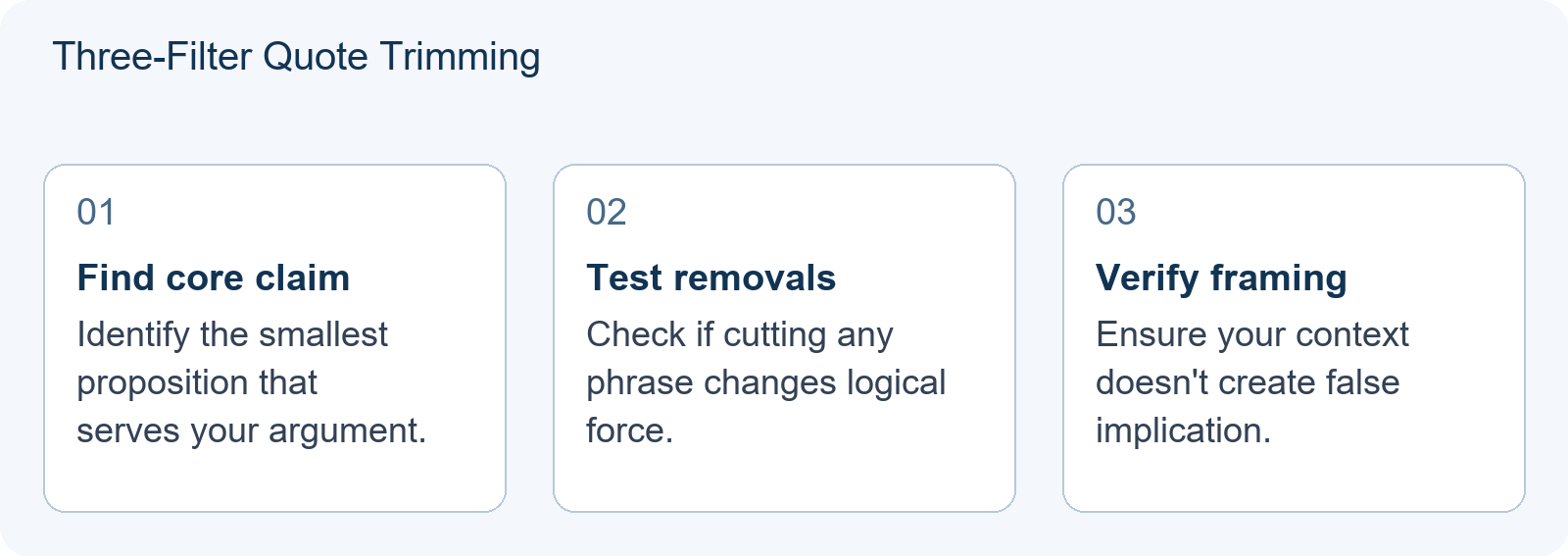
Effective quote trimming applies three sequential filters: (1) identify the irreducible proposition, (2) test whether removal of any remaining material changes the proposition’s logical force, and (3) verify that your remaining text does not create a false implication through juxtaposition with your own framing. This is not mere intuition. Each filter can be checked.
Filter one asks: what is the smallest claim the speaker is making that serves your purpose? Filter two asks: if I remove phrase X, does the speaker’s position become stronger, weaker, or different in kind? Filter three asks: does my surrounding sentence create an implicature that the original context did not support? Only after all three filters pass should the trimmed quote appear in your entry.
Worked Teaching Case: The Climate Scientist’s Interview
[Fictional teaching illustration.] A climate scientist says in a video interview: “I think the most urgent thing, and I’ve been saying this for years even though some colleagues disagree, is that we need to stop building in floodplains—not because we can’t engineer solutions, we absolutely can, but because the social cost of repeated displacement outweighs any technical benefit, and that’s a conversation policymakers keep avoiding.”
The student wants to use this in a 250-word summer reading response about infrastructure priorities. The full quotation is too long for the intended space. The student needs it under 20.
Step 1: Identify the irreducible proposition. The scientist’s core claim: stopping floodplain construction is more important than engineering solutions, because displacement costs exceed technical benefits. The “I’ve been saying this for years” and “some colleagues disagree” are credibility markers, not logical content. The “we absolutely can” [engineer solutions] is a concession that must be preserved; removing it would make the scientist appear anti-technology rather than pro-priority. The “conversation policymakers keep avoiding” is a secondary accusation, not the primary claim. Because the student is writing about infrastructure priorities, not engineering feasibility, the concession can be retained with a brief framing note rather than excised.
Step 2: Apply the three filters. Filter one yields: “we need to stop building in floodplains […] because the social cost of repeated displacement outweighs any technical benefit.” Filter two: the concession “not because we can’t engineer solutions, we absolutely can” must be tested—does its removal change the proposition’s force? Yes: without it, the scientist appears to deny engineering feasibility. The student must retain this or use a framing phrase like “While engineering solutions exist, [quote].” For this 250-word response, the student chooses to paraphrase the concession: “The scientist, acknowledging that engineering solutions are possible, argues that…” This preserves the speaker’s position. Removing “and that’s a conversation policymakers keep avoiding” leaves the core claim intact. Filter three: the student’s surrounding sentence is “Engineers often focus on stronger seawalls, but [quote].” This framing does not create a false implication; it accurately reflects the scientist’s priority.
Step 3: Verify the trimmed version. One finished sentence is: Acknowledging that engineering solutions are possible, the fictional scientist argues that “the social cost of repeated displacement outweighs any technical benefit.” The quotation is a continuous excerpt of the original; the concession is accurately paraphrased outside the quotation marks. The result preserves the priority argument and does not portray the speaker as denying engineering feasibility. Check the whole sentence against the source before counting its words.
Contrasting Case: Where the Same Method Fails
[Teaching illustration.] A politician says: “I support the bill, though I have reservations about Section 4, and I hope we can amend it before final passage.” A student writing a 450-word editorial wants to show bipartisan support. They apply filter one: the irreducible proposition is “I support the bill.” They consider removing the reservation and hope for amendment.
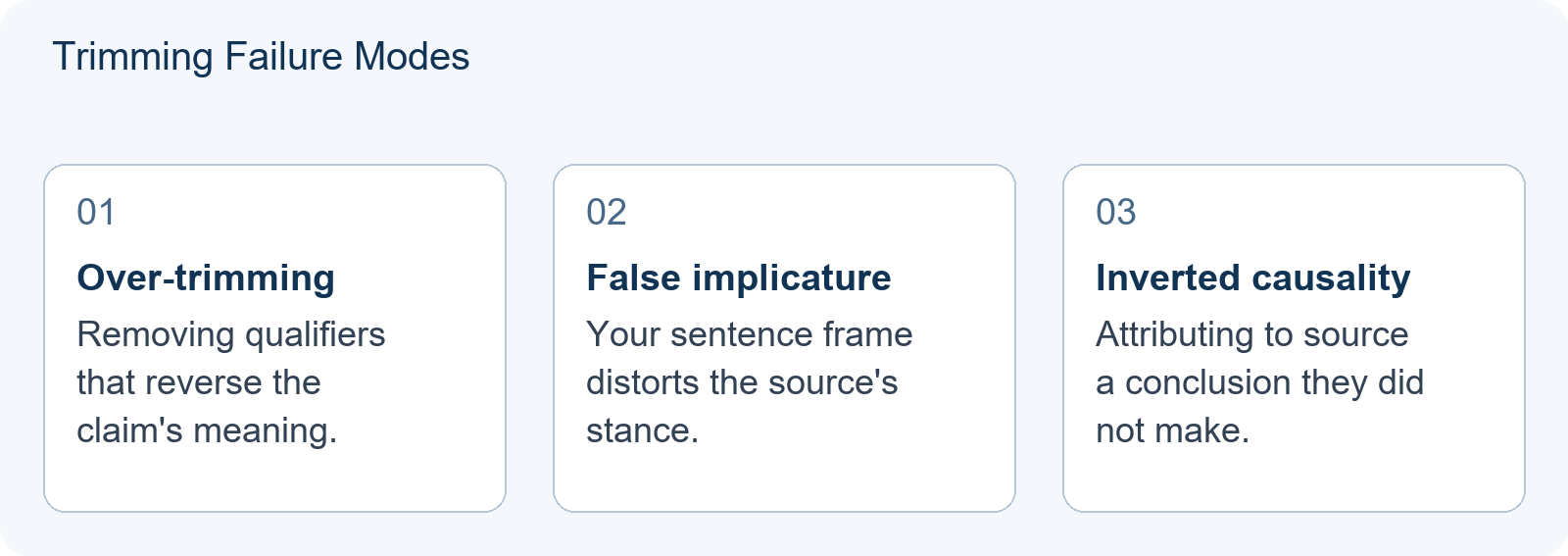
Filter two fails: removing “though I have reservations about Section 4” changes the logical force from qualified to unconditional support. The student must retain this qualifier or use a framing phrase that acknowledges it. Filter three also fails: the student’s intended framing—”unexpected supporters”—could be read as unconditional backing if the reservation is omitted. The original “though I have reservations” explicitly denies this. Even if the quote itself contains only genuine words, the juxtaposition with the student’s framing creates an implicature that the original context refutes. This risks misrepresenting the speaker.
The student attempted to save words by removing a concession and mischaracterized the speaker’s position. The contrasting case demonstrates that filter three—testing your own framing, not just the quote itself—is where an otherwise accurate excerpt can become misleading, and that filter two requires preserving qualifiers that change a claim’s logical force.
Practical Application: Diagnostic Exercise
Test your own trimming with this passage, written solely as a fictional teaching illustration: “The problem with standardized testing isn’t that tests measure nothing; they measure something quite precisely. The problem is that what they measure—test-taking skill, socioeconomic advantage, parental education level—is so confounded with actual learning that we can’t disentangle the two, and pretending we can has warped entire school systems.”
Task: trim to under 25 words for a 100-word personal narrative about a testing experience. Before reading the suggested answer, apply the three filters yourself.
Suggested answer: Acknowledging that tests measure some things precisely, the fictional speaker says those measures are “so confounded with actual learning that we can’t disentangle the two”. This short quotation is a continuous excerpt; its surrounding paraphrase preserves the concession. The two refers to the measured factors and actual learning, so the preceding sentence must make both clear. A compact quotation still needs enough context to remain intelligible. Do not silently delete a word inside an excerpt or join separated fragments without marking the omission.
Common wrong answer: “Standardized testing has warped entire school systems.” This fails filter two: the original speaker did not claim testing itself warped systems; they claimed the pretense of disentanglement did. The wrong answer inverts causality and intensifies the claim beyond what the source supported.
Questions about the contests?
Scan the WeChat QR code — we help with contest registration, one-on-one topic coaching, and full guidance to the deadline.
Scan the WeChat QR code

What the Diagnostic Result Means for Your Next Step
If you produced the correct trimmed version, your next learning task is speed: applying the three filters under contest conditions, with sources you did not choose. If you produced the wrong version, your task is conceptual: you are conflating the speaker’s conclusion with your own, a habit that Unlearning the School Essay: The IB and AP Habits That Sink a NYT Contest Entry (2026-27). The feedback you need is not “be more careful” but specific practice distinguishing a source’s exact claim from its plausible extensions.
For students preparing NYT contest entries, the practical next step is to collect five quotations from your intended source material, trim each to one-third length using the three filters, then have a peer or mentor apply the How to Get Useful Feedback on a Contest Entry — and What to Ignore to identify any implicature failures. This is preparation, not prediction; no method guarantees contest success, but systematic quote trimming prevents self-inflicted credibility wounds.
Related Preparation Resources
For adjacent skills in NYT contest writing, see our guides on How to Cut 40% From a Contest Entry Without Losing the Argument (2026), Quoting a Chinese-Language Source in an English Contest Entry: Translation, Names and Attribution (2026), and Writing About a Crowded Topic: How to Enter a NYT Contest on AI, Climate or Phone Bans and Still Get Read (2026). These address complementary challenges in the same contest ecosystem.
The New York Times Learning Network contests are organized by The New York Times Company; this article represents independent preparation analysis and is not affiliated with or endorsed by the organizer. Contest rules and deadlines for 2026-2027 are subject to official update; verify current requirements at the Learning Network website before submission.
Interpreting the Trimmed Quote: The Reader’s Perspective
Once you have applied the three filters and produced a trimmed quotation, your work is not finished. You must now simulate how a reader—specifically a contest judge encountering your entry for the first time—will interpret that quote in isolation. This step addresses a critical gap: the difference between your understanding of the source’s intent and the reader’s inference from the text on the page.
Consider the climate scientist example again. After trimming to “we need to stop building in floodplains because the social cost of repeated displacement outweighs any technical benefit,” ask yourself: Does this sentence, standing alone within your paragraph, sound like an absolute prohibition? Or does it sound like a prioritization argument?
In the original interview, the speaker explicitly conceded that engineering solutions are possible (“we absolutely can”). By removing this concession, you have removed the nuance that the scientist is not anti-technology, but pro-priority. A reader who sees only the trimmed quote might infer that the scientist believes engineering is useless or impossible. If your surrounding text argues for better engineering, this creates a contradiction. If your text argues against engineering entirely, you have misrepresented the source by making them appear more radical than they are.
Diagnostic Exercise: The Implicature Check
Test your interpretation skills with this hypothetical scenario based on the politician case discussed earlier. Suppose a student writes: “Senator Smith stated, ‘I support the bill.’ This shows strong backing for the legislation.”
Task: Identify the specific logical error in the student’s framing. Is it a factual error about the words spoken? No. Is it a contextual fraud? Yes. Why?
Answer: The error lies in the phrase “strong backing.” The word “strong” implies enthusiasm or unconditional support. As established, the Senator’s actual position was qualified and conditional. The student has used a true quote to support a false characterization of the speaker’s attitude. The fix is not to change the quote, but to change the framing: “Senator Smith expressed support for the bill, albeit with reservations about Section 4.” This preserves the truth of the support while accurately reflecting its nature.
Concrete Next Practice Task
To build this skill, perform the “Blind Read” test on your own drafts. After trimming a quote, copy your paragraph into a new document without looking at the original source material. Read it aloud as if you were a stranger. Ask two questions:
- Does the quoted person seem to hold the exact view I am attributing to them?
- If I added one qualifier back into the quote, would my argument collapse or just become more nuanced?
If adding a qualifier collapses your argument, your argument was likely built on a misrepresentation. If it becomes more nuanced, your argument is stronger because it is honest. This practice ensures that your quotations serve as evidence of close reading, not just decoration.
Frequently Asked Questions
Can I use ellipses to shorten quotes in NYT contests?
In very short word limits, ellipses consume space and often signal sloppy trimming. The three-filter method usually produces cleaner integration without them. If you use ellipses, ensure the omitted material does not contain negations or qualifiers essential to the original meaning. Mark all non-contiguous omissions explicitly; do not silently stitch separated passages into seamless quotes.
How do I handle a source that contradicts itself within the same sentence?
Do not trim away the contradiction to make the source neater. Either quote the full contradiction with your own analysis, or choose a different source. Presenting half a contradiction is a form of misrepresentation that judges can detect even in short entries. Preserve all qualifiers that contextualize the speaker’s position.
Does the NYT contest judge check my sources for accuracy?
Official judging criteria emphasize originality and close reading; the structural credibility of your entry depends on accurate quotation regardless of external verification. Inaccurate quotes weaken your argument’s internal logic. Maintain verifiable quotations from the start. This article’s teaching illustrations are fictional and labelled as such; always use actual sources in your contest entry.