If your best source is in Chinese, your advantage is real and your risk is specific: the quotation arrives in English with nothing around it a reader can check. This guide covers the three jobs that solve that — translating the sense and labelling the translation, handling names and terms on first and second reference, and writing an attribution line strong enough to carry a source your reader cannot open.
Why this problem lands on China-based writers first
Most contest advice assumes your sources are in the same language as your entry. For students at international schools in China, the most interesting material frequently is not: a provincial newspaper report, a school notice pinned to a wall, a public-account post that circulated for two days, a grandparent's account of something that happened before you were born. That access is a genuine competitive asset. Very few entrants in a large field can reach it.
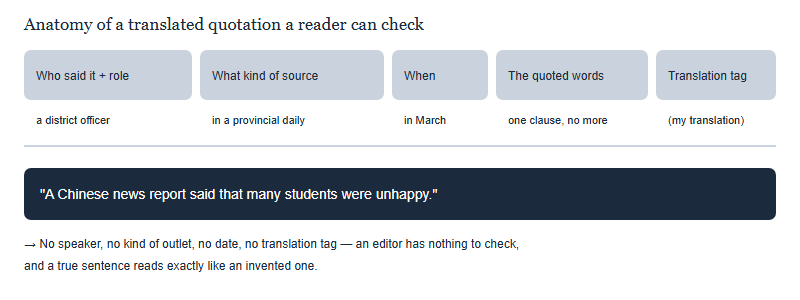
The failure mode is not bad translation. From our own editing of drafts by China-based students, the sentence that costs the writer is almost always structurally identical: “A Chinese news report said that many students were unhappy with the new policy.” Every word may be true. But there is no speaker, no outlet, no date, and no signal that a translation happened at all. A reader who wants to trust it has nothing to hold.
Two scope notes before the method. First, this is not a general citations guide: it is about the specific mechanics of moving a non-English source into an English entry. Second, whether a contest asks for a source list at all, and whether that list sits inside or outside the word limit, varies by contest and by year. Never assume, and never carry a rule over from a different competition — the answer is on the announcement page for the contest you are entering, and you should confirm it on nytimes.com/learning. If you are still choosing which contest suits your material, our overview of the Learning Network writing contests sets out the forms.
Translate the sense, then label the translation
Four rules, in order of how often students break them.
- Translate meaning, not word order. A literal rendering usually reads as stilted English and, worse, quietly changes the register. If the original is a blunt official sentence, your English should be blunt and official. If it is someone speaking casually, it should sound like speech. Ask what a careful English speaker would have said in that situation, then write that.
- Label it. Say plainly that the English is yours: “my translation,” or “translated from the Chinese.” Pick one convention and use it across the whole entry so a reader is never guessing which quotations were originally English. A single label near the first translated quotation, plus consistency afterwards, is usually enough for a short piece.
- Never put a paraphrase inside quotation marks. This is the line that separates a translated quotation from a fabricated one. If you are compressing, summarising or smoothing, drop the quotation marks and attribute the sense instead: the notice told parents the change would take effect immediately. Quotation marks are a promise that these are the words; a translation is already an interpretation, so do not stack a second one on top of it.
- Quote the shortest span that carries the point. Good practice on its own — long quotations are where short entries go to die — and it also keeps you well clear of reproducing substantial chunks of someone else's copyrighted text. Quote a clause where a clause will do.
One shortcut worth knowing: many ministries, universities, large outlets and international schools publish an official English version of the same document. If one exists, quote that version and say you are quoting it. You gain a source your reader can open, and you lose the translation question entirely.
Names, terms and the second-reference problem
This is where short entries lose words they cannot spare. Five decisions, each of which you make once and then apply mechanically.
- Romanisation. In running English prose, use pinyin without tone marks unless the contest asks otherwise. Tone marks are correct in a linguistics paper and distracting in a short contest entry. Whatever you choose, apply it to every term in the piece.
- Name order. Chinese names put the family name first, which means an English reader may not know which part is which. Decide once whether you are keeping the original order or inverting it, then signal the family name clearly on first mention so second reference is unambiguous. Then use the family name only. Do not switch systems halfway through, and do not silently invert one name and not another.
- Characters in the submission box. Do not assume a web form will accept or correctly render non-Latin characters, and do not discover this at the deadline. If including characters matters to your piece, test it and confirm the current submission requirements on nytimes.com/learning; if you are unsure, romanise and gloss instead. Nothing in a short entry is worth risking a mangled field for.
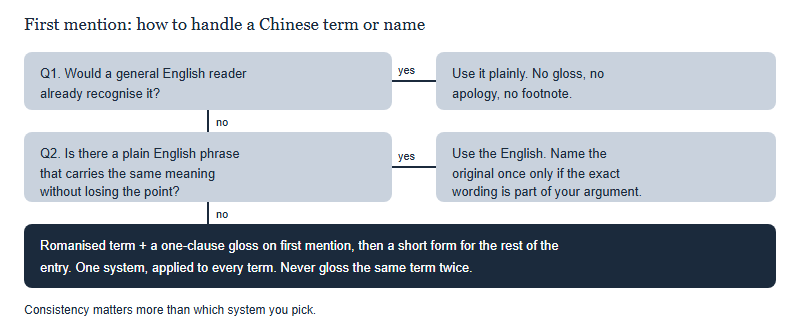
- Gloss once, in one clause. The commonest waste in these drafts is a two-sentence explanation of a term that the argument uses exactly once. One clause: the gaokao, China's university entrance examination, and move on. If a term needs a paragraph of setup, ask whether the entry actually needs the term.
- Never re-gloss. Explaining the same term twice tells the reader you have lost track of your own piece. First mention full, every mention afterwards short.
Attribution when your reader cannot open the source
An English-language reader can usually check your source themselves. With a Chinese-language source, they typically cannot, so your attribution has to do the work their click would have done. A strong line carries four things: who is speaking, what kind of source this is, when it appeared or was said, and how you came by it.
The “what kind of source” clause is the one drafts skip and the one that does the most work. “A newspaper” and “a provincial party newspaper” and “an education-industry trade site” and “a parent group chat” are four different kinds of evidence, and the reader is entitled to know which they are being offered. Naming the category is not hedging; it is the single cheapest way to sound like someone who knows what they are handling.
Questions about the contests?
Scan the WeChat QR code — we help with contest registration, one-on-one topic coaching, and full guidance to the deadline.
Scan the WeChat QR code

| Source type | What your attribution should carry | What to check before you use it |
|---|---|---|
| National or provincial newspaper report | Outlet and what kind of outlet it is, the month, the role of anyone quoted, and that the English is your translation | Whether an official English edition exists; whether the piece is reporting or commentary |
| School or district notice | Who issued it, to whom, when, and where you read it (posted, emailed, app) | That you are quoting the current version; keep a dated copy or photograph |
| Public-account post or social feed | Who runs the account and in what capacity, the date, and the date you read it | Whether the account is official, commercial or personal; posts can be edited or removed |
| Short video with subtitles | Who is speaking, where it was published, when, and whether you are translating the speech or the subtitles | That the subtitles match the speech; auto-generated captions are not a source |
| Interview with a relative, teacher or neighbour | Their relationship to the subject, that it was an interview, and roughly when it took place | Their permission, and how much identifying detail they are comfortable appearing in print |
| Official English version of a Chinese document | The issuing body, the document, and that you are quoting the published English text | That the English version says what the original says; note any difference rather than hiding it |
Three edge cases worth deciding in advance. Sources who should not be named. If naming someone would expose them, describe them by role and say why you are withholding the name, in a clause: a teacher at the school, who asked not to be identified. Never invent a fake name for a real person. Posts that disappear. Say when you saw it, and keep a dated screenshot for yourself; a source that has since been deleted is still usable if you are honest about the timeline. Family stories. Attribute the person and the fact that this is memory rather than record — memory is legitimate evidence when it is labelled as memory and dishonest when it is dressed as documentation.
Five lines to run before you submit
Do this as a separate pass, after the writing is finished and before you paste anything into a form. It takes about fifteen minutes.
- Highlight every quotation mark. For each pair, confirm those are words someone actually said or wrote, not your compression of them. If in doubt, remove the marks and keep the attribution.
- Check that every translated passage is labelled once and consistently. A reader should never have to wonder whether a given sentence started in English.
- Read your attribution lines alone, out of context. Each should answer who, what kind, when. If one of the three is missing, the sentence is not finished.
- Search your own draft for each romanised term. Confirm one spelling throughout, one gloss at first mention only, and short forms afterwards.
- Open the contest page. Confirm the word limit, whether a source list is wanted, whether it counts against the limit, and the deadline in your own time zone. Then check the contest calendar if you are lining up more than one entry this season.
One closing note on form. Some pieces are stronger when the source is not quoted at all but addressed. If your material is a notice, a rule or a decision made by an institution, writing to that institution can carry the quotation more naturally than writing about it — which is what makes the Open Letters Contest a useful container for exactly this kind of evidence. The translation and attribution discipline does not change; only the direction of address does.
Frequently asked questions
Do I need to include the original Chinese text?
Usually no. Romanise names and terms, gloss once, and check whether the submission form accepts non-Latin characters before you rely on it.
How should I label a translation I made myself?
Say so plainly, for example my translation, and keep one convention across the whole entry so a reader is never guessing.
Can I quote a public-account post or a short video?
Yes, if you describe what kind of source it is, when you saw it, and who is speaking. Vagueness is the problem, not the platform.
Do sources count toward the word limit?
It varies by contest and by year. Never assume: the answer sits on the announcement page for the contest you are entering.
This is an independent guide operated by Hanlin Education for China-based international-school students. It is not affiliated with, endorsed by, or sponsored by The New York Times Company or its Learning Network. Contest rules, word limits, eligibility and deadlines change from year to year — confirm current details on nytimes.com/learning before you enter. Errors are corrected within 7 working days of being reported.