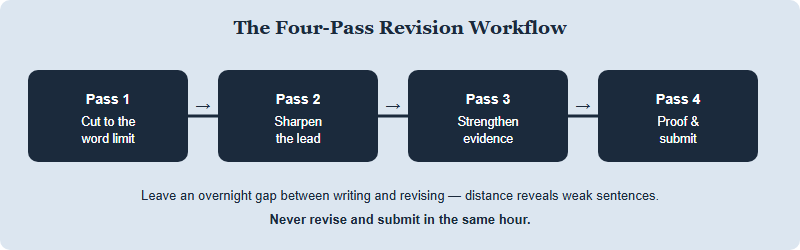
To revise a NYT Learning Network contest entry, work in four passes, not one: (1) cut your draft to the exact word limit by deleting weak sentences first; (2) rewrite the lead so it earns attention in one move; (3) verify every piece of evidence is specific, sourced, and doing real work; (4) proofread mechanics and confirm you can submit before the U.S. Pacific Time deadline. Revision is where most entries are won or lost — the first draft only gets you a candidate.
Why revision matters more than the first draft
The New York Times Learning Network runs roughly a dozen free student contests each school year for writers ages 13–19 worldwide. Most have tight ceilings — the My Tiny Memoir personal-narrative contest caps entries at 100 words, and opinion writing such as Open Letters sits in the 450–500-word range. A short ceiling is not a smaller version of a long essay; it is a different discipline. Every word has to earn its place, and that pressure is resolved almost entirely in revision.
This guide is a craft and process walkthrough, not a contest overview. If you still need to choose a contest or check the schedule, start with What Are the NYT Writing Contests and the contest calendar. If you want to understand the criteria reviewers apply, read what judges look for before you revise — you cannot revise toward a target you have not defined. Always confirm the exact rules, dates, and word counts of your specific contest on the official Learning Network site, because limits and formats change year to year.
One first-party note we give every China-based student we coach: a draft you finished a week ago beats a draft you finished an hour before the deadline, because revision needs distance. The single biggest avoidable mistake we see is no gap between writing and revising. Build at least one overnight gap into your plan.
Pass 1 — Cut to the exact word limit
Word limits in these contests are firm. An entry over the cap can be disqualified, so cutting is not optional — it is the first job. The mistake most students make is trimming evenly, shaving a word here and there until the piece is bland everywhere. Cut structurally instead: remove whole sentences that repeat a point, then tighten what remains.
Work in this order, deleting from the top of the list until you hit the ceiling:
- Throat-clearing openers. “In today’s society,” “Since the beginning of time,” “It is important to note that” — delete on sight. Start at the real sentence.
- Sentences that repeat a point you already made. Keep the stronger version; cut the echo.
- Adverbs and intensifiers that add heat but no meaning: very, really, truly, extremely, definitely.
- Hedges that weaken your argument: I think, in my opinion, sort of, maybe. In an opinion contest, owning the claim is the point.
- Long wind-ups to a quote or fact. “According to a study that was conducted by researchers who found that…” becomes “A 2024 study found…”.
After structural cuts, run a phrase-tightening pass. The table below shows the kind of swaps that recover 20–40 words from a typical draft — often the difference between fitting and not fitting in a 100- or 450-word entry.
| Wordy phrase | Tightened | Words saved |
|---|---|---|
| due to the fact that | because | 3 |
| in order to | to | 2 |
| at this point in time | now | 4 |
| has the ability to | can | 3 |
| a large number of | many | 3 |
| despite the fact that | although | 3 |
| make a decision | decide | 2 |
| in the event that | if | 3 |
For non-text formats the same logic applies to time, not words. The Audio Stories podcast contest works to a short ceiling (commonly stated as around five minutes — confirm on the official site), and the Voice and Choice summer reading contest accepts a short written response or a brief video. For audio and video, “cutting” means removing pauses, restarts, and filler (“um,” “so basically”), and trimming any setup before your real first line.
Pass 2 — Sharpen the lead
Reviewers read a large volume of entries. The opening lines decide whether yours is read closely or skimmed. A strong lead does one thing: it earns attention honestly, without a gimmick, and points straight at your central idea. According to the criteria most often described for these contests, judges reward an opening that “earns attention and a shape that serves the idea” — so the lead is not decoration, it is structure.
Diagnose your current opening against four common lead types, then choose deliberately rather than defaulting to the first one you wrote:
| Lead type | What it does | Best for | Risk |
|---|---|---|---|
| Concrete moment | Drops the reader into a specific scene | Personal narrative, profile, coming-of-age | Can stall if the scene has no stakes |
| Surprising fact | Opens with a precise, verifiable number or detail | STEM writing, editorial, review | Disqualifying if the fact is wrong |
| Direct claim | States your position in one confident sentence | Open Letters, editorial | Flat if there is no tension behind it |
| Tension / question | Names a real conflict the piece will resolve | Most formats | Cliché if the question is generic |
A practical test: cover your first two sentences and read from sentence three. If the piece is stronger without them, those sentences were a runway, not a lead — delete them. Then make sure your real opening contains something only you could have written: a specific detail, a particular stake, an angle a generic essay would miss.
Pass 3 — Strengthen the evidence
Reviewers consistently reward evidence that is “specific, cited or concrete support that does real work, not decoration.” This is the pass international students most often underuse, because it is tempting to keep general claims that feel safe. They are not safe — they are forgettable. Some contests are explicit about sourcing: Open Letters, for example, has in past years asked entrants to support the argument with credible evidence including at least one Times source and one non-Times source. Confirm your contest’s exact sourcing rule on the official site.
Questions about the contests?
Scan the WeChat QR code — we help with contest registration, one-on-one topic coaching, and full guidance to the deadline.
Scan the WeChat QR code

For each claim in your draft, run this evidence audit:
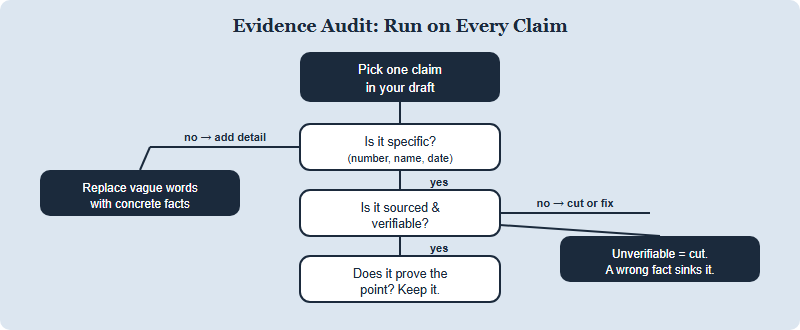
Three moves strengthen weak evidence fast: (1) replace a vague quantity (“a lot of students”) with a real one (“more than half of my grade”); (2) attribute facts cleanly (“a 2024 Times report” beats “studies say”); and (3) cut any statistic you cannot trace to its source — an unverifiable or wrong number can sink an otherwise strong entry, so when in doubt, remove it rather than guess. For narrative and profile contests, “evidence” means sensory and observed detail: the exact thing someone said, the specific object on the desk, the real moment — not a summary of feelings.
Pass 4 — Final proof and submission
The last pass protects the work you have already done. Read the piece aloud once — your ear catches dropped words, run-ons, and clumsy rhythm that your eye skips. Then run a fresh-eyes mechanical check and, critically, a logistics check, because for international entrants the submission window is the most common point of failure.
Deadlines for these contests are set in U.S. Pacific Time. For students in China, that is a real gap: a deadline listed for the end of a day on the U.S. West Coast falls in the middle of the next afternoon in Beijing, and forgetting daylight-saving shifts has cost entrants their submission. Convert the closing time to your local clock and aim to submit a full day early. Use this final checklist:
- Word/length count is at or under the official limit (re-check after every edit).
- Read aloud done — no dropped words, no sentence you stumble over.
- Spelling and grammar clean; names, places, and titles spelled correctly.
- Sourcing requirement met if your contest asks for specific sources.
- Original and unpublished — your own words; most contests require this and one entry per student.
- Eligibility confirmed (commonly ages 13–19; parental permission if under 18).
- Deadline converted from U.S. Pacific Time to your local time; plan to submit 24h early.
- Submission form fields filled correctly; you received a confirmation if one is provided.
Because rules, formats, and dates are updated each year, treat the official Learning Network contest page for your specific contest as the final authority on every limit and requirement above.
Frequently asked questions
How many revision passes do I really need?
At least the four here: cut to length, sharpen the lead, strengthen evidence, then proof. Run them as separate passes — trying to fix everything at once is why drafts stay weak.
What if my draft is way over the word limit?
Cut whole sentences first, not single words. Remove repeated points and throat-clearing openers, then tighten phrases. Even trimming evenly bland is worse than cutting structurally.
How do I handle the U.S. Pacific Time deadline from China?
Convert the closing time to Beijing time and account for daylight saving. The Pacific deadline often lands in the middle of the next afternoon locally — submit a full day early to be safe.
Can I use AI tools to revise my entry?
Rules vary by contest and year, and entries must be your own work. Confirm the current policy on the official Learning Network site before using any tool.
This is an independent editorial guide operated by Hanlin Education for China-based international-school students. It is not affiliated with, endorsed by, or sponsored by The New York Times Company or its Learning Network, and it covers only the student writing contests, not New York Times news. Contest rules, formats, word limits, and dates change every year — always confirm current details on the official Learning Network site (nytimes.com/learning) before you enter. We correct confirmed errors within 7 working days.