The Student Editorial Contest is the New York Times Learning Network’s flagship: each year tens of thousands of teenagers argue a position in about 450 words, backed by evidence. It is the most competitive of all the contests and the one admissions readers recognise most readily. This independent guide explains how a winning editorial is built, the rules students miss, and what judges reward.
Quick facts (2026)
| What it is | An opinion-writing contest: argue one clear position with evidence |
| Length | About 450 words (not counting the source list) |
| Evidence | You must cite sources — your own reporting or reliable published research |
| Who can enter | Students 13–19 worldwide · free · individual entries |
| When | Typically late winter to early spring (confirm the live window) |
| Official source | nytimes.com/section/learning |
What an editorial actually is
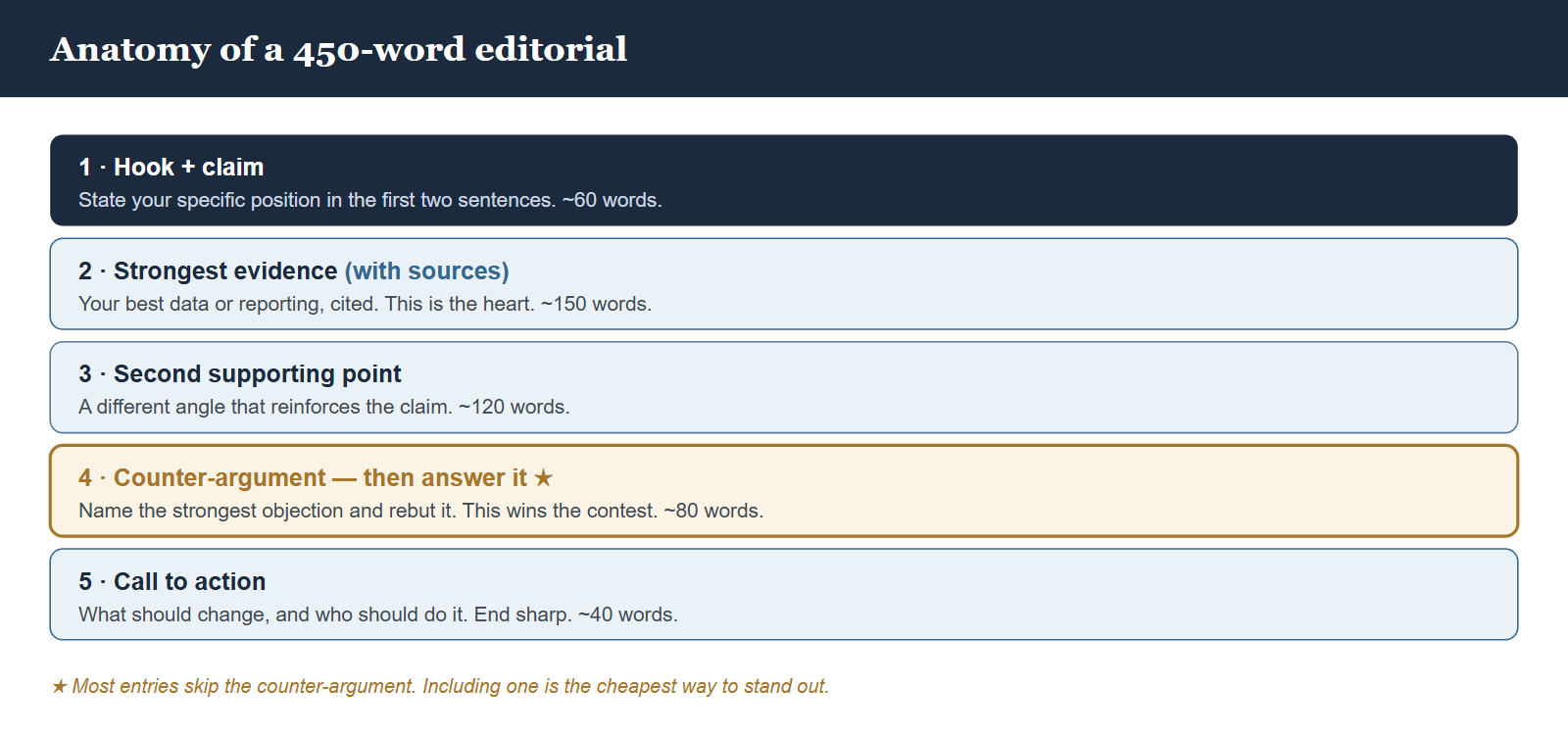
An editorial is not a school essay and it is not a rant. It is a short, evidence-backed argument for a specific position — the kind of piece a newspaper runs unsigned to say “here is what we think, and here is why.” The Learning Network judges it the way an editor would: does it take a clear stance, does it support that stance with real evidence, and does it stay honest about the other side? In 450 words there is no room to be vague. The single biggest reason strong writers underperform here is that they pick a topic so broad — “climate change”, “social media” — that 450 words can only scratch it. A narrow, arguable claim beats a big, safe one every time.
The rule students miss: evidence and sources
The Student Editorial Contest is explicit that opinions must be grounded in evidence, and entries include a list of the sources you used. This is where many international students lose ground — not because their argument is weak, but because they assert without citing. Treat every major claim as something a sceptical editor will ask you to prove. One well-chosen statistic from a reliable source, quoted precisely and attributed, is worth more than three sweeping sentences. Use a small number of strong sources rather than a long, thin list, and make sure each one genuinely supports the sentence it sits next to.
What judges reward
Across winning editorials, the same qualities recur. A precise, arguable claim: something a reasonable person could disagree with. Evidence that does real work: specific, cited, and explained — not dropped in. Fairness to the other side: the willingness to name the best counter-argument and answer it, which signals a writer who has actually thought. A voice that is yours: clear and direct, not an imitation of a professional columnist. For a fuller breakdown of how entries are read, see our guide to what judges look for in a winning entry.
A note for international and China-based students
You do not need an American topic to win. Some of the strongest editorials argue a position rooted in the writer’s own context — a policy debate in your country, an issue at international schools, a global question seen from where you actually stand. That perspective is an asset, not a handicap, as long as the claim is specific and the evidence is solid. Two practical reminders: the deadline is in U.S. Pacific Time (an 11:59 p.m. close is mid-afternoon the next day in Beijing), and because the editorial window often falls in late winter, map it against your exam calendar and start drafting three to four weeks early.
How we help
This is the contest where coaching matters most, because the gap between a good argument and a winning one is usually craft: narrowing the claim, choosing the one statistic that lands, and cutting a 700-word draft to a tight 450 without losing the spine. Our editorial team at Hanlin works with China-based students on exactly that — finding an arguable angle, sourcing it properly, and revising it down to the contest limit.
Frequently asked questions
How long is the NYT Student Editorial Contest entry?
About 450 words, not counting the list of sources you cite. The tight limit is part of the challenge — the contest rewards a precise argument over a broad one. Confirm the exact word count on the official Learning Network each year.
Questions about the contests?
Scan the WeChat QR code — we help with contest registration, one-on-one topic coaching, and full guidance to the deadline.
Scan the WeChat QR code

Do I have to cite sources?
Yes. Editorials must be grounded in evidence, and entries include the sources used. Use a small number of strong, reliable sources and make sure each one genuinely supports your claim, rather than a long, thin list.
Can international students win the editorial contest?
Yes. The contest is open to students 13–19 worldwide, and a position rooted in your own country or context can be a real advantage, provided the claim is specific and the evidence is solid.
What is the most common mistake?
Choosing a topic too broad for 450 words and skipping the counter-argument. A narrow, arguable claim that fairly answers the strongest objection stands out immediately.
This site is an independent editorial guide to The New York Times Learning Network’s free student writing contests, operated by Hanlin Education for China-based international-school students. We are not affiliated with, endorsed by, or sponsored by The New York Times Company or its Learning Network. Rules, word limits and dates change by season — always confirm the current rules on the official NYT Learning Network. Confirmed errors are corrected within 7 working days.
Prefer a shorter opinion format? The New York Times Open Letters Contest asks for a brief public letter rather than a full editorial — a good next step after the Editorial Contest.