Every New York Times Learning Network contest draws a large pool of entries, and a team of educators and editors reads them down to a shortlist and then to winners. Knowing how they read — the rubric dimensions that recur across contests — lets you write to the real standard instead of guessing. This independent guide explains the judging process and what consistently separates a winning entry from a competent one.
How the judging actually works
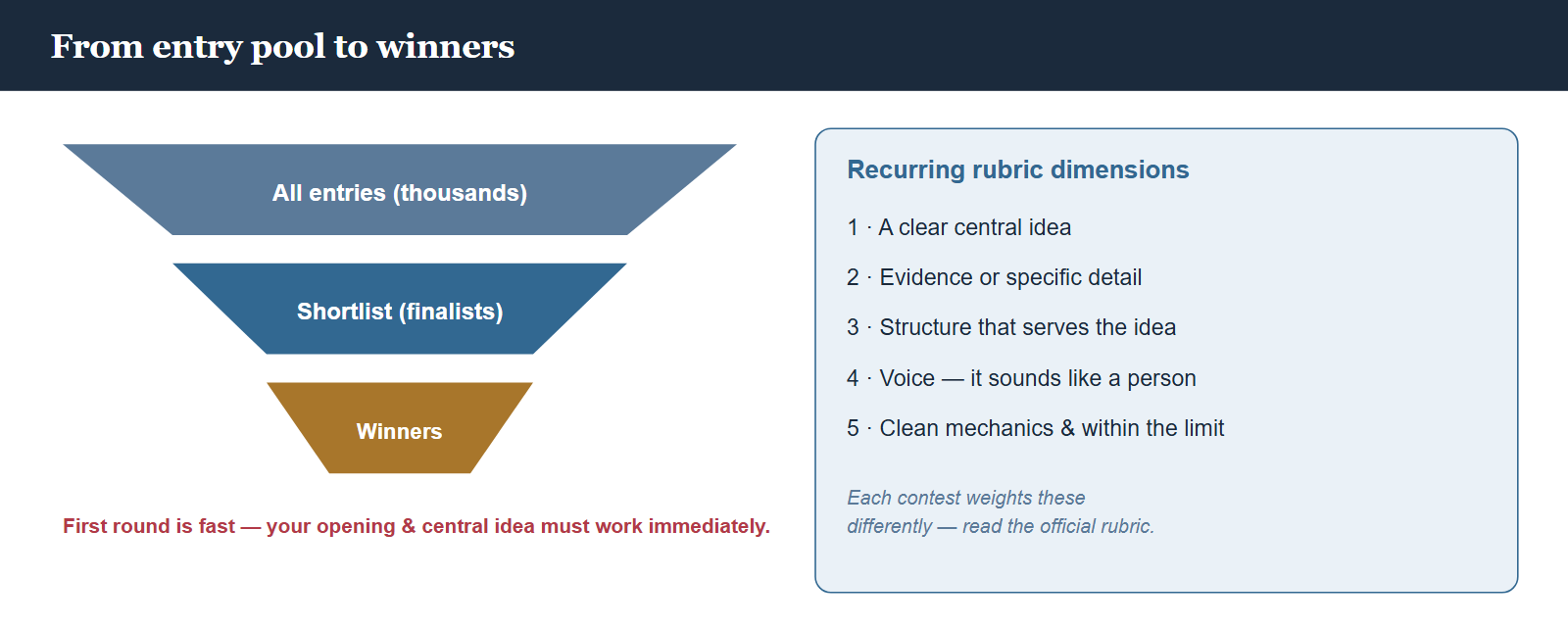
The contests are judged in rounds. A large group of readers — often teachers, Times journalists and Learning Network staff — first reads every entry against a published rubric, narrowing thousands of pieces to a shortlist. Those finalists are then read more closely to choose winners, runners-up and honourable mentions. The practical implication is important: in the first round, a reader spends only a short time with each piece, so your opening and your central idea have to work fast. A brilliant final paragraph cannot rescue an entry that did not earn its place in the first thirty seconds.
The five dimensions that recur
Each contest publishes its own rubric, and you should read the one for your contest — but five qualities show up again and again, whatever the genre.
| Dimension | What a top entry does |
| Central idea | One clear, specific point or story — not three half-developed ones |
| Evidence / detail | Specific, cited or concrete support that does real work, not decoration |
| Structure | An opening that earns attention and a shape that serves the idea |
| Voice | Sounds like a real person thinking, not an imitation of a pro |
| Mechanics & limit | Clean grammar, and comfortably within the word count |
What actually separates the shortlist
Most entries clear the basics — they are on topic and grammatical. What lifts a piece onto the shortlist is almost always specificity and a real point of view. The editorial that names the strongest counter-argument and answers it; the narrative that shows one precise moment instead of summarising a year; the review that commits to a judgement and proves it; the explainer whose analogy actually makes the idea click. Readers remember the entry that did one thing precisely, not the one that did five things adequately. If you want a single revision question, ask: “what is the one specific thing only I could have written here?” — and cut everything that blurs it.
A note for international students
Two reassurances grounded in how the rubric works. First, mechanics matter but a native accent does not: clean, clear writing is rewarded, and that is achievable in a careful second language — recognised entries regularly come from multilingual students. Second, specificity favours you: a precise detail from a world the reader does not already know is exactly the kind of evidence that survives the first round. Write to the rubric, lead with your clearest idea, and let your own context supply the specifics. For how this plays out contest by contest, start from our guide to choosing a contest; for deadlines, see the contest calendar.
Frequently asked questions
How are NYT writing contests judged?
In rounds. A large group of educators and editors reads all entries against a published rubric to form a shortlist, then reads finalists closely to choose winners. Because the first round is fast, your opening and central idea must work immediately.
Questions about the contests?
Scan the WeChat QR code — we help with contest registration, one-on-one topic coaching, and full guidance to the deadline.
Scan the WeChat QR code

Is there a rubric I can read?
Yes. Each contest publishes its own rubric, and you should read the one for your contest. Five dimensions recur across contests: a clear central idea, evidence or specific detail, structure, voice, and clean mechanics within the word limit.
What separates a shortlisted entry from the rest?
Specificity and a genuine point of view. Entries that do one precise thing — answer the counter-argument, show one exact moment, commit to a judgement — beat entries that do several things adequately.
Do grammar mistakes disqualify international students?
Clean mechanics matter, but a native accent is not required. Clear, careful writing in a second language is rewarded, and recognised entries regularly come from multilingual students.
This site is an independent editorial guide to The New York Times Learning Network’s free student writing contests, operated by Hanlin Education for China-based international-school students. We are not affiliated with, endorsed by, or sponsored by The New York Times Company or its Learning Network. Judging processes and rubrics change by season — always confirm the current rubric for your contest on the official NYT Learning Network. Confirmed errors are corrected within 7 working days.