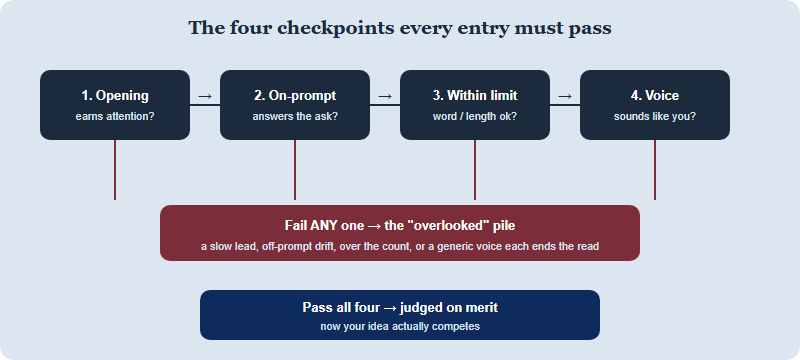
Most NYT Learning Network entries are not rejected because the writer lacked talent — they are overlooked because of four recurring craft mistakes: a slow opening that wastes the first sentence, drifting off the exact prompt, going over the word count (or padding it), and a voice that sounds like everyone else's. The good news is that all four are fixable in revision, before you ever hit submit. Below is each failure mode, why a judge skims past it, and the specific fix.
Why so many strong entries still get passed over
The Learning Network runs a handful of contests across a school year — seven on the 2026-27 calendar we have been shown, including two new ones, a visual-art contest and a STEM interview video (per the organiser’s 2026-27 calendar as relayed to us in September 2026 — confirm the current dates on nytimes.com/section/learning) — opinion (now Open Letters), the 100-word Tiny Memoir, review, photo essay, podcast, the summer reading contest, and multimedia events — and each draws thousands of entries from students aged 13–19 worldwide. Judges (Times journalists and educators) read against a published rubric, and they read fast. A reader scoring a long stack does not give your piece a charitable second chance: if the first lines do not earn attention, or the entry breaks a stated rule, it slips out of contention long before the strongest sentence in paragraph four.
That is the uncomfortable but useful truth. The bar is not "is this a good student writer?" — it is "does this specific entry, under these specific constraints, reward a tired reader in the first ten seconds?" The mistakes below are the ones that quietly cost good writers a place. (For the foundational picture of which contests exist, see What Are the NYT Writing Contests; for how reviewers actually score, see what judges look for.)
Mistake 1 — A weak opening that wastes the first sentence
The single most common reason a promising entry gets skimmed is a throat-clearing opening: a dictionary definition, a sweeping "Since the beginning of time…", or a restatement of the prompt. In a 100-word Tiny Memoir, a slow first sentence costs you a fifth of the whole piece. In Open Letters, where the limit is short, the reader has likely decided your level by the end of paragraph one.
The fix: open on a concrete image, a specific moment, or a precise claim — never an abstraction. Apply the "first 25 words" test: read only your opening 25 words aloud. If a stranger could not tell what the piece is about or feel a reason to continue, rewrite them. A reliable move is to delete your original first sentence entirely; the real opening is often hiding in sentence two or three, where you stopped warming up and started saying something true.
Mistake 2 — Answering a different prompt than the one asked
Each Learning Network contest asks for something specific, and the format is part of the ask. An Open Letter must be a letter — addressed to a person or group who could actually change the issue — not a general essay. A review must evaluate a specific work and make a recommendation, not summarize the plot. A memoir must capture one moment, not narrate a whole year. Entries that ignore the form, however well written, read as off-prompt to a judge holding the rubric.
The fix: before drafting, copy the contest's own rules page into a document and turn each requirement into a checkbox — required form, required citations, required focus. Open Letters, for example, asks for evidence including at least one New York Times source and at least one non-Times source; an opinion entry missing a citation is an easy cut. Re-read your finished draft once with only one question in mind: did I do the exact thing the prompt asked, in the exact form? Confirm the current requirements for your contest on the official rules page each cycle — wording changes year to year.
Mistake 3 — Breaking the length rule (over the count, or padding to it)
Length limits are not suggestions; in many cycles, exceeding them makes an entry ineligible. The rules also reward precision: in Open Letters, the title and the sources are not counted toward the word limit, so spending body words restating your title is pure waste. The opposite error is just as visible — padding a thin idea to reach a ceiling produces filler sentences a judge feels immediately. The table below summarizes the kind of constraints recent cycles have used (always re-confirm exact numbers before you submit).
| Contest (recent cycles) | Length constraint | The mistake to avoid |
|---|---|---|
| Open Letters (opinion) | ~500 words or fewer; title & sources excluded — confirm on the official site | Padding to the ceiling; wasting body words on the title; omitting a required source |
| My Tiny Memoir | 100 words or fewer; title not counted | Trying to tell a whole year; a slow first sentence eats 20% of the piece |
| Review (e.g. "My List") | Short-form; covers a set number of works — confirm current rules | Summarizing instead of evaluating; no clear recommendation |
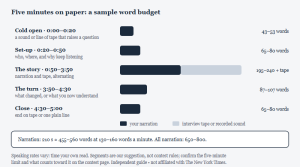
| Podcast / audio | Time-capped (about 5 minutes in recent cycles) | Running long; burying the point past the first minute |
| Summer reading response | Short written reply, or video up to ~90 seconds — confirm current rules | Generic praise of the article; no personal connection or specific reaction |
The fix: treat the limit as a design constraint. Draft long, then cut 15–20% — the cutting almost always sharpens the writing. Count the words in the exact field the contest counts (remembering what is excluded), not your word processor's total. For a deeper, pass-by-pass cutting method, see our companion guide on revising an entry, and check deadlines on the contest calendar so you are cutting with time to spare, not at 11:58 p.m.
Mistake 4 — A generic voice that could belong to anyone
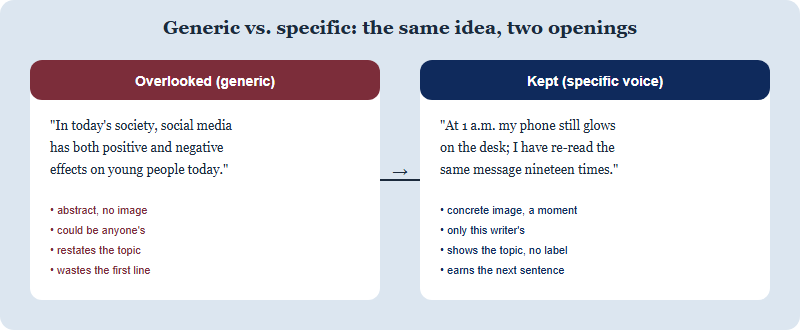
When judges describe winners, they consistently use one word: voice. The entries that get overlooked are not badly written — they are anonymous. They use the safe, exam-essay register ("In today's society, technology has both advantages and disadvantages…") that a thousand other students also used. Nothing in the piece could only have been written by this one person.
Questions about the contests?
Scan the WeChat QR code — we help with contest registration, one-on-one topic coaching, and full guidance to the deadline.
Scan the WeChat QR code

The fix: trade the general for the specific. One concrete detail from your own life, classroom, city, or family does more than a paragraph of abstraction — and it is something no other entrant can copy. Replace abstract nouns ("challenges," "society," "impact") with things a reader can see. Read your draft aloud: where it sounds like a textbook, it is generic; where it sounds like you talking, that is your voice — keep more of that.
An extra trap for China-based international students
Students writing from China hit three avoidable mistakes that have nothing to do with talent. First, deadline math: the Learning Network posts cutoffs in U.S. time, not Beijing time — a deadline of 11:59 p.m. U.S. Pacific is mid-afternoon the next day in China, and misreading it costs an otherwise-finished entry. Always convert the official time to Beijing time and aim to submit a day early. Second, translated-essay register: writing in Chinese first and translating produces formal, generic phrasing that reads as anonymous to an English-language judge; draft in English and read aloud to catch it. Third, missing the citation rule on opinion entries — non-U.S. students sometimes skip the required New York Times source. None of these is about ability; all three are pure process, and all three are checkable before you submit. (More on eligibility and timing in our international-students guide on the contests overview.)
A 6-point pre-submission self-check
Run this list once on the final draft, in order. If any answer is "no," fix it before you submit — each maps to a failure mode above.
- Opening: Do the first 25 words give a concrete image or precise claim — not a definition or the prompt restated?
- On-prompt: Did I do the exact thing the rules asked, in the exact form (letter, review, memoir)?
- Rules: Did I meet every stated requirement, including any required citations, checked against the official rules page this cycle?
- Length: Am I within the limit measured the way the contest counts it (knowing the title/sources may be excluded), with no padding?
- Voice: Is there at least one detail only I could have written, and does it sound like me read aloud?
- Logistics: Did I convert the deadline to Beijing time, submit one entry per the rules, and plan to send it a day early?
Frequently asked questions
What is the most common reason NYT contest entries get overlooked?
A weak opening. Judges read fast; a definition or prompt-restatement in the first sentence loses attention before your best idea appears.
Does going one word over the limit really disqualify an entry?
In many cycles, exceeding the stated limit makes an entry ineligible. Treat the limit as firm and confirm the exact number on the official rules page.
How do I make my voice stand out without being gimmicky?
Use one concrete, true detail from your own life instead of abstractions. Specific beats clever — and no other entrant can copy it.
What deadline mistake do international students make most?
Reading the cutoff as Beijing time. Deadlines are posted in U.S. time; convert it and submit a day early to be safe.
This is an independent guide operated by Hanlin Education for China-based international-school students. It is not affiliated with, endorsed by, or sponsored by The New York Times Company or its Learning Network, and covers only the student writing contests — never New York Times news. Contest names, word limits, citation rules, and deadlines change each cycle; always confirm current details on the official site at nytimes.com/learning before you enter. Examples shown are illustrative and are not reproductions of any published winning entry. Found a factual error? We correct confirmed mistakes within 7 working days.