To win a New York Times Learning Network contest, build a year-round writing habit instead of cramming inside each contest window. The Learning Network runs contests back-to-back across the school year for writers ages 13–19 worldwide, and each window is only about six weeks. Students who write a little every week — keeping an idea bank, drafting on a fixed schedule, and banking finished pieces — arrive at each deadline with material ready to revise, while one-shot entrants are still staring at a blank page.
Why a habit beats a sprint for NYT contests
Most students treat NYT contests as isolated events: they notice a deadline, write something in a weekend, submit, and forget about it until the next one. That pattern fights the structure of the contest year. The Learning Network’s free student contests run almost continuously — one window closes and the next opens roughly two months later — so the calendar is really a year-long sequence, not a set of unrelated sprints. A student who only writes when a deadline looms is constantly starting cold, every six weeks, all year.
This guide is a craft-and-process playbook for building that sustainable practice. It is not a contest overview. If you still need to choose a contest or check this year’s schedule, start with What Are the NYT Writing Contests and the contest calendar. To understand the bar you are training toward, read what judges look for before you build your routine — a habit without a target just produces more mediocre pages. Always confirm the exact dates, ages, and word limits of any specific contest on the official Learning Network site, because contests are added, retired, and re-dated every year.
A first-party observation from coaching China-based international-school students: the single strongest predictor of a competitive entry is not raw talent or even a coach — it is whether the student already had a draft to revise when the window opened. Revision wins contests, and you can only revise something that already exists. The habit’s whole purpose is to make sure a draft always exists.
Map the contest year before you build the habit
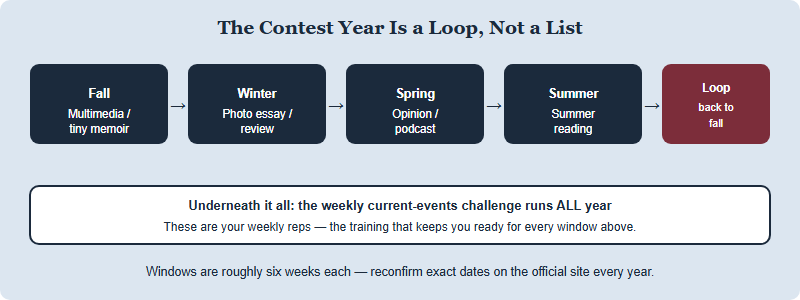
A year-round habit needs a year-round map. The Learning Network publishes its full slate before the school year starts, and the windows sit in a predictable rhythm of roughly six-week cycles, plus one challenge that runs continuously. The table below shows the 2025–2026 sequence as a worked example so you can see the shape of the year — not as a permanent schedule. Treat these as illustrative; reconfirm every date on the official site for your own year, because the lineup changes annually.
| Window (2025–26 example) | Contest | Format demand | What to practise in the weeks before |
|---|---|---|---|
| Sept–Oct | Growing Up With A.I. (multimedia) | Essay, comic, podcast, video, song, infographic | Pick one medium; collect personal A.I. moments |
| Oct–Dec | My Tiny Memoir (100-word narrative) | 100 words maximum | Drafting tiny scenes; ruthless cutting |
| Dec–Jan | Local Lens (photo essay) | 6–8 images + captions | Shooting a sequence; caption writing |
| Jan–Feb | My List (review) | 3–5 works of art or culture | Note-taking on things you consume anyway |
| Feb–Apr | Open Letters (opinion) | 500 words or fewer | Argument structure; one clear claim |
| Apr–May | Audio Stories (podcast) | 5 minutes or less | Scripting for the ear; recording basics |
| Jun–Aug | Voice and Choice (summer reading) | Weekly responses (video ≤90s) | Habit of responding to what you read/watch |
| All year | Conversation Challenge (current events) | Weekly short writing | Your low-stakes weekly reps |
Two structural facts make the habit strategy work. First, the windows overlap with how a school year actually flows, so you can align contest prep with terms rather than treating it as extra load. Second, the weekly Conversation Challenge runs the entire school year — it is purpose-built to be your low-stakes weekly repetition, the gym where you train before the meet. The 2025–26 year also dropped the former “How to…” informational writing contest and added the multimedia Growing Up With A.I. contest, a useful reminder that you should never hard-code last year’s lineup into your plan.
The four habits that keep you contest-ready
A sustainable practice is not “write more.” It is four small, repeatable systems that run quietly between deadlines so that every window opens with you already ahead. None of them requires more than a few hours a week, and all of them survive a busy IB or A-Level term.
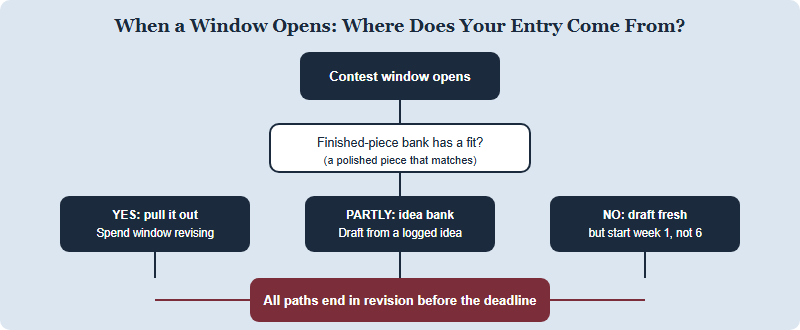
Habit 1 — The idea bank. Keep one running document or note where you log raw material: a sentence someone said, a moment that stuck with you, a strong opinion you can’t shake, a book or show worth reviewing. Tag each entry by which contest it might feed (memoir, opinion, review, photo). When a window opens, you are not inventing an idea under pressure — you are shopping from a shelf you already stocked. Aim for two or three entries a week; that is enough to never run dry.
Habit 2 — The weekly rep. Use the year-long current-events challenge (or your own prompt) to write one short, low-stakes piece every week. The point is not to win the weekly challenge; it is to keep your drafting muscle warm so contest weeks feel normal, not exceptional. A fixed slot — say, Sunday evening for thirty minutes — beats “when I feel inspired,” because inspiration does not keep a calendar.
Habit 3 — The format rotation. The contests demand very different forms across the year: a 100-word memoir, a 500-word opinion letter, a 6–8 image photo essay, a five-minute podcast. In the weeks before each window, deliberately practise that form’s specific discipline — cutting for the 100-word memoir, structuring one clear claim for the opinion letter, writing for the ear for the podcast. Rotating your practice to match the upcoming window means you train the exact skill you are about to need.
Questions about the contests?
Scan the WeChat QR code — we help with contest registration, one-on-one topic coaching, and full guidance to the deadline.
Scan the WeChat QR code

Habit 4 — The finished-piece bank. Whenever a weekly rep turns into something you actually like, polish it to a near-final state and file it. Over a term you accumulate a small reserve of finished or near-finished pieces. When a window opens that fits one of them, most of your work is already done — you spend the window revising toward the contest’s specific rules instead of writing from zero. This is the habit that most directly converts into competitive entries.
A realistic weekly schedule that survives a busy term
The most common reason a writing habit collapses is that students design one that assumes free time they do not have. A practice that fits around exams, extracurriculars, and sleep is the only one that lasts a full year. Here is a lightweight weekly rhythm that adds up to roughly two to three hours — small enough to keep, large enough to compound.
| Cadence | Action | Time | Why it matters |
|---|---|---|---|
| Daily (2 min) | Add one line to the idea bank | ~15 min/week | You never face a blank page cold |
| Weekly (fixed slot) | One short drafting rep | ~45 min | Drafting stays a normal, warm muscle |
| Weekly | Read one Learning Network mentor piece in your upcoming form | ~20 min | You internalise the target by reading it |
| Monthly | Polish one rep into the finished-piece bank | ~45 min | You build a reserve of ready entries |
| Per window | Pick, revise, proof, submit before the deadline | spread over the window | Revision — not first-drafting — fills the window |
Notice what is not on this list: writing a full contest entry every single week, or grinding daily for hours. Sustainability beats intensity. A student who keeps a two-to-three-hour weekly habit for nine months will out-prepare a student who does a frantic forty-hour push the week before one deadline — and will be ready for several windows, not just one. Pair this routine with a clear-eyed read of what judges look for so your reps train toward the actual criteria, not just word count.
One honest caveat: a habit does not guarantee a win, and no one can promise you a prize or a college admission — these contests are highly competitive and selective. What the habit reliably does is change what you bring to the table: a real draft, made with distance and revision, instead of a rushed first attempt. That is the variable you actually control.
Frequently asked questions
How many hours a week does a year-round NYT writing habit really take?
About two to three hours: a daily idea-bank line, one weekly drafting rep, some mentor-text reading, and a monthly polish. Sustainability matters more than intensity.
I can only enter one contest this year — is a year-round habit overkill?
No. Even for one entry, the habit means you arrive with a banked draft to revise instead of writing cold. Revision under less time pressure is where entries improve most.
Which contest should a beginner build their habit around first?
The weekly current-events challenge is the natural training ground because it runs all year and is low-stakes. Use it to warm up before tackling a formal six-week window.
Do the contest dates stay the same every year?
No. The Learning Network adds, retires, and re-dates contests each year — the 2025–26 slate dropped one contest and added a new multimedia one. Always confirm current dates on the official site.
This is an independent guide operated by Hanlin Education for China-based international-school students. It is not affiliated with, endorsed by, or sponsored by The New York Times Company or its Learning Network, and it covers only the student writing contests — never New York Times news. Contest names, dates, age ranges, and word limits change from year to year; always confirm current details on the official Learning Network site at nytimes.com/learning before you enter. Confirmed errors are corrected within 7 working days.