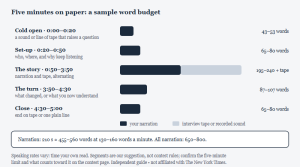
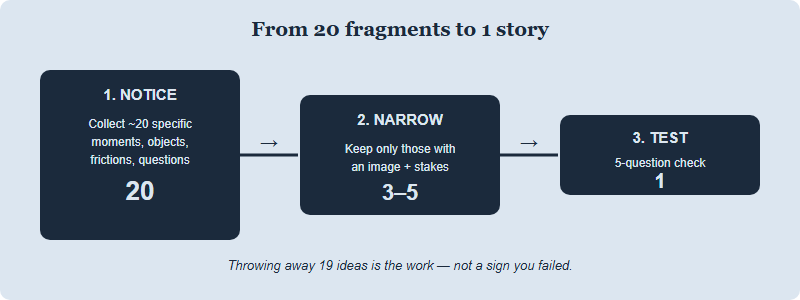
To find your story for a New York Times Learning Network writing contest, work in three moves: notice (collect specific moments, objects, and questions from your own life and reading), narrow (cut to the one idea with a concrete image and real stakes), and test (check that only you could have written it, that it fits the contest's tight word limit, and that it's original). This is craft, not a contest overview — and finding the idea is the part that decides everything else.
Most students lose the contest before they draft. They reach for a “big” topic — climate change, mental health, the importance of family — and produce something a thousand other 13-to-19-year-olds could submit. Judges read for the opposite: an entry only you could write. Below is a repeatable process to get there. If you still need the lay of the land first, start with what the NYT writing contests are and the contest calendar; this guide assumes you've picked a contest and now need an idea worth a hundred hours.
Why the idea matters more than the prose
NYT Learning Network contests are deliberately short. A Student Editorial runs to roughly 450 words; the Personal Narrative is brief by design; “My Tiny Memoir” gives you about 100 words; an Open Letter, around 500. (Exact word limits change by season and by contest — always confirm the current count on nytimes.com/learning.) When the container is that small, a strong idea carries the piece and a weak idea cannot be rescued by good sentences. There is no room to “build up to” a point. You either arrive with something specific, or you don't.
A second structural fact shapes how you choose: for most of these contests you may submit one entry per contest (the Summer Reading Contest is the known exception, accepting weekly responses across the summer). One shot per contest means idea selection is not a warm-up — it's the highest-leverage decision you'll make. And because every entry must be your original, unpublished work, the idea also has to be genuinely yours, not borrowed from a sample essay or an AI draft.
One more thing worth naming for our readers. These contests are open to students 13–19 worldwide, and the audience on the other side is a general adult readership. As a student at an international school in China, you are sitting on material most US-based applicants will never have: a bilingual home, a grandparent's migration story, a specific street market, the exact texture of a boarding-school dorm in a second language. That is not a disadvantage to write around — it is frequently the most original thing in the pile. (For what the readers actually reward, see what judges look for.)
Step 1 — Notice: build a raw-material bank
You cannot “think up” a good story on a deadline. You harvest one from things you've already lived. Before you commit to anything, spend two or three days filling a notes file with small, concrete entries — no editing, no judging. Aim for quantity; the goal is twenty fragments so you can throw away seventeen.
Use prompts that force specificity rather than themes. The difference between a theme and a fragment is the difference between “my relationship with my mother” and “the morning my mother re-folded my packed suitcase without a word.” The first is a topic everyone has; the second is a scene only you have.
- Objects. Name five objects in your room that carry a story. A cracked phone screen, a half-finished model, a textbook in a language you're losing.
- Frictions. Write down three things that quietly annoy or unsettle you at school or at home. Irritation is a reliable signal of a real opinion (gold for an Editorial or Open Letter).
- Turns. Note three moments when you changed your mind about something or someone. Change is the engine of a Personal Narrative.
- Curiosities. List three questions you'd genuinely Google at midnight. These become STEM Writing or review angles.
- Contradictions. Where do you do one thing but believe another? Tension makes prose move.
Match your raw material to the contest's shape rather than forcing it. The table below maps the kind of fragment that tends to feed each contest type. (Which contests are running this season — and their exact rules — should always be checked on the official calendar; this is a craft map, not a schedule.)
| Contest type | What it rewards | The kind of fragment to mine for | A bad idea vs. a workable idea |
|---|---|---|---|
| Editorial / Open Letter | A clear, evidence-backed argument with stakes | A “friction” you can defend with one credible source | “Social media is bad” → “Why our school's phone-ban policy backfires” |
| Personal Narrative / Tiny Memoir | One vivid moment that changed something | A “turn” — the smallest scene where you shifted | “My immigration journey” → “The first time a teacher mispronounced my name and I let it stand” |
| Review / My List | A specific judgment, well-supported | A “curiosity” or strong reaction to one work | “This movie was great” → “Why the silence in this scene does more than the dialogue” |
| STEM Writing | Making one complex idea clear and human | A midnight “curiosity” with a real-world hook | “How vaccines work” → “The math error that explains why my flu shot ‘failed’” |
| Summer Reading | A genuine, personal response to a Times piece | An “object” or “contradiction” a real article touched | “This article was interesting” → “This piece on elder care made me call my grandmother” |
Step 2 — Narrow: from a topic to a single image with stakes
Now cut. Look at your fragments and keep only the three to five that have two things at once: a concrete image (something a reader can see, hear, or hold) and real stakes (something actually mattered, changed, or was lost). A fragment with an image but no stakes is a postcard. A fragment with stakes but no image is an essay prompt. You want both.
Two practical narrowing tools:
The “smaller is bigger” move. Counterintuitively, the way to write about a huge theme is to shrink it to one moment. You don't write about “cultural identity”; you write about the afternoon you ordered in Mandarin at a restaurant in London and the waiter answered in English. The small scene contains the big theme without announcing it. Judges consistently reward the specific over the sweeping, because the specific is what an AI or a hurried applicant can't fake.
The one-sentence test. Before you draft, force your idea into a single sentence with this shape: “I want to show [specific thing] so that a reader feels/understands [specific effect].” If you can't finish that sentence without vague words (“important,” “interesting,” “meaningful”), the idea isn't narrow enough yet. Compare:
Questions about the contests?
Scan the WeChat QR code — we help with contest registration, one-on-one topic coaching, and full guidance to the deadline.
Scan the WeChat QR code
- ❌ “I want to write about how hard it is being an international student.” (No image, no effect — a theme.)
- ✅ “I want to show the 40 seconds I froze during roll call on my first day, so a reader feels how a name can become a small act of courage.” (Image + stakes + effect.)
For argument-based contests (Editorial, Open Letter), the same discipline applies, but stakes mean “why this matters to people beyond me” and the image is often a single telling fact. Narrow until your claim could be disagreed with — if no reasonable person could take the other side, it's not an argument, it's a platitude.
Step 3 — Test: the five questions before you commit
Once you have a finalist idea, run it through five checks. This is the gate. If your idea fails two or more, go back to your fragment bank — don't try to force a weak idea through revision later. (For improving a draft you've already committed to, that's a separate stage covered elsewhere on this site; here we're only deciding what to write.)
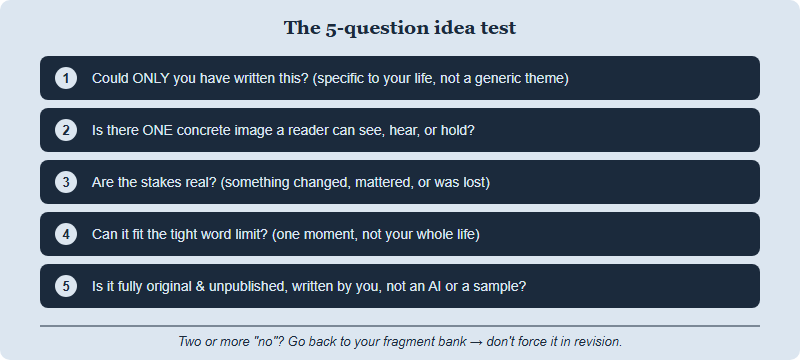
A note on question 5, because it carries real consequences. NYT Learning Network entries must be original and unpublished. “Original” also means written by you — not generated by an AI tool and lightly edited, and not modelled so closely on a published winning entry that it stops being yours. The most common, and most avoidable, way strong writers disqualify themselves is by letting a tool find the idea for them. The whole point of Steps 1–3 is that the idea comes from your life, which is the one thing no model can copy. For exact rules on originality, AI use, and what counts as eligible, confirm on nytimes.com/learning before you submit.
A worked example, and a first-party pattern we see
Here's the process compressed. Imagine a Grade 11 student at an international school in Shenzhen, entering the Personal Narrative. Her first instinct is “the pressure of being a third-culture kid” — a true feeling, but a theme, not a story. Running the notice step, she lists objects: a WeChat voice message from her grandmother she's never replied to in dialect because she's ashamed of her accent. That's a fragment with an image (the unplayed message) and stakes (shame, a fading language, love unspoken). The one-sentence test writes itself: “I want to show the message I keep not answering, so a reader feels how a language can hold a relationship hostage.” Five-question test: only she could write it (yes), concrete image (the message), real stakes (yes), fits a short word count (yes — it's one object, one tension), original and hers (yes). That idea will out-compete the theme every time.
As an editorial desk that coaches China-based international-school students through these contests, the single most reliable pattern we observe is this: the students who place are almost never the ones with the most “impressive” topic. They're the ones who trusted a small, specific, slightly uncomfortable moment from their own life — often one rooted in the bilingual, between-cultures experience they initially assumed was too ordinary to use. The work of coaching is rarely teaching grammar; it's giving a writer permission to keep the small true thing instead of trading up for a big false one. (We can't promise any result — no one honestly can — but we can promise the small-and-true idea travels further than the big-and-generic one.)
Common idea-stage mistakes (and the fix)
| The mistake | Why it fails | The fix |
|---|---|---|
| Picking the “important” topic | Importance ≠ originality; everyone picks it | Pick the specific moment, not the big subject |
| Starting to draft before narrowing | You discover the idea is thin at word 300 | Pass the one-sentence test first |
| Choosing a story with no image | Reader has nothing to see; prose floats | Anchor to one object, place, or moment |
| Letting an AI suggest the idea | Risks originality rules; it's not yours | Mine your own fragment bank |
| Saving “my whole life” for a 100-word piece | Scope and word limit collide | One scene; trust the small to imply the large |
Finding the story is the hardest hour of the whole process and the one most worth slowing down for. Notice widely, narrow ruthlessly, test honestly — then go check the current rules and deadlines on the official site before you write, and only then begin to draft.
FAQ
How do I pick a topic if my life feels “too ordinary” for the NYT?
Ordinary is the point. Mine one specific moment, object, or friction — a small true scene almost always beats an impressive-sounding theme that anyone could write.
Can I reuse one strong idea across several NYT contests?
Shape it to each contest's form, but submit original work each time. Most contests allow one entry each; confirm current rules on nytimes.com/learning before entering.
Is it okay to use AI to brainstorm my story idea?
Entries must be your original work. The safest, strongest route is to mine your own life, not a model. Always check the official AI and originality rules first.
How specific should my idea be before I start drafting?
Specific enough to pass the one-sentence test: “I want to show [exact thing] so a reader feels [exact effect]” — with no vague words like “important.”
This is an independent guide operated by Hanlin Education for China-based international-school students. It is not affiliated with, endorsed by, or sponsored by The New York Times Company or its Learning Network, and it covers only the student writing contests — never New York Times news. Contest rules, word limits, eligibility, and deadlines change each season; always confirm current details on the official site at nytimes.com/learning before you submit. We do not reproduce copyrighted winning entries and describe craft and structure only. Spotted an error? We correct confirmed mistakes within 7 working days.