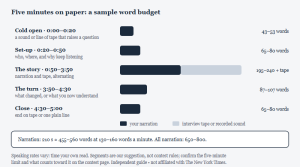
The Open Letters: Our Opinion-Writing Contest is one of the New York Times Learning Network's free student contests. It asks you to do one focused thing: write a short public letter — about 460 words — of protest or appeal, addressed to a person or group who could actually change an issue you care about. It is open to students aged 13–19 worldwide, there is no fee and no qualifying round, and you submit directly through the Learning Network. This guide explains exactly what the contest asks for and how to write a letter that stands out.
What the contest asks for
An open letter is not a general essay. It is a letter — written to a specific reader, with a specific request — that is also meant to be read by the public. The whole challenge is doing real persuasion in a very tight word count, so every sentence has to earn its place.
| Element | Detail |
|---|---|
| Format | A public letter of protest or appeal, around 460 words (confirm the current limit officially) |
| Audience | A named person or group who can act on your issue — not “the world” in general |
| Who can enter | Middle and high school students aged 13–19, worldwide |
| Cost & rounds | Free; no nomination and no qualifying round — submit directly |
| When | Runs in late winter/spring; the 2026 cycle ran roughly late February to early April (always confirm dates on the official Learning Network) |
How to write one that stands out
Because the format is so tight, strong entries are built the same way. Work through these five moves — and notice that the first one decides most of the others:
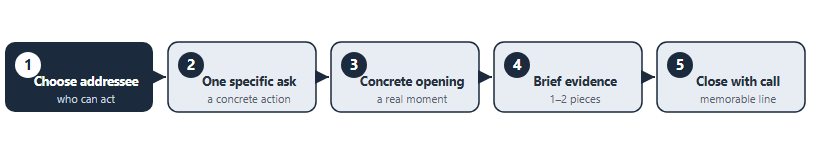
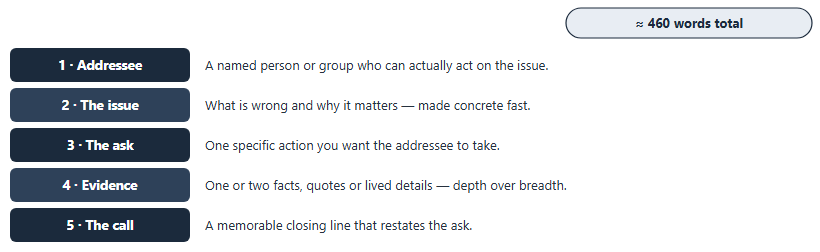
- Choose an addressee who can act. A school board, a company, a lawmaker, a specific official — someone with the power to change the thing you are writing about. This single choice gives your letter its focus and its “ask.”
- Make one specific request. Not “do better,” but a concrete action the addressee could take. A sharp ask is more persuasive than a broad complaint.
- Lead with a concrete moment. Open on a real scene, number or example that makes the issue vivid in one or two sentences — not an abstract introduction.
- Support it, briefly. One or two pieces of evidence — a statistic, a quote, a lived detail — are enough at this length. Depth beats breadth.
- Close with the call. End by restating the ask and why acting matters now. The last line should be the one the reader remembers.
For how submission works across all of the Learning Network's contests, see our how-to-enter guide; for the full line-up and timing, our contest calendar keeps them in one place.
Frequently asked questions
How long should an open letter be?
Around 460 words. The tight limit is the point — confirm the exact current limit on the official Learning Network before you submit.
Questions about the contests?
Scan the WeChat QR code — we help with contest registration, one-on-one topic coaching, and full guidance to the deadline.
Scan the WeChat QR code

Who can enter the Open Letters contest?
Students aged 13–19, in middle or high school, anywhere in the world. It is free and there is no qualifying round — you submit directly during the contest window.
When is the contest open?
It runs in late winter and spring; the 2026 cycle ran roughly from late February to early April. Dates change each year, so confirm the current window on the official Learning Network.
What makes a winning open letter?
A clear addressee who can act, one specific ask, a concrete opening, brief evidence and a memorable close — all in about 460 words. Precision and a real voice matter more than covering everything.
This is an independent student guide to the New York Times Learning Network's writing contests, operated by Hanlin Education. It is not affiliated with, endorsed by, or sponsored by The New York Times Company or its Learning Network. Contest rules, word limits and dates change each year — always confirm the current details on the official Learning Network before entering.