The Summer Reading Contest — listed for 2027 as Voice and Choice — is the New York Times Learning Network’s friendliest competition. It asks one question — what got your attention in The Times? — and invites students worldwide to answer briefly. The shape of it changed for 2026-27: where the contest once ran week after week across the summer, the calendar we have been shown lists three submission windows rather than a weekly loop, and accepts a short written response or a video of up to about ninety seconds (per the organiser’s 2026-27 calendar as relayed to us in September 2026 — confirm the current dates on nytimes.com/section/learning). Each window therefore matters more than any single week used to. This independent guide explains how it works and how to do it well.
Quick facts (2026-27 season)
| What it is | A short summer writing (or video) contest from The NYT Learning Network, listed for 2027 as Voice and Choice |
| When | Three windows in summer 2027 — 4–11 June, 2–9 July and 30 July–6 August (per the organiser’s 2026-27 calendar as relayed to us in September 2026 — confirm the current dates on nytimes.com/section/learning) |
| The prompt | The same in every window: what in The Times caught your interest, and why? |
| Length | Short — around 250 words, or a video of up to about ninety seconds |
| Who can enter | Students 13–19 worldwide • free • you may enter in each window that runs |
| Official source | nytimes.com/section/learning |
How the three windows work
Unlike the flagship contests, which have a single deadline, Summer Reading opens more than once. The same prompt runs in each window, entries close at the end of it, editors read and publish a few favourites, and the next window opens later in the summer. Each window is judged on its own, so a weak one does not follow you into the next. What has changed is how many you get: the 2026-27 calendar we have been shown lists three, where earlier seasons ran a weekly loop across the whole summer.
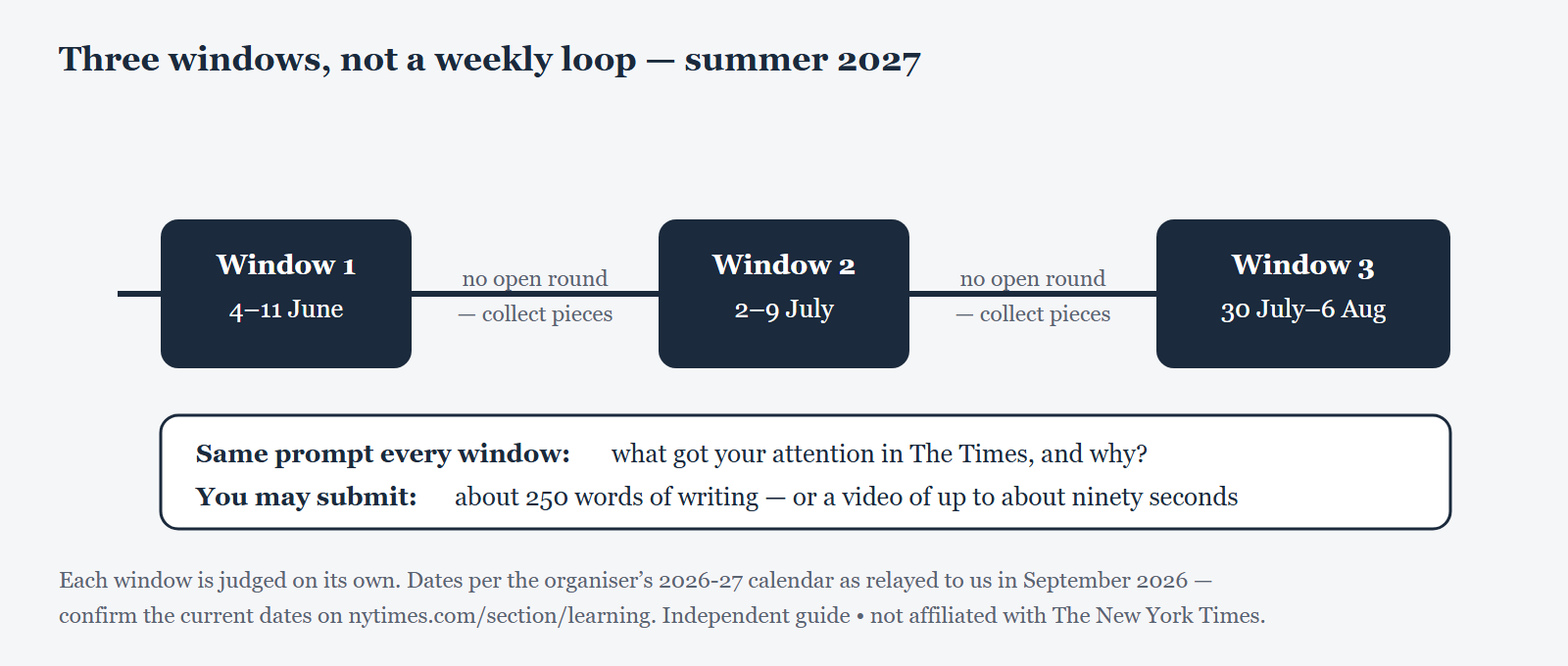
The repetition is still the point, but it now has to be manufactured rather than handed to you. When the contest ran weekly, the habit built itself; with three windows, the drafting practice has to happen in between them. In our experience the students who gain most treat each window as a real deadline and keep writing short reactions in the weeks around it — which is the one skill every other contest demands: finishing something on a deadline, more than once.
Why it suits international and China-based students
Three features make Summer Reading unusually friendly to students far from New York. First, the deadline maths is gentle: a Pacific-Time close lands in the middle of the next afternoon in Beijing, so you are never racing a midnight you misjudged. Second, you respond to anything that genuinely interested you — a science graphic, a sports photo, a piece about your own country — so you are never forced onto unfamiliar American ground. Third, it is short: roughly 250 words, or a video of about ninety seconds, rewards a clear, honest reaction over polished length, which levels the field for multilingual writers.
This is also where international entries genuinely place. Students we have worked with at Hanlin have been recognised in the Learning Network’s contests, including an Honorable Mention in the Summer Reading Contest. We share that not as a headline — the entry pool is large and the contest is competitive — but as concrete evidence that a focused response written from a desk in China is read on the same page as everyone else’s.
What a strong response actually contains
The most common mistake is to summarise the article you picked. Editors have already read The Times — they do not need a recap. What they are looking for is you: a specific, honest reaction and a reason it landed. A strong response of that length usually has three moves.
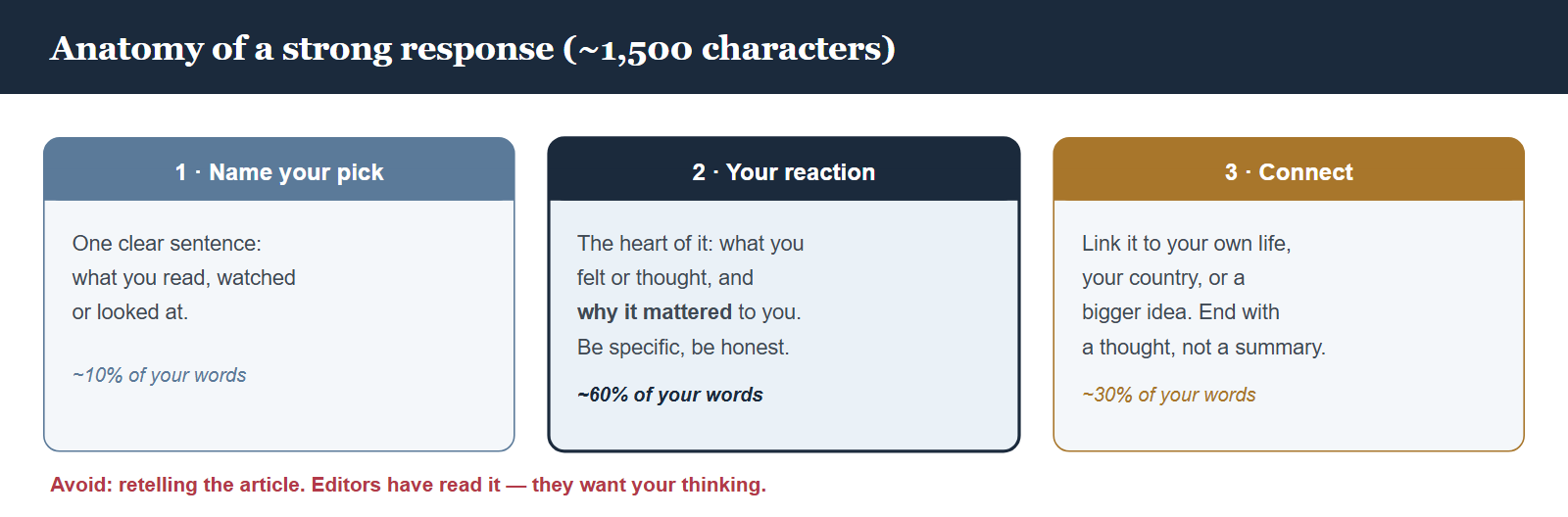
Notice the proportions: roughly 10% naming your pick, 60% your reaction, 30% the connection. If more than a quarter of your response is describing what the article said, you have written a book report, not a Summer Reading entry. To see how this lens applies across the other contests, our guide to what judges look for goes deeper, and the full season is laid out in our contest calendar.
A simple plan for the summer
With three windows rather than a summer of weeks, the arithmetic changes: there is no longer a cheap practice round to burn. A realistic plan is to enter all three, treat the first as the one where you learn the format, and aim to make the second and third genuinely strong. Keep a running note of anything in The Times that sparks a reaction between windows, so that when one opens you are choosing from a shortlist rather than starting from a blank page. For a student at an international school in China, that habit — noticing, reacting, finishing on a deadline — is worth more by August than any single certificate.
Questions about the contests?
Scan the WeChat QR code — we help with contest registration, one-on-one topic coaching, and full guidance to the deadline.
Scan the WeChat QR code

Frequently asked questions
How long is a Summer Reading Contest response?
Short — around 250 words, and for 2027 the calendar we have been shown also allows a video of up to about ninety seconds. The contest rewards a clear, specific reaction rather than length, so the limit is part of the challenge. Confirm the current limit on the official Learning Network each year.
Can international students enter the Summer Reading Contest?
Yes. It is open to students aged 13 to 19 worldwide, free to enter, and you may enter in each window that runs. Deadlines are in U.S. Pacific Time, which falls around Saturday afternoon in Beijing.
What can I write about?
Anything published in The New York Times that genuinely interested you that week — an article, photo, video, graphic or podcast. The key is to explain your reaction and why it mattered to you, not to summarise the piece.
How often can I enter?
In each window that runs — three of them across summer 2027 on the calendar we have been shown (4–11 June, 2–9 July, 30 July–6 August). Each window is judged separately, so a weak one never counts against you. Confirm the current dates on the official Learning Network.
Next steps
- How to enter, step by step — the mechanics, once you have picked your book or film
- Preparation resources — structure, length discipline and worked examples
- The full contest calendar — Summer Reading is one of several — plan the year, not one entry
This site is an independent editorial guide to The New York Times Learning Network’s free student writing contests, operated by Hanlin Education for China-based international-school students. We are not affiliated with, endorsed by, or sponsored by The New York Times Company or its Learning Network. Contest formats, character limits and dates change by season — always confirm the current rules on the official NYT Learning Network. Confirmed errors are corrected within 7 working days.