For New York Times Learning Network writing contests, your entry must be your own original work: you may quote and reference outside sources, but you have to credit them, you must not copy anyone else's words or ideas, and any AI use is allowed only within the official rules — which still require the thinking and writing to be genuinely yours. This guide shows how to cite cleanly, fact-check your own claims, and read the AI policy honestly. Always confirm the current rules at nytimes.com/learning.
What "original" actually means in a contest entry
Across its 2025–2026 calendar, the Learning Network runs roughly eight free contests for students aged 13–19 worldwide — from the 100-word My Tiny Memoir personal narrative and the My List review to Open Letters opinion writing, Voice and Choice summer reading, and the Growing Up With A.I. multimedia contest (contest names and dates change each season; confirm on the official site). Different contests, one constant: judges are looking for your thinking and your voice. "Original" here does not mean "an idea no human has ever had." It means the words on the page are yours, the argument is one you actually built, and every borrowed fact, quote, or image is attributed to where it came from.
That distinction matters because most strong entries do use outside material. A review cites the book or film it judges. An Open Letters opinion piece leans on a statistic or an expert. A summer-reading response quotes the Times article that sparked it. Using sources is not a weakness — hiding them is. The line you must never cross is passing off someone else's language, structure, or insight as your own. If you are new to how these contests work, start with our overview of what the NYT writing contests are, then come back here for the integrity mechanics.
How to cite and quote correctly
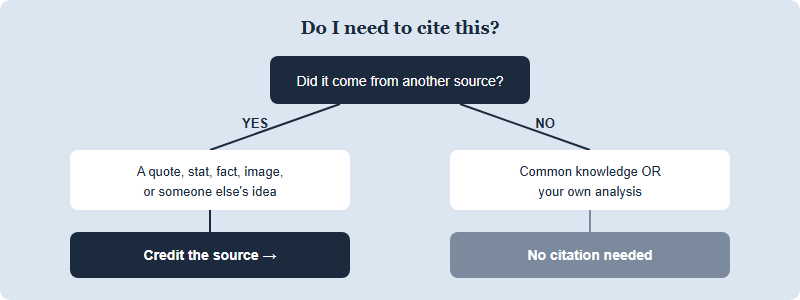
Contest entries are short, so you rarely need a formal bibliography. What you need is clear in-text attribution a reader can follow. The Learning Network typically asks for the contest's own format (some contests request a sources list or an artist's statement; some have strict word limits that exclude citations, some that include them). Because those details shift by contest and by season, check the specific rules page before you submit and confirm whether your citations count toward the word limit on the official rules.
Whatever the format, these craft habits keep you safe:
- Quote exactly, then attribute. Put borrowed wording in quotation marks and name the source in the same sentence: As economist Jane Doe wrote in The Atlantic…. Never lightly reword a sentence and drop the marks — that is paraphrase-plagiarism.
- Paraphrase in your own structure. A real paraphrase changes the sentence shape, not just a few synonyms, and still credits the original idea.
- Cite ideas, not just words. If a writer's argument shaped yours, say so — even if you used none of their phrasing.
- Link or name, consistently. Pick one style (author + publication, or a short source list at the end) and apply it to every borrowed item.
- Keep a working source list as you draft. Paste every URL and page you touch into a scratch doc immediately; reconstructing citations the night before the deadline is how mistakes happen.
| Situation in your draft | What this is | What to do |
|---|---|---|
| You use an author's exact sentence | Direct quote | Quotation marks + name the author/source in-text |
| You restate their point in your own words | Paraphrase | No quotes, but still credit the idea to its source |
| You cite a statistic or study result | Borrowed fact | Name the source; verify the number against the original |
| You include a photo, chart, or audio clip you didn't make | Third-party media | Credit the creator; check the contest's media-use rules |
| "Water boils at 100°C" / widely known dates | Common knowledge | No citation required |
| Your interpretation of the evidence | Your analysis | No citation — this is the original part judges reward |
Fact-checking your own claims
Originality and accuracy travel together. A vivid claim that turns out to be wrong undercuts the credibility a judge is weighing — and AI tools, if you used one to brainstorm, are notorious for inventing confident-sounding "facts" and fake citations. Treat every concrete assertion in your draft as a claim you must defend. The discipline is simple: if you state it as fact, you should be able to point to where you got it.
A practical self-check loop before you submit:
- Highlight every number, name, date, and quotation in your draft. Each highlight needs a real source you have actually seen — not a half-remembered figure.
- Go back to the primary source. If a statistic appears in a blog that cites a study, find the study. Confirm the number, the year, and the context (a 2019 figure is not a 2026 figure).
- Re-read quotations against the original word for word. Misquoting — even by accident — is both an accuracy error and an integrity one.
- Never trust an AI summary as a source. If a tool gave you a "fact" or a citation, verify it independently before it goes in. Many AI-generated references do not exist.
- When you can't verify it, cut it or soften it. Drop the claim, or reframe it as your impression rather than asserting it as established fact.
This is the same "drop it rather than guess it" rule serious editors live by. For contests like Open Letters opinion writing or the review contest, the strongest entries pair a real voice with evidence that holds up — which is exactly what we cover when we walk through how to find your story.
The AI rules, read honestly
Here is the part students most often get wrong. The Learning Network has stated that AI tools may be used only in accordance with its official guidelines, and for at least one contest the framing is explicit: the submission must primarily reflect your creative and presentation skills, not an AI's. The exact policy — what is permitted, what must be disclosed, and which contests treat AI differently — is set by The Times and can change each season, so read the rules for your specific contest and confirm on the official site. The spirit, though, is stable and worth internalizing: the contest is a test of your thinking and craft, not the tool's.
Questions about the contests?
Scan the WeChat QR code — we help with contest registration, one-on-one topic coaching, and full guidance to the deadline.
Scan the WeChat QR code
Translate that spirit into a clean line for yourself:
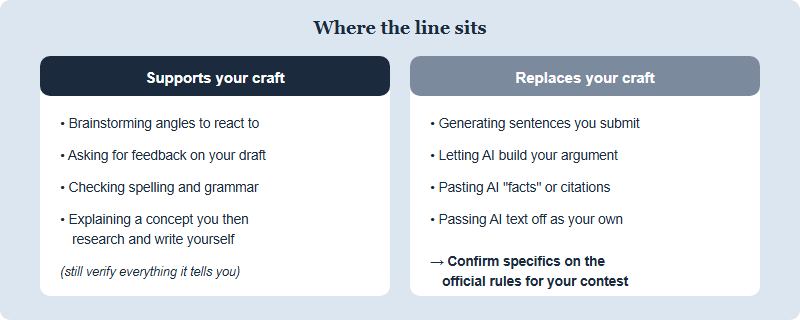
Two honest cautions. First, if a contest requires a statement about how you made your entry, that statement is part of your integrity record — describe your process truthfully. Second, "the rules technically allowed it" is not the same as "it's a strong entry." Judges reward a real human voice and genuine thinking; an entry that leans on a tool to do the actual writing tends to read as generic, exactly the quality that loses. The most reliable way to win is also the most honest: do the research, find your angle, and write it yourself.
A pre-submission integrity checklist
Run this list against your final draft before you submit. It takes ten minutes and protects months of work. Plan it into your timeline using the contest calendar so you are not doing it at 11:59 pm.
| Check | Why it matters |
|---|---|
| Every quote is in quotation marks and attributed | Prevents the most common form of plagiarism |
| Every paraphrase credits the original idea | Borrowed thinking still needs credit |
| Every number/date/name traces to a source you verified | Accuracy and integrity in one pass |
| No AI-generated text is presented as your own words | Core of the AI policy and of honesty |
| Any required process/artist's statement is truthful | The statement is part of your entry's honesty |
| You re-read the specific contest rules today | Word limits, citation handling and AI terms change by season |
| The argument and voice are unmistakably yours | This is what actually wins |
Frequently asked questions
Can I use AI to help with my NYT contest entry?
Only within The Times's official guidelines, and the writing and thinking must be genuinely yours. Confirm what's permitted for your specific contest at nytimes.com/learning.
Do citations count toward the word limit?
It depends on the contest, and rules change by season. Check that contest's current rules page and confirm on the official site before you submit.
What counts as plagiarism in a short entry?
Using someone else's words, structure, or ideas without credit — including lightly reworded sentences or unattributed AI text. Quote and attribute instead.
How do I fact-check my own claims?
Highlight every number, name and quote, trace each to a primary source you've actually seen, and cut anything you can't verify.
This is an independent guide operated by Hanlin Education for China-based international-school students. It is not affiliated with, endorsed by, or sponsored by The New York Times Company or its Learning Network, and it covers only the student writing contests, not New York Times news. Contest names, formats, word limits, deadlines, citation handling and AI policies change by season — always confirm current details on nytimes.com/learning. Confirmed errors are corrected within 7 working days.