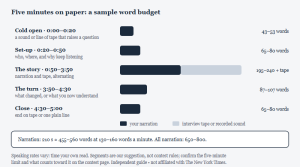
Every New York Times Learning Network writing contest is governed by two unforgiving rules: a tight word limit (most contests fall somewhere between roughly 100 and 600 words) and a strict submission format. Get either wrong and a strong entry can be set aside before a judge reads the argument. This independent guide decodes what actually counts toward the limit, how non-essay contests are measured, and the format traps that catch careful students — with exact values always to be confirmed on the official site.
Why the word limit is the real test
These contests are short by design. A Learning Network editorial is closer to 450 words than to a school essay’s two thousand, and a personal narrative is measured in hundreds of words, not pages. The skill being assessed is compression — saying something true and specific in very little space. That is why the word limit is not a formality to check at the end; it shapes every choice you make about scope, evidence and voice from the first sentence.
For international students this matters twice over. Writers working in a second language often over-explain — adding a clause to make sure the point lands. Inside a 450-word cap, that instinct is expensive. The discipline of the limit is exactly the discipline that later produces a sharp college essay, which is one reason the contests are worth entering even before any award. For the full line-up and how to pick your contest, start with our guide to the NYT Learning Network contests.
One rule above all: exact word counts, format specifications and submission steps change every season and differ by contest. Treat the numbers below as the recurring shape of the rules, and confirm the live limit for your contest on the official NYT Learning Network before you submit.
What usually counts toward the limit — and what may not
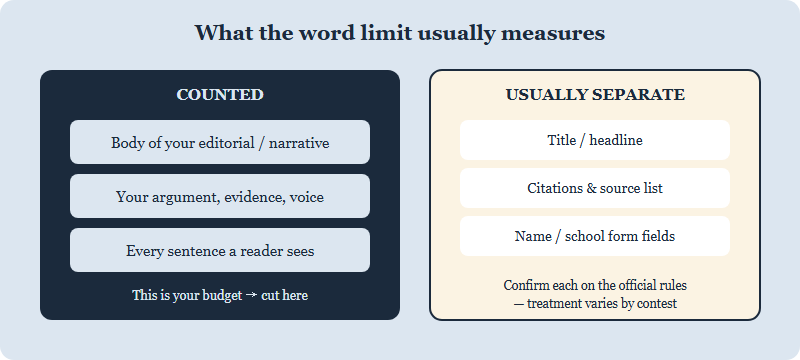
The most common panic question is: “Does my title count? Do my citations count?” The honest answer is that the rules state this explicitly for each contest, and you must read them — but there are conventions worth understanding so you know what to look for.
| Element | Typical treatment | What to do |
| The body of your piece | Counts — this is the limit | Budget it first; write long, then cut |
| Title / headline | Often excluded, but confirm | Check the contest rules before assuming |
| In-text citations & source list | Frequently excluded from the count for contests that require sourcing | Source anyway; never skip citations to save words |
| Your name / school fields | Entered separately on the form, not in the word count | Keep them out of the body |
| Captions, artist’s statements, footnotes | Varies by contest — sometimes separate, sometimes counted | Read the specific contest’s rules |
The safe operating rule: assume the body text is what is measured, and read the official rules for every exception. Do not cut citations, captions or a works-cited list to squeeze under a limit — for contests that require sourcing, those are usually counted separately, and removing them can hurt you on credibility while gaining you nothing.
How non-essay contests are measured
Not every Learning Network contest is judged on a word count. Several ask for a different unit of measurement, and students who treat them like an essay misread the brief. The principle to remember: each contest defines its own ceiling, and that ceiling is the test.
- Video and multimedia contests (for example a vocabulary-on-film contest) are typically capped by a time limit — measured in seconds, not words. A 15-second cap rewards a single sharp idea; treat it like a poster, not a paragraph.
- Audio / podcast contests are usually bounded by a running-time limit. Script tightly, because spoken words run long, and confirm the exact maximum length on the official rules.
- Review and Summer Reading contests are word-limited like the essays, but the unit being judged is your response to one specific work — the limit forces you to choose what to react to, not to summarise everything.
Because these formats and their exact ceilings change from season to season — and because some contests rotate in and out — never assume last year’s specification still applies. Check the current contest page, then plan your structure around its specific unit. The recurring seasonal pattern is mapped in our contest calendar.
The submission form: read it before you write
A surprising number of avoidable losses happen not in the writing but on the submission form. The official entry form for each contest asks for specific information and often includes steps that students discover too late. Without inventing the exact fields — they change, and you must read the live form — here is what to anticipate.
| Form element | Why it trips students up |
| Word-count or time confirmation | Some forms ask you to state your count; an inaccurate figure is a credibility risk — count honestly |
| Parental / guardian permission | Entrants under 18 typically need a permission step; arrange it days early, not at the deadline |
| Originality / AI declaration | Contests ask the work be your own; be ready to affirm authorship truthfully |
| Source list field (sourced contests) | Often a separate box — have your citations formatted and ready to paste |
| One-entry / format limits | Many contests limit how many entries you may submit; confirm before submitting twice |
Two of these deserve emphasis for China-based students. First, the parental-permission step for under-18 entrants is real and time-sensitive — do not leave it to the final hour. Second, contests that require sourcing usually want your citations supplied in a specific way; our companion guide on finding and shaping your story pairs naturally with getting the evidence right before you ever open the form.
Questions about the contests?
Scan the WeChat QR code — we help with contest registration, one-on-one topic coaching, and full guidance to the deadline.
Scan the WeChat QR code

The deadline is a format rule too
It is easy to think of the deadline as separate from “format,” but a late entry is a disqualified entry no matter how well it meets the word limit. Every Learning Network deadline is set in U.S. Pacific Time, which is the single most common way international students lose a finished piece.

The practical takeaway: a U.S. late-night deadline is actually generous for China — it lands around mid-afternoon the next day in Beijing. But that only helps if you read it as a Pacific-Time deadline and convert it. Submit a day early to dodge last-minute server load, and you have turned a classic trap into an advantage.
What we see with China-based students
This site is run by the editorial team at Hanlin Education, and we work each year with students at international schools in China who enter these contests. On format specifically, three patterns repeat. Students who write past the limit on purpose, then cut hard almost always produce a sharper final piece than those who write to length from the start — a 600-word draft compressed to a tight 450 beats a padded 450 nearly every time. Students who read the submission form before drafting avoid the parental-permission scramble that loses finished entries at the deadline. And the writers who treat the word limit as a creative constraint, not a punishment, are the ones whose entries get read closely. None of this guarantees an award — these contests are genuinely competitive — but it removes the self-inflicted reasons strong writing gets set aside.
Frequently asked questions
Does the title count toward the NYT contest word limit?
It is often excluded, but this varies by contest and changes by season. Read your contest’s official rules before assuming, and never pad or cut the body to compensate for the title.
Do citations count toward the word limit?
For contests that require sourcing, citations and the source list are frequently counted separately from the body. Always include your citations; confirm how they are measured on the official Learning Network rules.
How are video or podcast contests measured?
Usually by a time limit in seconds or minutes rather than a word count. Treat a short video cap like a poster — one sharp idea — and confirm the exact maximum length on the official contest page.
What happens if I go over the word limit?
Exceeding the stated limit can lead to disqualification, so stay within it. Write long while drafting, then compress hard, and count honestly if the form asks you to state your figure.
This site is an independent editorial guide to The New York Times Learning Network’s free student writing contests, operated by Hanlin Education for China-based international-school students. We are not affiliated with, endorsed by, or sponsored by The New York Times Company or its Learning Network. Word limits, format specifications, submission steps and deadlines change by season and by contest — always confirm the current rules on the official NYT Learning Network. Confirmed errors are corrected within 7 working days.