A contest reader meets your first sentence before anything else, and a limp opening can make even a thoughtful entry feel ordinary. The fix is not a clever gimmick — it is starting at a real moment instead of clearing your throat. This guide breaks down five reliable ways to open a New York Times Learning Network contest entry, the anatomy of a first line that earns the second, and the tired openers to delete on sight.
Why the first line does so much work
Learning Network judges read a large stack of entries. Your opening sets the tone in seconds and quietly signals whether you are going to summarize or actually think. A strong first line buys goodwill; a generic one asks the reader to be patient before you have earned it.
Judges apply a simple diagnostic without meaning to: the first-three-sentences test. If, after three sentences, the reader still does not know what your entry is really about or why you care, attention drifts. You cannot control how many entries a judge reads in a sitting, but you can control whether yours announces a point of view immediately.
Word limits raise the stakes further. The Summer Reading Contest, for example, asks for about 450 words (per a Hanlin note; confirm on the official page), and every other Learning Network contest sets its own limit — so confirm yours on the contest calendar and official page. When you only have a few hundred words, the first sentence is not a warm-up. It is load-bearing. If you are new to these contests, our overview of what the NYT writing contests are explains how the different formats work.
The throat-clearing problem: what to cut
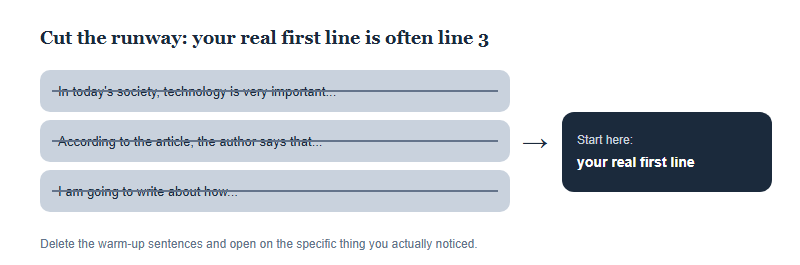
Most weak openings are not wrong — they are warm-up sentences the writer needed in order to get going, then forgot to delete. The reader does not need your runway. Your real first line is often the third sentence of your draft. Watch for these:
- “In today's society…” / “Since the beginning of time…” — the cosmic wind-up that could open anything.
- “According to the article…” — leading with the source instead of your reaction.
- “I am going to write about…” — announcing the essay instead of starting it.
- The dictionary definition — “The word ‘courage’ is defined as…”
These openers are not errors of grammar; they are errors of confidence. They stall because the writer is easing in rather than starting. The good news is that the cure is subtraction: delete them, and your entry almost always begins in a stronger place.
Five ways to open
Once the runway is gone, choose a lead that fits your piece. These five cover almost every contest entry:
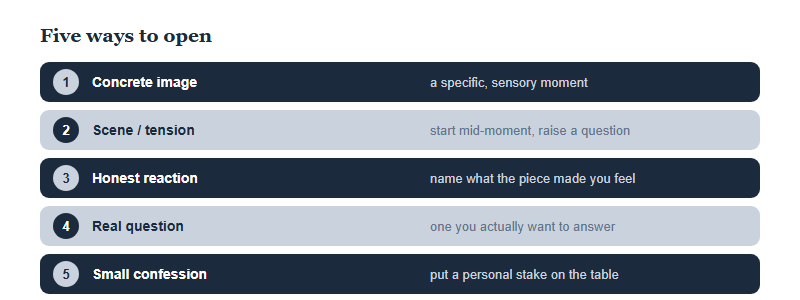
Here is how each works, with original examples you can study for shape (never copy published winners):
| Lead type | Original example | Trap to avoid |
|---|---|---|
| Concrete image | “The classroom clock had been stuck at 2:15 for a year, and only I seemed to notice.” | A pretty image with no point behind it |
| Scene / tension | “My grandmother refused to leave the hospital until she had watered the plant on the windowsill.” | Melodrama or a fake cliffhanger |
| Honest reaction | “I did not expect a chart about bus routes to make me angry, but there I was.” | Vague praise like “this was interesting” |
| Real question | “What does a city owe the people who clean it at night?” | A rhetorical question you never return to |
| Small confession | “I have been pretending to like a book my whole class loves.” | Oversharing that never connects to your point |
Weak to strong: three openings rewritten
Seeing the edit is more useful than reading the rule. Each pair below keeps the same idea but swaps a warm-up opener for a real entrance (all examples are original):
| Weak opening | Stronger rewrite | What changed |
|---|---|---|
| “In today's society, social media has a big impact on teenagers.” | “I deleted the app on a Tuesday and reinstalled it by dinner.” | A universal claim became one specific, honest moment. |
| “This article was very interesting and made me think a lot.” | “I have never argued with a weather map before.” | Vague praise became a concrete, surprising reaction. |
| “I am going to explain why exam pressure is a serious problem.” | “The night before the mock exam, my brother slept in the hallway so the light would wake him at 4 a.m.” | An announcement became a scene with real stakes. |
Notice the pattern: every rewrite trades an abstraction for a specific, checkable detail. You do not need a dramatic life story — a deleted app or a sibling in a hallway is plenty, because specificity is what makes a reader lean in.
The anatomy of a first line that lands
Strong openings tend to share a few structural traits. Aim for:
- A concrete noun. “A stuck clock” beats “a problem in my school.” Specificity reads as authority.
- A verb that moves. Let something happen, refuse, break, or surprise — not just “is” or “was.”
- One idea. Do not stack three thoughts into sentence one. Save them; they are your paragraphs.
- A hint of stakes. The reader should sense that something is at risk, unresolved, or worth caring about.
Beware the opposite failure, too: an opening so vague it could belong to anyone. “Life is full of challenges” is not an opening; it is a placeholder. Replace every abstract noun — society, technology, challenges — with something a reader can actually see.
Questions about the contests?
Scan the WeChat QR code — we help with contest registration, one-on-one topic coaching, and full guidance to the deadline.
Scan the WeChat QR code

Short is fine. A six-word opening can outperform a thirty-word one, because length is not the variable that matters — pressure is. A short sentence that opens a question does more work than a long one that merely arranges the furniture. And in a reaction contest, connect to the piece you read within a sentence or two, so the judge sees both your voice and the source that sparked it.
Match the opening to the contest
Different Learning Network contests reward slightly different entrances (confirm each contest's brief officially):
- Reaction-based contests (such as Summer Reading): open on the detail that snagged you or the feeling it triggered, then name what you read.
- Narrative contests: open in scene — a specific moment, not a summary of your whole life.
- Argument or letter contests (such as the Open Letters Contest): open on the stake — who is affected and why it cannot wait — so the reader feels the urgency before the evidence arrives.
Whatever the format, resist the urge to explain your opening. If your first line is a scene, do not follow it with “This shows that…” Let the image do its work and trust the reader to follow you into the second sentence.
A quick self-test before you submit
Run your first sentence through four questions:
- Does it contain a concrete noun a reader can picture?
- Could this exact line open a hundred other essays? If yes, it is too generic.
- Does it make the reader need sentence two?
- When you read it aloud, does it sound like you — or like a textbook?
If a line fails, do not agonize. Look two or three sentences down; the real opening is usually already written, waiting under the warm-up.
One habit makes all of this easier: write your opening last. Once the body exists you know what the piece is actually about, and the right first line is far easier to find — sometimes it is a phrase you already wrote in the middle. Draft freely, then go hunting for it.
Frequently asked questions
Should a contest entry open with a quote from the article?
It can, but lead with your angle on it, not the quote alone. A borrowed sentence should frame your reaction, not replace it. Confirm any citation rules on the official page.
Is a rhetorical question a good opening?
Only if you genuinely answer it in the piece. A question you abandon feels like a trick; a question you chase can organize the whole entry.
How long should the opening sentence be?
There is no fixed length. Short, concrete openings often work best inside tight word limits — about 450 words in Summer Reading, and each contest's own limit otherwise. Confirm officially.
What if I cannot think of a strong first line?
Draft the whole entry first, then delete your opening paragraph. The sentence underneath is often the real beginning you were reaching for.
This is an independent guide operated by Hanlin Education for China-based international-school students. It is not affiliated with, endorsed by, or sponsored by The New York Times Company or its Learning Network. Contest formats, word counts, and deadlines change every year — confirm current details on nytimes.com/learning. Spotted an error? We correct verified mistakes within 7 working days.