The last line is the note that keeps ringing after a judge finishes reading, yet most contest entries fade out on a summary of what they just said. A strong ending does the opposite: it lands on the newest thought, not a restatement. This guide covers four kinds of ending that work in a New York Times Learning Network contest, the closers to avoid, and a quick test for whether your final line earns its place.
Why the ending carries so much weight
Readers remember beginnings and endings most. After a judge has read dozens of entries, your last sentence is the taste left in their mouth — it shapes the final impression far out of proportion to its length. In a tight word count, that leverage is even higher: the Summer Reading Contest asks for about 450 words (per a Hanlin note; confirm officially), and every Learning Network contest sets its own limit, so a wasted final sentence is an expensive mistake.
There is also a practical reason to sweat the ending: it is the easiest place to sound like everyone else. “In conclusion” and “only time will tell” appear in thousands of entries, so a fresh, specific close is one of the fastest ways to stand out from a large field without resorting to any gimmick.
If you are still learning how the different formats work, our overview of what the NYT writing contests are is a good starting point. This piece assumes you have a draft and need to nail its landing.
The one rule: end on the newest thought
The most common weak ending simply restates the introduction. But the reader already read your introduction — repeating it signals that your thinking stopped. A strong ending pushes one step past where the body left off. Ask yourself: after everything I just argued or described, what do I understand now that I did not at the start? End there.
This does not mean a dramatic twist. It means a small, earned movement — a realization, a reframing, an image that now means more than it did on page one because of everything in between.
A quick way to find that newest thought: look at your final body paragraph and ask what it implies that you never quite said out loud. That unspoken implication is often your ending. You are not adding new information; you are naming the understanding your evidence has already produced.
Four kinds of landing
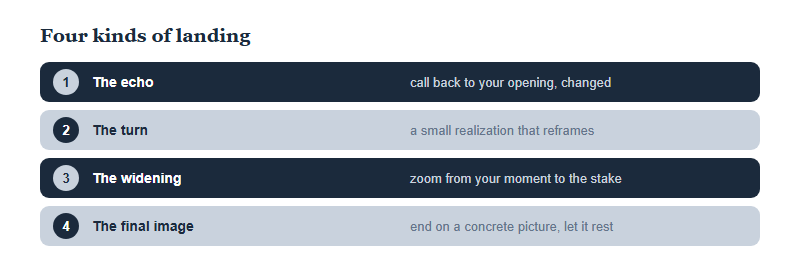
Four ending shapes cover almost every contest entry, and none of them is inherently better than the others. The right landing depends on how your piece began and what it discovered along the way. Read your draft once, straight through, and notice which shape it is already leaning toward — the ending is often half-built before you sit down to name it. Pick the one your piece has been quietly setting up.
| Ending type | Original example (for shape only) | Trap to avoid |
|---|---|---|
| The echo | “The clock still says 2:15. Now I am the one who checks it.” | Repeating your opening word-for-word |
| The turn | “I came in to argue about bus routes. I left arguing with myself.” | A twist that contradicts your own point |
| The widening | “One stuck clock is a small thing. A school that stops noticing small things is not.” | Preaching, or a grand generic moral |
| The final image | “She watered the plant, set down the cup, and finally let them wheel her away.” | An image with no meaning behind it |
Weak to strong: three endings rewritten
As with openings, the edit teaches more than the rule. Each pair keeps the writer's point but replaces a wind-down closer with a real landing (all examples are original):
| Weak ending | Stronger rewrite | What changed |
|---|---|---|
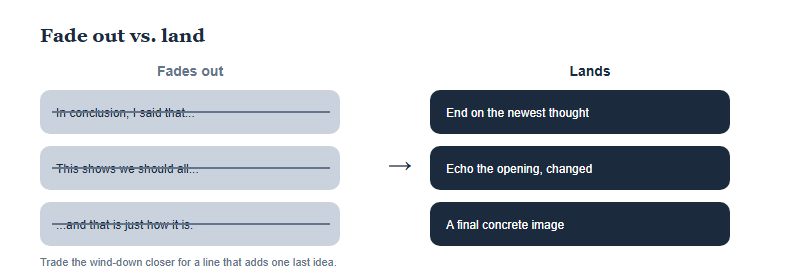
| “In conclusion, social media has both good and bad sides.” | “I reinstalled the app, but the phone lives in another room now.” | A both-sides summary became a small, specific change. |
| “This shows that we should all care more about the environment.” | “The river is still there. So is the pipe.” | A generic moral became a concrete, unresolved image. |
| “At the end of the day, exams are just part of life.” | “My brother passed. He still sleeps with the hallway light on.” | A cliche became a detail that lingers. |
Each rewrite stops summarizing and instead leaves the reader with one concrete thing to hold. Notice, too, that the stronger endings are shorter — landings rarely need many words.
Endings to avoid
Five closers weaken almost every entry they touch:
- “In conclusion…” followed by a restatement. The reader can see the essay ending; you do not need to announce it.
- The lecture. “This shows that we should all…” turns a thoughtful piece into a slogan.
- The new-topic dump. Introducing a fresh idea in the last line that you never develop leaves the reader hanging.
- The trail-off. “…and that is just how it is” reads as a shrug, not a landing.
- The cliche. “Only time will tell” and “at the end of the day” are places thinking goes to stop.
What these five share is a retreat from specificity. At the exact moment the reader is most attentive, the writer reaches for a phrase that would fit any essay ever written. The remedy is always the same: get more concrete, not more general — name a person, an object, or an action rather than a category.
Questions about the contests?
Scan the WeChat QR code — we help with contest registration, one-on-one topic coaching, and full guidance to the deadline.
Scan the WeChat QR code

Let the ending answer the opening
The most satisfying endings are secretly designed with the opening. If you began on a concrete image, the echo ending returns to it — but changed by everything in between, so the reader feels how far the piece has traveled. If you began on a question, the ending is where you finally answer it (or admit why you cannot). This is also why endings come easier when your opening is strong: a vivid first image or a genuine question gives the last line something specific to answer.
This bookend logic matters most in argument and letter formats. In the Open Letters Contest, for instance, a widening ending that returns to the specific person affected — not a generic call to action — leaves the strongest impression, because it reminds the reader who the stakes belong to. Confirm each contest's brief on its official page.
As a rough map: reaction contests often suit the turn or the echo; personal narratives suit the final image; arguments and letters suit the widening — as long as it narrows back to a specific person or place rather than a slogan. Treat these as starting points, not rules, and let your own piece decide.
A last-line self-test
Before you submit, run your final sentence through four checks:
- Does it add? If your last line says nothing your earlier lines did not, it is a summary, not a landing.
- Could you delete it and lose nothing? If so, delete it — the line above may already be your ending.
- Does it restate the intro? If it echoes your opening idea without changing it, push one step further.
- Does it land when read aloud? Say the last three sentences out loud. A landing has a small click; a shrug does not.
When you have an ending you trust, keep the contest calendar open and pick your next entry — the fastest way to get better at landings is to write a lot of them.
And if your ending fails all four checks, do not panic and pile on more words. The cure for a weak ending is almost never a longer one — it is finding the line, often already sitting in your draft, where your thinking actually arrived, and stopping there.
Frequently asked questions
Should a contest entry always have a separate conclusion paragraph?
Not necessarily. Inside a tight word limit, one strong final sentence often beats a whole wind-down paragraph. Let the piece stop when the thought is complete.
Is it okay to end on a question?
Yes, if the question is genuine and grows out of your piece. Avoid a vague question used only to sound deep — end on one that your entry has actually earned.
Can I reuse a line from my introduction as the ending?
Reusing it word-for-word feels flat. Change it — same image, new meaning — so the echo shows how far your thinking moved.
How do I end without sounding preachy?
Return to something concrete and specific rather than a grand moral. Trust the reader to draw the lesson from your detail. Confirm all rules on nytimes.com/learning.
This is an independent guide operated by Hanlin Education for China-based international-school students. It is not affiliated with, endorsed by, or sponsored by The New York Times Company or its Learning Network. Contest formats, word counts, and deadlines change every year — confirm current details on nytimes.com/learning. Spotted an error? We correct verified mistakes within 7 working days.