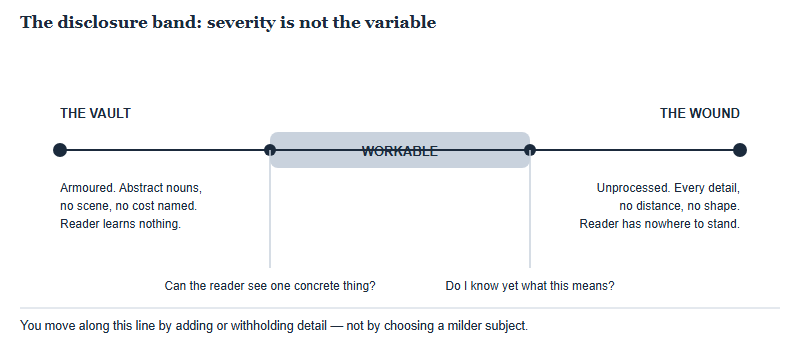
Difficulty is not depth. Personal contest forms reward specificity, which pulls students toward the hardest material they own — illness, separation, loss, a family under strain. But readers are not scoring severity. They are asking what you did with it. The workable band sits between the armoured draft that reveals nothing and the raw one a reader cannot use.
Severity is not the variable
The belief underneath most difficult student entries is that a bigger subject produces a stronger piece. It does not, and the belief is worth dismantling early because it drives two opposite disasters: students who reach for material they cannot yet handle, and students who conclude their own lives are too uneventful to write about.
What a reader can actually assess is narrow and specific. How precisely did you see the thing. What did you select and what did you leave out. What does the finished piece understand that a diary entry would not. None of those improve because the underlying event was worse. A grandmother’s hands on a bus ticket, fully observed, will outperform “the meaning of family” every time, and the second phrase is what students reach for when the first feels too small to count.
This is not an argument for avoiding hard material. A great deal of the best student writing is about difficult things, and the personal forms exist partly to make room for it. The point is only that the difficulty earns nothing on its own — it has to be converted into observation before it becomes writing. And it must be real: never invent or inflate an experience to make a piece land. Beyond the obvious dishonesty, whether a given contest requires non-fiction, and what counts as original work, are rules questions to confirm on the official Learning Network page.
Three ways a difficult entry fails
These failure modes are recognisable from the first paragraph, and each has a specific repair. Note that two of the three come from being too close to the material and one from being too far, which is why “write more about it” is such unreliable advice.
| Failure | What it looks like on the page | What the reader experiences | The repair |
|---|---|---|---|
| The vault | Abstract nouns, years summarised in a clause, “it was a difficult period”, no scene anywhere | Learns the category of the event and nothing about the event | Choose one hour and put it on the page in full |
| The wound | Everything, in order, at the same intensity; nothing selected, nothing withheld | Is handed something heavy with no handle on it | Cut to the single moment, then write the sentence that comes after it |
| The bow | A tidy resolution arriving in the last two lines: what mattered was family, what mattered was hope | Stops believing the preceding paragraphs, retrospectively | End on what changed in you, not on the problem being solved |
The bow deserves particular attention because it is the one students are taught. School reflective writing frequently asks for a lesson learned, and the reflex survives into contest entries where it reads as insincerity. If the situation is not resolved, saying so is stronger than manufacturing an ending. A reader will forgive an unresolved piece; they will not forgive a false one.
The test that works: distance, not subject
The useful question is not “is this too much to say?” It is “have I finished thinking about this?” Material becomes writable at the point where you can look at it rather than only from inside it, and that point has nothing to do with how serious the event was.
There is one reliable operational test. Try writing the last line first. Not the resolution — the sentence that tells the reader what the piece now understands. If you can write it, you have distance and you can safely go back and put the hard scene on the page in full detail, because you know where it is going. If you cannot write it, you are still inside the experience. That is information about timing, not a verdict on your ability.
Two further checks, both quick:
- The selection check. Can you cut a third of it? If every detail feels non-negotiable, you are probably writing to discharge the experience rather than to communicate it. Communication requires choosing; discharge refuses to.
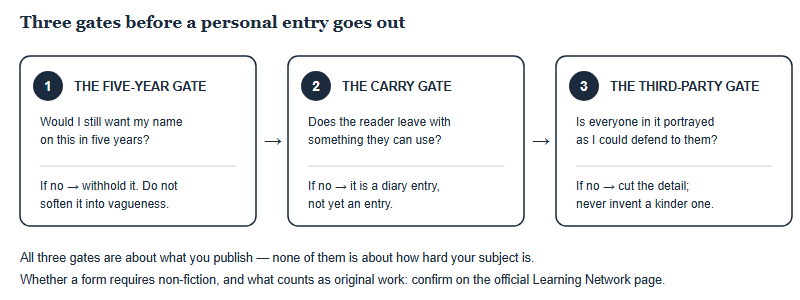
- The five-year check. Would you still be willing to have your name attached to this in five years, when the people in it have moved on and you have too? A yes is not a guarantee of quality, but a no is a reliable stop signal.
A practical separation that helps more than anything else on this list: draft the piece privately first, with no word limit and no contest attached, then decide separately whether to enter it. Students routinely conflate two different decisions — whether to write something and whether to publish it — and the conflation is what produces both the vault (deciding not to write because you have decided not to publish) and the wound (publishing because you have written).
Other people are in your story, and they did not agree to be
Every personal entry has co-authors who never consented. A mother, a friend who said the wrong thing, a teacher who handled it badly. This is the part students think about least and regret most.
The first move is to notice that identifiability comes in three grades, and that most people only consider the first:
Questions about the contests?
Scan the WeChat QR code — we help with contest registration, one-on-one topic coaching, and full guidance to the deadline.
Scan the WeChat QR code

- Identifiable to strangers. Named, or described so specifically that a reader anywhere could find them. Rare in student entries.
- Identifiable to your community. Everyone at your school knows exactly which teacher, which incident, which family. This is where nearly all the real damage happens, and changing a name does nothing about it. For a student at a small international school where the whole cohort reads the same things, this grade matters far more than the first.
- Identifiable to themselves. Only that one person will recognise it. Often unavoidable, and often fine — provided the portrayal is one you could defend to them.
From that, three working rules. Ask when you can, and you can more often than you expect; a parent asked in advance is usually an ally and occasionally a source of detail you did not have. Change identifying detail, never change what happened — the moment you improve or worsen someone’s behaviour to make the arc land you have crossed from non-fiction into something else, and whether that is permitted at all is a rules question for the official Learning Network page, not something to infer. Apply the to-their-face test: read the paragraph imagining the person is holding it. Assume they will hold it, because in a school community they usually do.
Addressed forms sharpen all of this considerably. When a piece is written to a named recipient rather than about them, the ethics and the craft become the same problem — our guide to the Open Letters contest works through what it means to write for a reader who can answer back.
When the honest answer is “not this piece, not this year”
Choosing a smaller subject is a craft decision, not a retreat. “Smaller” here means something precise: material you have complete access to, that you are allowed to think aloud about, and that has an ending you can actually reach by the time you submit. A piece about a queue, a borrowed jacket or a mistranslation can meet all three. A piece about a bereavement six weeks old usually meets none of them, however important it is.
One first-party observation, de-identified and offered as a pattern rather than a rule. Across the personal entries we read from China-based students, the vault is far more common than the wound — roughly the reverse of what most published craft advice assumes. Reticence about family matters, a school culture that rewards composure, and writing in a second language all push in the same direction, toward abstraction. The useful note on those drafts is almost never “tell me more”; it is “give me one hour of it, with the objects still in the room”. Individual results vary and nothing here changes the odds in any contest.
Finally, a boundary worth naming plainly. If sitting with the material is genuinely distressing rather than merely difficult, that is not a craft problem to push through for a deadline. Talk to a counsellor, a tutor or someone at home, and let the contest wait. There will be another one; our calendar overview shows how the year is shaped, and the sequence repeats.
Frequently asked questions
Do these contests reward more serious subjects?
No. Readers assess how precisely you saw something and what shape you gave it. A small subject fully observed beats a large one gestured at.
Should I change names and details to protect people?
Change identifying details where you can, but never change what happened. Whether composites are permitted is a rules question for the official page.
How do I know whether I am too close to the material?
Try writing the last line first. If you cannot say what the piece understands, you are still inside the experience rather than looking at it.
Is it a weakness to write about something ordinary?
No. Ordinary material you can reach completely is far stronger than dramatic material you can only describe from a distance.
This is an independent guide operated by Hanlin Education for China-based international-school students. We are not affiliated with, endorsed by, or sponsored by The New York Times Company or its Learning Network. Contest line-ups, prompts, eligibility rules, word limits and deadlines are set by the Learning Network and change from year to year — confirm current details on nytimes.com/learning before you plan or submit. Factual errors are corrected within 7 working days of notice.