You already did the reading. An Extended Essay, an IA, a research paper or a history coursework essay represents months of work that most students never touch again — and then they start a contest entry from nothing. The research travels. The prose does not. Here is how to pull a contest-sized piece out of a file you have already written.
You are sitting on research you have not used
The pattern is almost comically wasteful. A student finishes a major piece of coursework, files it, and then in the same term begins a contest entry on a subject they know nothing about — researched over a weekend, written from three tabs. Meanwhile the coursework did something genuinely unusual: for a few months it made them the person in their school who knew most about one narrow thing.
That is a real asset, and it is worth being precise about why. It is not that you wrote thousands of words; nobody cares. It is that in the course of writing them you probably handled a primary source directly, or collected data yourself, or interviewed somebody, or visited a place. An entry researched over a weekend from search results has none of those. Access and first-hand handling are exactly what short forms reward, because they are what cannot be assembled from search results.
Students hesitate here because they suspect the whole idea might be a form of cheating. It is not, provided you are clear about which layer of the work may travel and which may not — that distinction is the rest of this article. But note the boundary now: whether a piece of writing previously submitted for school assessment, or previously published in a school magazine, may be entered at all is an eligibility question set by the contest. Confirm it on the official Learning Network page rather than reasoning from what other competitions permit.
What transfers, and what does not
Open your coursework and sort it into three piles. Most of the document is in the third pile, and that is normal — academic scaffolding exists to demonstrate rigour to an examiner, and a general reader neither wants nor needs to see it.
| Component of your coursework | Travels? | What it becomes |
|---|---|---|
| The research question (“To what extent…”) | No | Has to be rewritten as a claim, in a declarative sentence |
| Literature review / theoretical framework | No | Nothing. It exists to show an examiner you read around the topic |
| Methodology section | Rarely | At most one clause, and only if how you know is itself surprising |
| A primary source you handled yourself | Yes | Often the concrete centre of the entry |
| Fieldwork, site access, an interview | Yes | The scene, or the authority standing behind a claim |
| A finding that surprised you | Yes | Usually the lead. This is the single most valuable item in the file |
| Data you collected | One figure of it | A single number, framed in one sentence — not a table |
| Your evaluation and conclusion | Partly | The claim, once the hedging is stripped out |
| The bibliography | No | Re-check the sources at source instead of trusting your own notes |
| The prose itself | Never | Retype from the idea, with the original file closed |
Read that middle column and the shape of the job becomes clear. You are not shortening a document. You are extracting perhaps two items from it — a finding and the thing that produced the finding — and building a new piece around them.
The hardest move: from a research question to a claim
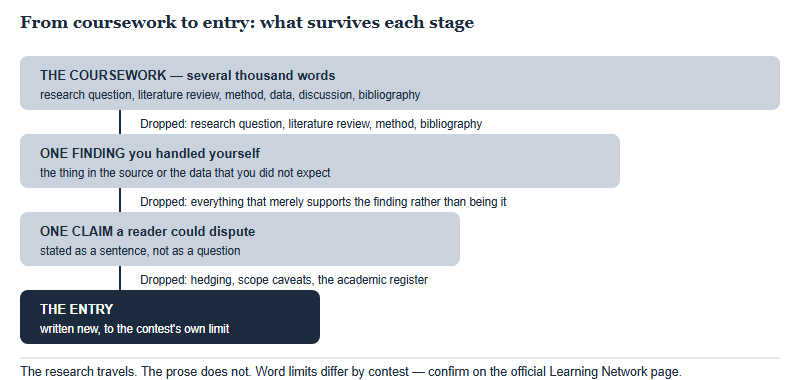
Coursework is engineered to be balanced. It asks a question, surveys the positions, weighs them, and concludes cautiously. Contest forms want the opposite: a position you will defend, or a scene you will let stand. Converting between the two is the move that most students get wrong, and it happens in two steps rather than one.
Take an invented example. Suppose an Extended Essay investigated whether air-quality readings in a district tracked reported respiratory clinic visits. The academic version asks: to what extent do publicly reported air-quality indices correlate with primary-care respiratory presentations in district X? Nobody outside an examination room will read that sentence.
Step one is to find the finding — not the conclusion, the finding. In this invented case the conclusion was a cautious “partial correlation, with limitations”, but the interesting thing the student actually discovered along the way was physical: the monitoring station nearest the school is mounted well above street level. Step two is to state that as something a reader could argue with: the number our school trusts is measured several metres above where anyone actually breathes.
Notice what has happened. The entire apparatus — the correlation analysis, the limitations paragraph, the literature — has gone. One physical fact survived, and it now carries the whole piece. That is not a loss of rigour; the rigour is what let you find the fact in the first place, and it stays visible in how confidently you can handle challenges to it.
One warning about the same move: the register has to change too, and that is a separate discipline from the extraction. Coursework habits — signposting, hedging, nominalisation, the passive — will follow the content across unless you actively strip them, and they are the fastest way to make a good finding read like a report. Which form the finished piece belongs in is a further question: a finding like this could become an argument, a letter to whoever commissioned the station, or a straight explainer. Our overview of what the Learning Network contests are sets out what each family asks for.
Questions about the contests?
Scan the WeChat QR code — we help with contest registration, one-on-one topic coaching, and full guidance to the deadline.
Scan the WeChat QR code

Three rules that keep you inside the line
Everything above is legitimate use of your own knowledge. These three rules are what keep it that way.
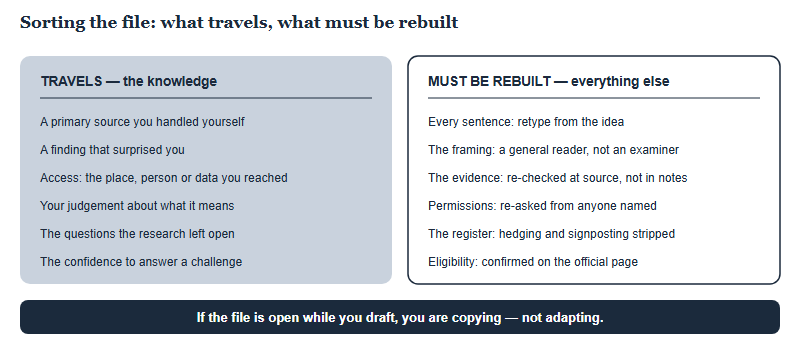
- The text never travels. Not a sentence, not a well-turned phrase you were proud of. The practical method is mechanical: write a note of the finding in about thirty words from memory, close the coursework file entirely, and draft from the note. If the document is open beside you, you are copying and adapting, not writing. This also produces better prose, because a sentence built for a short piece has different work to do than one built for an examiner.
- Re-verify everything for a public audience. Coursework is read by one examiner who assumes good faith and is marking your reasoning, not fact-checking your figures. A contest entry is read by strangers with no such assumption. Go back to source for every number, date and attribution — not to your own notes, to the source. Anything you cannot re-confirm does not go in.
- Eligibility is not something you can reason out. Whether previously submitted or previously published work may be entered, and what the originality conditions are, is set by the contest and revised over time. Confirm on the official Learning Network page. Do not infer it from another competition’s rules, from what a teacher assumes, or from what a friend did last year.
A fourth, easily forgotten: permissions do not carry over. Someone who agreed to be interviewed for a school assignment agreed to appear in a document read by one examiner. A public entry is a different proposition, and the correct move is to go back and ask again, naming what it is for.
Which coursework yields which kind of entry
What follows is our editorial judgement about likely fits, not a rule and certainly not a statement about eligibility. Match your material to the form family first, then check what that contest actually requires.
- Science IA or lab work → an explanatory piece, but only if you can answer “why should a stranger care?” without irritation. A well-executed titration is not automatically interesting; an unexpected source of error often is.
- History essay or historical investigation → usually an argument, occasionally a profile if one person sits at the centre of what you found. Archive work is a strong asset here because first-hand contact with an original document is not something a weekend of searching can produce.
- English literature essay → a review, if the object is contemporary and available to a general reader; otherwise an argument about how something gets read.
- Psychology, geography or economics IA → argument if you found something, explainer if you understood something. The distinction is worth being honest about, because an explainer written by someone who does not really understand the mechanism is transparent.
- Service, activity or community project records → narrative or profile. The interviews you already conducted are the asset; the reflection template you filled in is not.
- Language B, translation or bilingual coursework → often a narrative built around a single word or mistranslation.
On that last one, a first-party observation offered as a pattern rather than a promise, and de-identified: among the students we work with, translation problems are consistently the most productive raw material and the most under-used. A word that does not cross cleanly between Chinese and English is concrete, personal, genuinely unfamiliar to a general reader, and small enough to fit a short form without compression — which is a rare combination. Individual results vary and nothing here affects the odds in any contest.
Once you know roughly what your material wants to be, work out where in the year to aim it. The sequence of contests across the school year is set by the Learning Network and revised annually; our calendar overview shows the shape of the year, and the official page carries the current dates.
Frequently asked questions
Can I enter an essay I already submitted for school?
An eligibility question, not a craft one. Rules on previously submitted or published work are set by the contest — confirm on the official page.
Is reusing my own research self-plagiarism?
Using knowledge you built is normal practice. Reusing sentences is not. Draft with the original file closed and the distinction looks after itself.
My coursework runs to thousands of words. How much of it survives?
Usually one finding and the source behind it. The research question, literature review and methodology are examiner scaffolding and do not travel.
Do I need a bibliography the way I did for school?
Short forms usually attribute inside the sentence rather than in a list, but sourcing expectations differ by contest — check the official page.
This is an independent guide operated by Hanlin Education for China-based international-school students. We are not affiliated with, endorsed by, or sponsored by The New York Times Company or its Learning Network. Contest line-ups, prompts, eligibility rules, word limits and deadlines are set by the Learning Network and change from year to year — confirm current details on nytimes.com/learning before you plan or submit. Factual errors are corrected within 7 working days of notice.