For students preparing for the NYT Open Letters Contest 2027, the hardest craft problem is not picking a topic — it is serving two readers at once. The contest window runs from February 17 to March 31, 2027, and, per the 2026-27 New York Times student contest calendar as summarised by Hanlin International Education (published September 6, 2026), entries must be addressed to an individual or group with the power to drive change around a social issue the student truly cares about. The letter is inspired by Martin Luther King Jr.’s “Letter from Birmingham Jail”. Entries run up to 500 words excluding the title, and eligibility for the series is generally open to students aged 13-19 worldwide, including students who have finished high school but have not yet started university. The core difficulty is structural: the letter faces its recipient and is also read by the public. Balance both audiences inside that limit and the draft stops reading like a private plea or a general essay.
This article is aimed at students who have already chosen a recipient and now need to know how to keep an unseen second reader in the room. It does not repeat the earlier Hanlin guide on NYT Open Letters Contest: Choosing a Recipient Who Can Act; it assumes that decision is done and works on what comes next.
The Two Readers Every Open Letter Must Serve
An open letter is a hybrid form. It is not a private email, and it is not a standard editorial either. It occupies a middle space where personal conviction meets public persuasion. The primary recipient has agency — a school board, a city council, a CEO, a minister, a peer group, a university committee. The secondary audience is the stranger scrolling the Learning Network page. That stranger does not know you, does not share your grievance, and is reading to find insight, clarity or a new angle on a known problem.
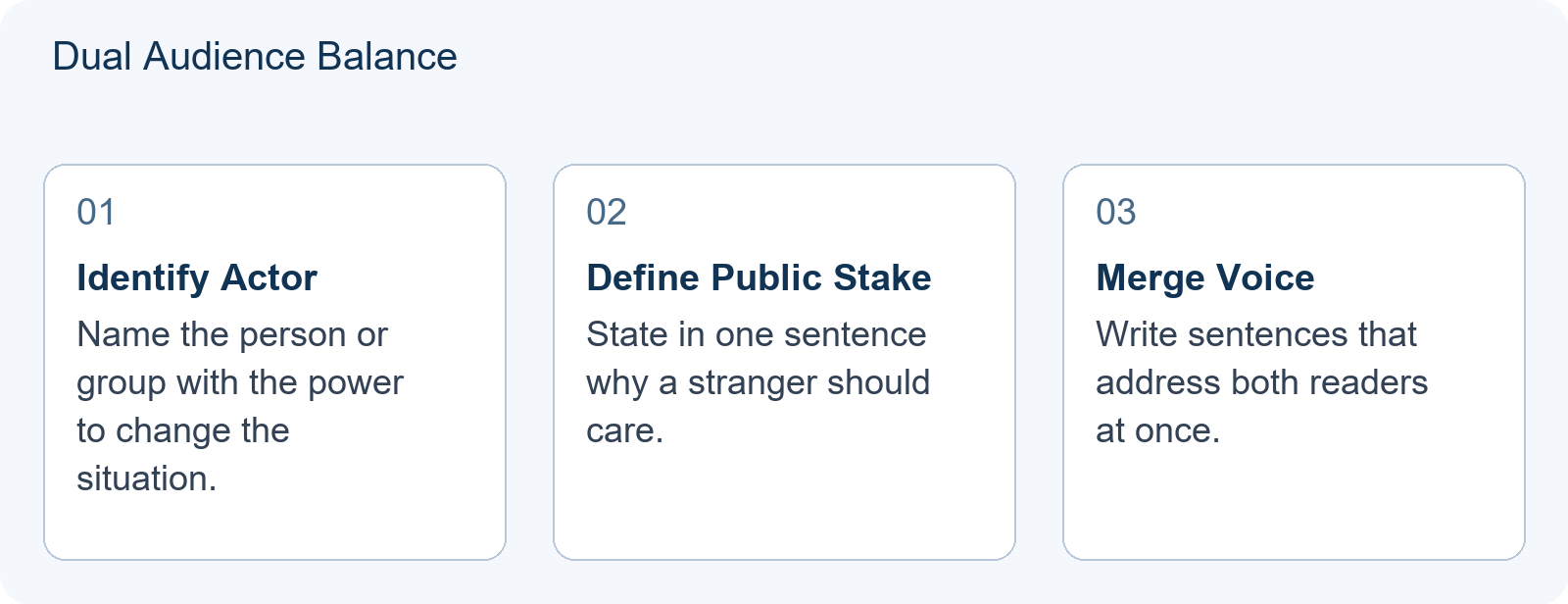
Missing the second reader produces a letter that feels insular. Missing the first reader produces a letter that feels vague. The strongest entries interleave the two. They use direct address to create urgency and specificity, and they use public voice to supply evidence, emotional resonance and wider relevance. If you are writing to a mayor about park funding, you cannot simply recite a budget line. You must show every resident who uses those parks why the line matters, and in doing so you invite the public reader into the argument.
There is a useful test before you draft: cover the salutation. Does the letter still make sense to a reader who has never met your recipient? Then cover the body and keep only the salutation. Does that alone tell you who has the power to change something? If either test fails, the balance is off.
A Two-Column Planning Table: Recipient Needs vs. Public Context
Because the two audiences pull in different directions, planning matters more than drafting. A simple two-column table lets you check, paragraph by paragraph, which reader each section is primarily serving. Every good sentence technically serves both, but the emphasis should visibly shift back and forth rather than clump into one column.
| Element | Recipient Focus (Direct Appeal) | Public Focus (Context and Persuasion) |
|---|---|---|
| Opening | Name the recipient and signal why their power is the point of the letter. | Hook the wider reader with a specific scene, number or shared value. |
| Body 1: The gap | Describe the specific failure, delay or omission in the recipient’s current policy or practice. | Explain what that gap costs the broader community, with one concrete example. |
| Body 2: The ask | Make one action the recipient can take, stated in an imperative sentence. | Show why the action is feasible, fair and already working elsewhere. |
| Closing | Restate the request and invite a reply. | Close on a forward-looking image or principle that the public can carry away. |
If a student finds every row filled only under “Recipient Focus”, the letter is closer to a complaint box entry. If every row lands under “Public Focus”, the letter has drifted into a general op-ed that forgot its addressee. The table is not a template for the final draft — it is a planning tool for spotting that drift before the writing hardens.
How the 500-Word Limit Changes the Balance
Five hundred words is tight. In an 800-word essay you might have room for background. Here, every word must do double duty, and that pressure actually helps. Long background bores the public; vague requests frustrate the recipient. Brevity becomes a rhetorical tool, not just a submission rule.
A common cut is historical context. Instead of walking a reader through a decade of policy, focus on the immediate consequence. Use active verbs and specific nouns. “It was decided that funds would be cut” distances both audiences; “You cut the funds in March” names the actor and the moment. Compress further by fusing fact and implication in a single sentence: “The library closes at 4 p.m., leaving working parents without after-school childcare.” One line informs the public about the schedule and signals to the recipient the human cost of that decision.
Word budgets help here. As rough guide only, many strong short opinion pieces spend roughly 60-90 words on the opening, 250-300 on the two body paragraphs, and 60-90 on the close, with the remainder held for transitions. Treating these bands as targets prevents the middle from swallowing the ask.
Labelled Teaching Illustration: Same Paragraph, Two Audiences
The block below is a hypothetical teaching illustration, created to show how a single paragraph can serve both readers. It is not a submitted entry and not an official contest example.
Hypothetical Draft:
“Principal Smith, when you reduced counselling staff last year, you did not just save budget dollars; you removed the safety net for hundreds of students who now walk past empty offices hoping for help. We see the anxiety in our hallways, and we need you to restore those positions before another crisis arrives.”
- Recipient address (direct appeal): “Principal Smith… you did not just save… you removed… restore those positions.” Names the actor, assigns consequence, states the ask.
- Public engagement (context): “empty offices hoping for help… anxiety in our hallways… another crisis.” Vivid, accessible imagery that gives a stranger a reason to keep reading.
- Joint work done by one word: “We” converts a private grievance into a shared stake, which is exactly the move an open letter needs.
Notice that the vocabulary stays plain. No policy jargon, no acronyms, no clinical phrasing. The language is clear enough that a stranger understands the scene, firm enough that the administrator feels the pressure. The phrase “walk past empty offices” sketches a visual for the reader; “reduced counselling staff” states the fact for the recipient. That synthesis is the hallmark of a strong short open letter.
Common Imbalance 1: Private Plea With No Public Stake
One frequent fault is a draft that reads like a personal email. Students assume that because the letter is “open”, the public will automatically infer the wider relevance. They write something like: “Dear Mr. Johnson, please approve our club’s budget. We need $200 for supplies.” This fails the public test. A stranger has no reason to care about your club, and no principle is being defended.
The fix is to lift the specific request onto a general principle: “Dear Mr. Johnson, approving the science club’s budget is not just about buying microscopes; it is about whether a student from a low-income family has the same access to hands-on science as everyone else.” Now the public reader sees an equity question, and the recipient sees a defensible rationale for the expense. The test to keep asking: if I were a stranger reading this, what is the sentence that stops my scroll?
Questions about the contests?
Scan the WeChat QR code — we help with contest registration, one-on-one topic coaching, and full guidance to the deadline.
Scan the WeChat QR code

Common Imbalance 2: Essay With No Addressee
The opposite failure is a general opinion piece that never really speaks to anyone. “Climate change is a serious problem affecting us all.” That line could open a thousand essays. It does not name an actor, and without an addressee the letter loses both urgency and structural anchor.
The revision is to identify the decision-maker: “To the City Council, your delay in passing the green energy ordinance leaves our neighbourhood vulnerable to flooding.” Now there is a target. The public still learns the issue, but the letter has direction. If you find you have written several paragraphs before the word “you” appears, the essay has probably taken over. Pull the addressee back in early, and keep at least one direct address per major paragraph.
Revising for the Second Reader Without Losing the First
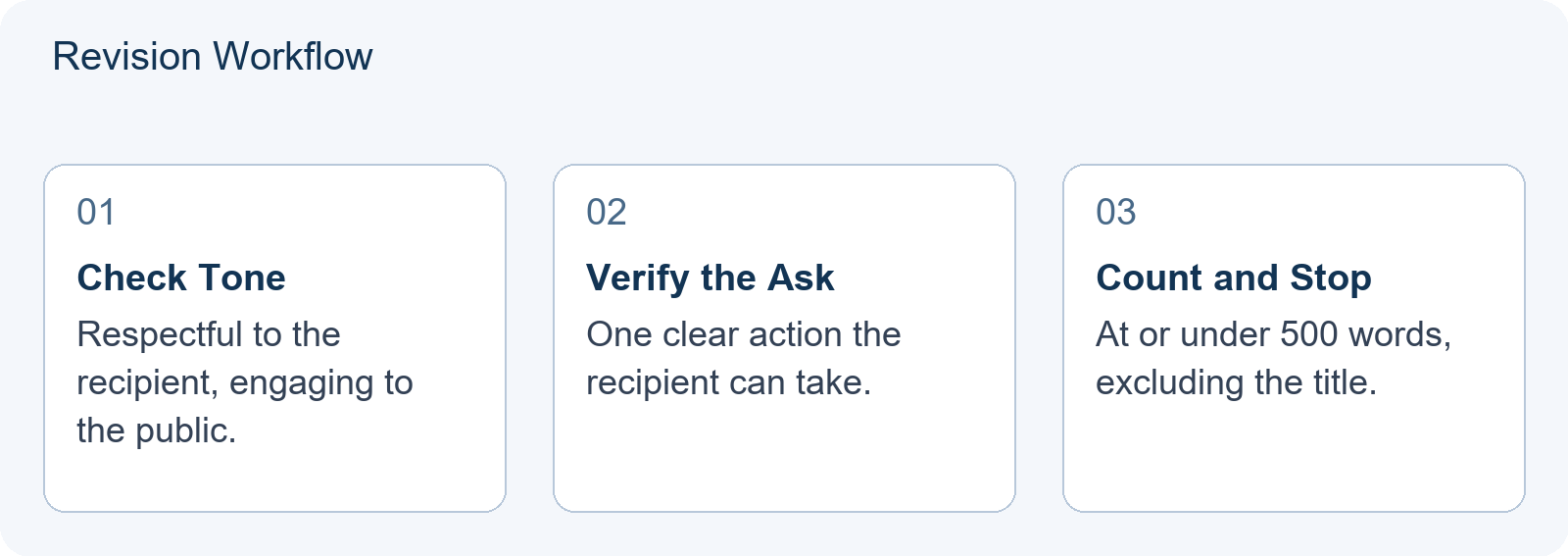
During revision, run a reader-swap check. Read the draft once aloud as the recipient. Is it respectful but demanding? Is the ask unmistakable? Then read again as a busy parent or a fellow student skimming the news. Is it interesting in the first three lines? Is it easy to follow without context?
If the public reader is lost, simplify syntax and cut subordinate clauses. If the recipient feels unheard, strengthen the imperative verbs and use “you” more often. Direct address creates both intimacy and accountability, but do not let it tip into accusation. The best letters invite the recipient into the solution rather than only blaming them for the problem, and that tonal balance protects credibility with both audiences.
Tone consistency matters too. A sudden drop from formal to slangy confuses the reader and signals a rushed edit. Aim for a voice that is recognisably a high school student but polished enough to sit on a major newspaper platform. That is what “authentic but edited” means in practice.
Finally, treat the writing process as part of the submission, not an afterthought. The 2026-27 season formalises a zero-tolerance rule against generative AI at any stage of creation, and process documentation counts toward how entries are reviewed. Hanlin’s guide on the NYT Contest Google Docs Workflow: Keeping a Clear Record of Your Own Writing walks through how to keep a clean, honest record of a revision from first draft to final, which is worth setting up before you start cutting for the 500-word limit rather than after.
Where the draft still feels one-sided in argument — for example, where the recipient has a reasonable defence you have not acknowledged — the techniques in Hanlin’s piece on How to Handle the Counterargument in a Short NYT Contest Entry (2026) apply directly, and often the strongest three words in an open letter are “even if you”, because they concede a point before making the ask harder to refuse.
Submission Checklist and Where to Stop
Before submitting, verify the essentials against the published contest page for the 2026-27 season. Confirm the word count is at or under 500, excluding the title. Confirm the recipient is clearly named or identified as a group. Confirm the social issue is specific enough that a stranger could summarise it in one sentence. Confirm no generative AI tool was used in any stage of creation, and that you can show your working process if asked.
Then stop. Once the dual-audience balance is right, further tinkering tends to dilute the voice rather than improve the argument. A slightly uneven draft that moves both readers is more publishable than a polished one where each paragraph addresses only one audience. The aim is not perfection; it is effective communication under a hard word limit.
General event background is available at Event background.
This is an independent preparation guide, not affiliated with, endorsed by, or sponsored by The New York Times.
Frequently Asked Questions
Can I address a group instead of one person?
Yes. The 2026-27 calendar states the letter is written to an individual or group with the power to drive change, so a school board, city council, company or peer group is acceptable provided the addressee can realistically act.
Does the title count towards the 500-word limit?
No. Entries are up to 500 words excluding the title, so only the body of the letter counts towards the maximum length.
Can I use AI to help draft or polish the letter?
No. The 2026-27 season imposes a zero-tolerance ban on generative AI at any stage of creation, and process documentation is part of how entries are reviewed. Keep an honest record of your own drafting, revision and cuts.