The workable rule is authorship, not word count. A helper may ask questions, point at what is unclear and name a problem. You must supply every idea and write every sentence yourself, and you must be able to explain any line in the entry without prompting. The binding rules are the ones the Learning Network publishes for your contest and cycle — read them on the official page before you accept any help at all.
Start at the rules page, not at a principle
Contests set their own terms on outside assistance, and those terms are the authority. Before a teacher, tutor, parent or classmate reads a word of your draft, open the official contest page and answer four questions from it directly: who is eligible to enter, what the contest says about the entry being your own work, what it says about outside help or assistance of any kind, and what it says about AI tools. If the page is silent on something, that silence is not permission — ask your teacher or the organiser rather than deciding for yourself.
This matters more than students expect because school norms and contest norms are not the same norms. Inside a school, a teacher editing your sentences during a workshop is normal, encouraged pedagogy. In a contest that asks for your own work, the same act can change what you are submitting. Nobody has behaved badly; two reasonable systems have collided. The student is the one holding the consequences, so the student has to be the one who knows the line.
There is a second collision worth naming for families in China. Coaching and tutoring are a normal part of how many international-school students prepare for everything, and a tutor whose habit is to improve a piece of writing will improve it — by rewriting. That instinct is right for an exam-prep essay and wrong here. If you work with any paid support, including ours, the responsibility to keep the entry yours does not transfer to them. It stays with you.
One first-party observation. In drafts we read, the tell for over-help is almost never a dramatic one. It is unevenness: two paragraphs written in a register the rest of the piece cannot sustain, a vocabulary spike, or a fluent transition sitting between two plain paragraphs. Readers who see a lot of student writing notice the seam quickly, and the effect on them is not admiration.
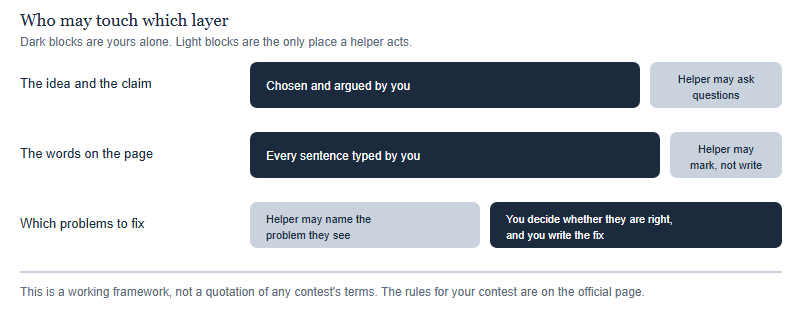
Three layers of a draft, and who may touch each
Break any draft into three layers and the boundary stops being a matter of judgement. Two of the three layers are yours entirely. Only the third is shared, and even there the helper's role stops before the keyboard.
| Situation | Clearly fine | The grey zone | No longer your entry |
|---|---|---|---|
| Choosing a topic | An adult asks what you have been arguing about lately | An adult offers a list of topics and you pick one | An adult tells you what to argue and why it will do well |
| Structure | Someone says the middle sags and they lost the thread | Someone sketches an outline for you to fill in | Someone reorders your paragraphs and rewrites the joins |
| Sentences | Someone underlines a sentence they had to read twice | Someone offers "you could say something like…" | Someone supplies replacement wording you paste in |
| Language and grammar | Someone flags that a tense is inconsistent | Someone corrects errors silently across the draft | Someone rewrites your prose into fluent English throughout |
| Evidence | Someone asks where a number came from | Someone hands you a source to use | Someone researches and supplies the evidence and framing |
| Final check | You read it aloud to someone and hear your own problems | Someone proofreads typos without comment | Someone submits or edits the entry on your behalf |
The language row is the hardest one for students writing in a second language, and it deserves a straight answer. Wanting your English to be correct is legitimate; there is nothing shameful about asking whether a tense is wrong. The line is between someone telling you that a sentence is broken and someone handing you a repaired sentence. The first leaves you as the author and teaches you something. The second produces a draft in a voice that is not yours, which is both a rules risk and — because judges notice unevenness — a craft cost.
The handback test
When the categories still feel blurry, use a behavioural test instead of a definitional one. Follow what physically happens to the draft after a helper reads it.
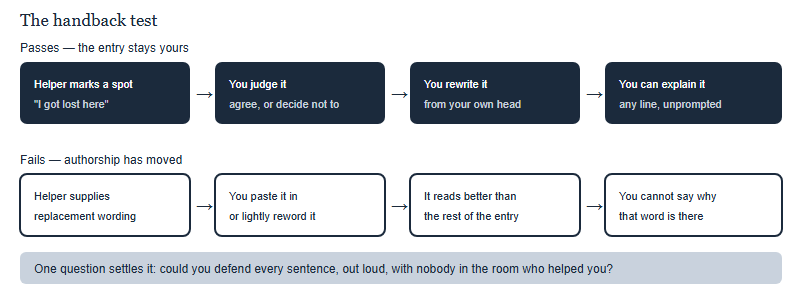
Two habits make the test easy to pass. The first is the closed-document rule: when you sit down to act on feedback, close the annotated file and rewrite from your own notes. Working directly on top of someone else's suggested wording is how borrowed phrasing survives into a final draft nobody intended to submit. The second is to keep your drafts. A dated sequence of versions is the cheapest possible record of your own process, and it costs nothing while you are working.
If you want a portable version of the whole framework, it is one sentence: help may improve the writer, not the draft. Anything that makes you better at spotting your own weak paragraph is fine. Anything that makes this particular entry better without making you better has probably moved authorship.
Questions about the contests?
Scan the WeChat QR code — we help with contest registration, one-on-one topic coaching, and full guidance to the deadline.
Scan the WeChat QR code

What good help actually looks like
Staying inside the line does not mean working alone. The most useful forms of support are also the ones that are clearly permissible under an own-work expectation, because none of them put words into your draft.
- The read-aloud. You read the entry to someone who says nothing. You will hear the broken sentences yourself. No one has touched the draft and the diagnosis is complete.
- The comprehension check. A listener tells you what they think you were arguing. If it does not match your intention, you have found a structural problem without receiving a single suggestion.
- Questions instead of edits. "Why does this matter to someone outside your school?" "What is the strongest objection to this?" Questions are safe by construction: the answers must come from you.
- Timeline support. A parent who helps you protect two hours a week is providing real, entirely uncontroversial help. Our contest calendar gives the usual shape of the year to plan around; confirm all dates on the official pages.
- Rules verification. Ask an adult to read the official contest page alongside you and check eligibility and requirements. Getting the rules right together is not assistance with writing.
The opposite is worth stating plainly too. A helper who returns a draft with sentences rewritten has not given you feedback; they have given you their sentences. If that is what you receive, treat it as diagnosis — read their version, work out what problem they were solving, delete their wording, and solve it yourself.
If a draft has already gone too far
Sometimes you realise late that a paragraph is not really yours. The instinct is to reword it until it feels sufficiently changed. That instinct is wrong, and it is also the thing that produces the seam a reader notices. Light rewording of someone else's sentence leaves their thinking, their rhythm and often their vocabulary in place.
- Identify honestly. Go through the entry line by line and mark anything you could not have written unaided. Be strict; the point is a clean answer, not a comfortable one.
- Delete, do not edit. Remove the marked passages entirely. Editing them keeps the underlying structure of someone else's sentence.
- Rebuild from the gap. Write what the missing passage needs to do — one line of purpose — then draft it fresh without looking at what was there.
- Read the whole thing aloud. If any passage still sounds like a different person, it is. Repeat.
- If in doubt, ask. Your teacher or the organiser can tell you whether what happened is within the rules. Asking before submission is always cheaper than explaining afterwards.
It is worth keeping the stakes in proportion. Contests recognise a small number of entries and no amount of help of any kind guarantees a result, so an over-helped entry trades away authorship for something that was never certain. The reliable return from entering is that you get better at writing — and that return only exists if the writing was yours. If you are still deciding which contest to enter and what its brief demands, our overview of the Learning Network contests is the sensible starting point, and our guide to the Open Letters Contest shows how a form's own requirements shape what a finished entry should look like. Confirm every rule on the official page for your contest and cycle.
Frequently asked questions
Can my English teacher correct my grammar?
Rules vary by contest, so check the official page. The safe practice: a helper flags an error, you work out and type the correction.
Is a tutor allowed to help me prepare?
Teaching you craft beforehand is different from working on the entry. Whatever the support, every idea and sentence submitted must be yours.
What if someone rewrote part of my draft?
Delete that passage rather than rewording it. Note what it needed to do, then write it fresh yourself, and ask your teacher if unsure.
Where do I find the official rules on outside help?
On the Learning Network contest page for your specific contest and cycle. Terms differ between contests and change — never assume last year's.
This is an independent guide operated by Hanlin Education for China-based international-school students. We are not affiliated with, endorsed by, or sponsored by The New York Times Company or its Learning Network. The framework above is our editorial guidance, not a statement of any contest's terms: eligibility, own-work requirements, rules on outside assistance and AI, and deadlines are set by the Learning Network and change each cycle — confirm current details on nytimes.com/learning, and consult your teacher or the organiser if you are unsure. Any factual error reported to our editorial desk is corrected within 7 working days.