Yes — but as evidence of real writing, not as a trophy. A recognised New York Times Learning Network entry is a credible, widely understood signal, and the work itself often becomes strong college-application material. But it is not a shortcut to admission, and any guide that promises otherwise is selling something. This independent piece gives an honest answer for international and China-based students.
What a recognised entry actually signals
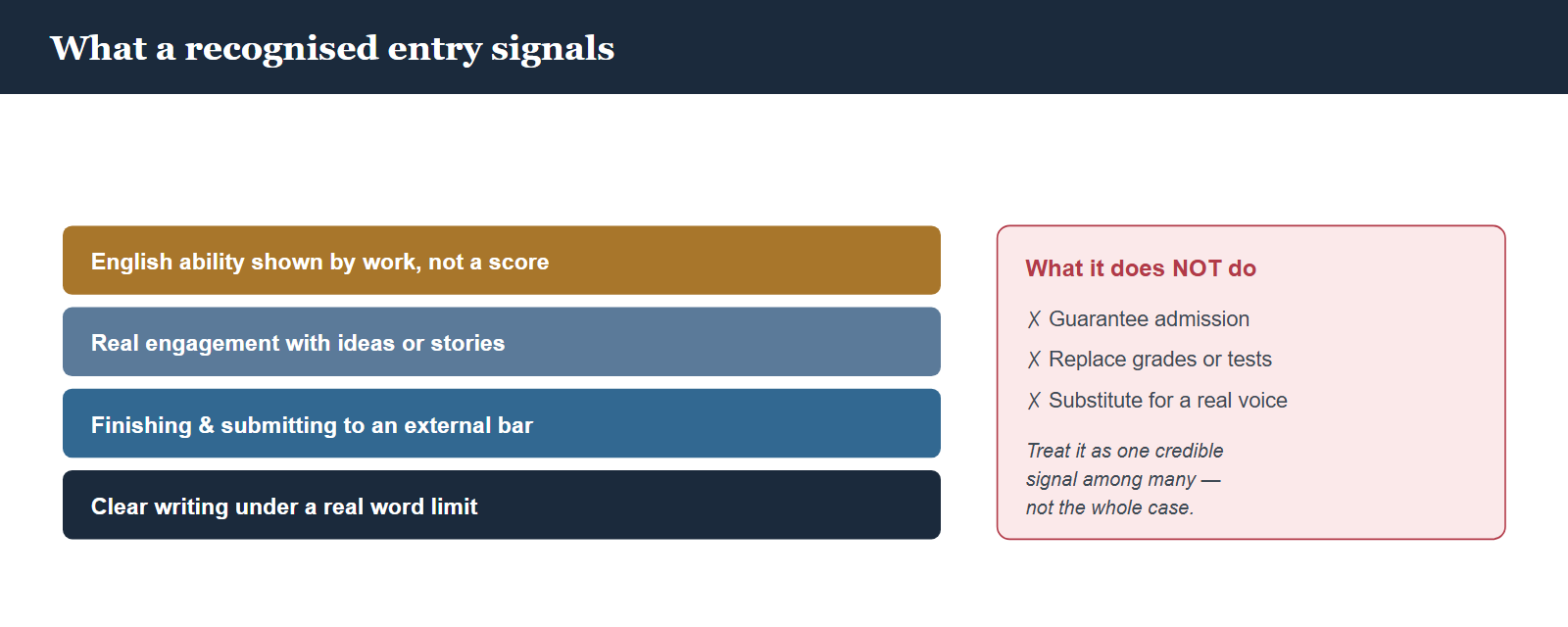
Admissions readers know these contests are competitive and widely entered, and that winning pieces are edited to a high standard. So a recognised entry signals three things at once: that you can write clearly under a real constraint, that you finished and submitted something to an external bar rather than only to a teacher, and that you engage with ideas or stories beyond the syllabus. For an international applicant, it also quietly answers a question every reader has — can this student write in English at the level the degree demands — with evidence rather than a test score.
The bigger value is upstream of any award
Here is the part students underrate: most of the value arrives whether or not you win. Arguing a position in 450 words, or shaping a true experience into 600, is exactly the discipline a strong college essay demands. We routinely see students reuse the thinking — and sometimes the actual material — from a contest entry in their personal statement or supplemental essays. A Personal Narrative entry can become the seed of a Common App essay; a STEM Writing piece can anchor a “why this major” supplement. Seen this way, the contest is training that happens to come with a chance at recognition, and the hours are well spent at either outcome.
An honest word on the odds
These contests are genuinely competitive — the flagship Student Editorial Contest draws tens of thousands of entries — so recognition should be treated as a bonus, not a plan. The students who benefit most are the ones who enter to become better writers, submit consistently, and let the awards take care of themselves. Students we have worked with at Hanlin have earned recognition in the Learning Network’s contests, including an Honorable Mention in the Summer Reading Contest; we share that as proof it is achievable from China, not as a typical outcome. Chasing a certificate makes for anxious, generic writing. Chasing a genuinely good piece is what occasionally produces the certificate.
How to make a contest entry pull double duty
Plan your entries so they feed your applications. If you are a science applicant, the STEM Writing or editorial contests can develop the exact arguments your supplements will need. If your strength is voice and story, the Personal Narrative is the most direct rehearsal for the Common App essay there is. Keep every draft, including the cut paragraphs — the line you trimmed to hit 450 words is often the seed of a different essay later. And map the contest dates against your application timeline using our contest calendar, so the writing lands before, not during, application crunch.
Frequently asked questions
Do NYT writing contests help with college admissions?
They help as credible evidence of writing ability and intellectual engagement, and the work often becomes college-essay material. They do not guarantee admission or replace grades and test scores — treat a recognised entry as one signal among many.
Questions about the contests?
Scan the WeChat QR code — we help with contest registration, one-on-one topic coaching, and full guidance to the deadline.
Scan the WeChat QR code

Is it worth entering if I probably will not win?
Yes. Most of the value comes from the writing practice itself, which directly strengthens your college essays, regardless of the result. The contests are competitive, so enter to improve and let recognition be a bonus.
Can a contest entry become a college essay?
Often, yes. A Personal Narrative entry can seed a Common App essay, and a STEM Writing piece can anchor a “why this major” supplement. Keep all your drafts, including cut paragraphs, as essay material.
Does it matter for international applicants specifically?
It can help, because a recognised English-language entry shows writing ability through real work rather than only a test score — a question many admissions readers have about international applicants.
This site is an independent editorial guide to The New York Times Learning Network’s free student writing contests, operated by Hanlin Education for China-based international-school students. We are not affiliated with, endorsed by, or sponsored by The New York Times Company or its Learning Network. We are also not affiliated with any university; admissions outcomes depend on many factors. Always confirm current rules on the official NYT Learning Network. Confirmed errors are corrected within 7 working days.