Everyone enters the Student Editorial Contest. Far fewer students notice the Learning Network’s lesser-known contests — Vocabulary, podcast, multimedia, the 100-word “tiny memoir”, and open-ended challenges that appear through the year. They have smaller entry pools and reward different talents, which makes them some of the smartest entry points for international students new to the whole thing. This independent guide maps them out.
The contests most students overlook
| Contest (typical) | What it asks | Best for |
| Vocabulary Video | A very short video that defines and dramatises one word | Creative, visual students; low word count |
| Podcast | A short student-made audio piece — story, interview or argument | Audio storytellers; team or solo |
| Tiny Memoir | A true story in about 100 words | Anyone — the lowest barrier to start |
| Multimedia / open prompts | Varies — image, audio and text combined, or themed challenges | Experimenters across formats |
Exact contests rotate year to year, so check the current line-up on the official site — but the category is reliable: every year there are several smaller competitions running alongside the headline ones.
Why a smaller contest is a smart first move
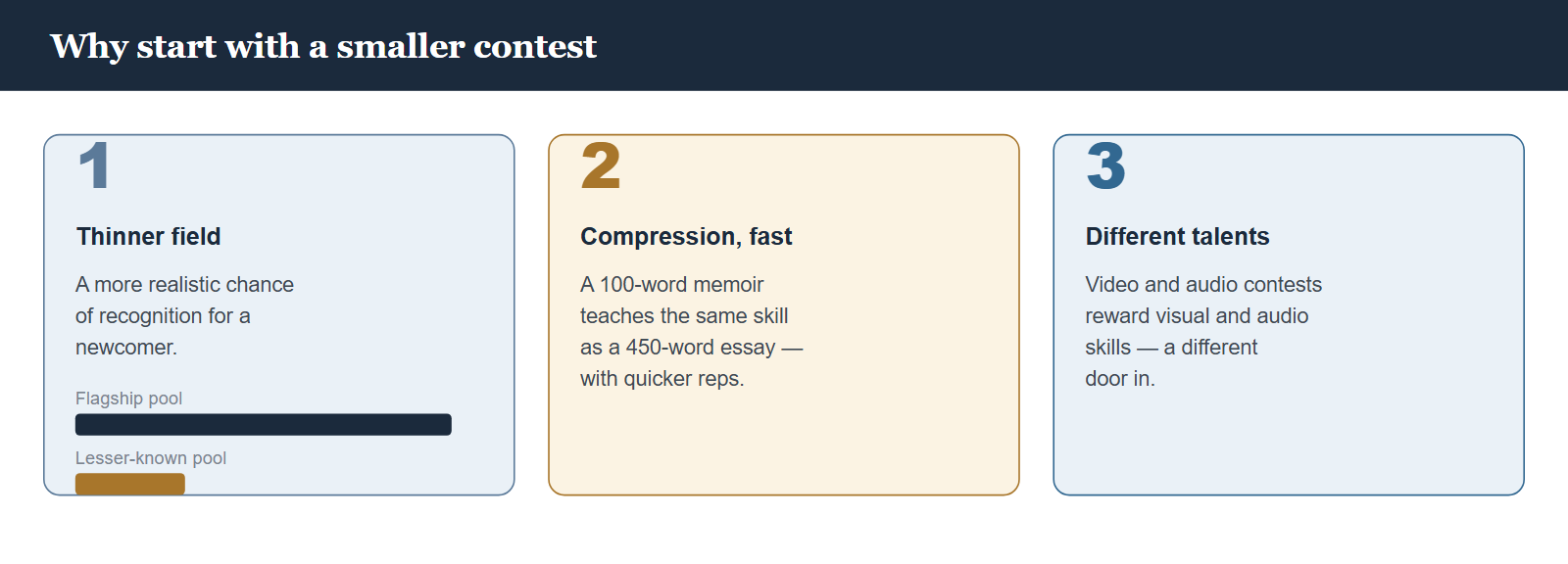
There is real strategy in starting small. A contest with a few thousand entries gives a newcomer a more realistic chance of recognition than the flagship’s tens of thousands — not because the bar is lower, but because the field is thinner. Just as importantly, the shorter formats teach the core skill faster: a 100-word tiny memoir forces the same compression a 450-word editorial does, with a fraction of the drafting time, so you can practise finishing and submitting several times before you tackle the big contests. And the multimodal contests reward students whose strengths are visual or audio rather than prose — a genuinely different door in.
How to make a short entry count
Short does not mean easy — it means every word and second carries weight. In a 100-word memoir, cut every sentence that does not move the moment forward; one concrete image beats three lines of explanation. In a vocabulary video, pick a word with a visual life — one you can show, not just define — and let the image do the work the words cannot. In a podcast, a single clear voice and one good story beats elaborate production. Across all of them, the rule from the bigger contests still holds: do one specific thing precisely rather than several things adequately.
A path for a student new to the contests
If you have never entered, here is a sensible ladder. Start in summer with the Summer Reading Contest to build the deadline habit; try a tiny memoir or vocabulary contest to practise compression in a low-stakes field; then, once you have finished and submitted a few times, step up to a flagship like the Editorial or Personal Narrative with real confidence. The smaller contests are not a consolation prize — they are the training ground, and occasionally the win. Map the whole year with our contest calendar, and remember every deadline is in U.S. Pacific Time.
Frequently asked questions
What lesser-known NYT contests are there?
Alongside the flagship essay contests, the Learning Network typically runs Vocabulary, podcast, multimedia and short “tiny memoir” challenges, plus occasional open-ended prompts. The exact line-up rotates each year, so confirm the current contests on the official site.
Questions about the contests?
Scan the WeChat QR code — we help with contest registration, one-on-one topic coaching, and full guidance to the deadline.
Scan the WeChat QR code

Are smaller contests easier to win?
The bar is not lower, but the field is thinner, which can give a newcomer a more realistic chance of recognition. They are also a faster way to practise finishing and submitting before you tackle the flagship contests.
Which contest is best for a complete beginner?
A short-format contest such as the tiny memoir or vocabulary challenge, or the weekly Summer Reading Contest. They teach the core skills of compression and deadline-writing with low stakes.
How do I make a 100-word entry strong?
Make every word carry weight: cut anything that does not move the moment forward, and let one concrete image do the work of several explanatory sentences. Do one specific thing precisely.
This site is an independent editorial guide to The New York Times Learning Network’s free student writing contests, operated by Hanlin Education for China-based international-school students. We are not affiliated with, endorsed by, or sponsored by The New York Times Company or its Learning Network. The contest line-up and dates change by season — always confirm the current contests on the official NYT Learning Network. Confirmed errors are corrected within 7 working days.