Entering a single New York Times Learning Network contest is worthwhile. But the students who get the most from these free, year-round contests do something more deliberate: they sequence three or four entries across one school year into a coherent portfolio that shows a writer developing. This independent guide explains how international students can plan a contest year, choose a through-line, and turn separate submissions into genuine evidence of growth — without overloading an already busy calendar.
Why a portfolio beats a single entry
One recognised entry is a nice line on a list. A body of work across a year tells a different story — that you write by habit, can handle more than one form, and improve from draft to draft. Admissions readers and teachers reading a recommendation both respond to that arc far more than to a one-off result. And because the Learning Network runs roughly a dozen contests across the school year, the raw material for a portfolio is already there, free and open to students aged 13 to 19 worldwide.
A crucial caveat first, because it governs everything below: a portfolio is about quality and coherence, not volume. Entering all dozen contests usually produces twelve rushed pieces and recognition in none. Three or four deliberate entries, each given real time, is the stronger plan. For the full menu of contests and how to choose one, start with our guide to the NYT Learning Network contests.
Set expectations honestly: a contest portfolio strengthens your writing and your application narrative, but no contest result guarantees admission anywhere. These contests are competitive, recognition is never assured, and the deeper payoff is the writing skill you build. Always confirm on the official site for current contests and rules: the official NYT Learning Network.
The four-entry year: a realistic template
Here is a template that fits the typical contest calendar and leaves room for school. The exact dates shift every year — confirm them — but the seasonal shape is stable enough to plan around. The idea is to start low-pressure in summer, take on one flagship contest in the school year, and add one or two that play to your strengths.
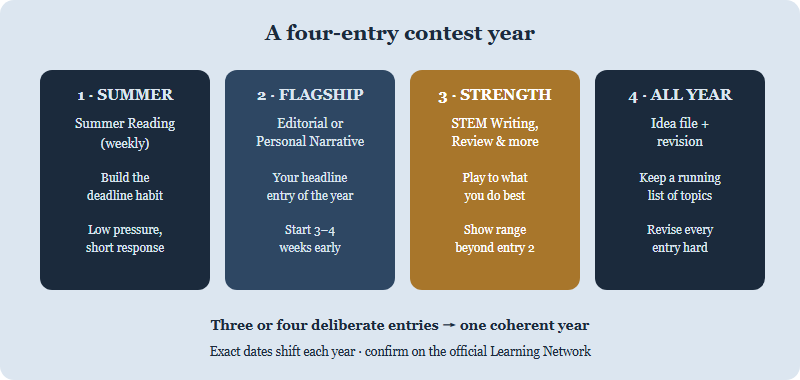
Notice that this is not “enter everything.” It is a small, sequenced set with a deliberate escalation: a warm-up, a flagship, a strength piece, and a habit of revision running underneath. To slot this against real dates, lay it over our contest calendar and your own school timetable.
Find a through-line — but don’t force one
A portfolio reads as more than the sum of its entries when there is a through-line — a recurring concern that shows up across different forms. A student interested in cities might write an editorial on public transport policy, a STEM piece on traffic modelling, and a review of a documentary about urban design. Same curiosity, three forms. That coherence is what makes a reader think “this person has something they care about,” rather than “this person enters contests.”
| If your through-line is… | Editorial angle | Narrative / other angle |
| Public health & medicine | Argue a policy (e.g. school mental-health support) | STEM piece explaining one mechanism; a personal narrative on a clinic visit |
| Climate & environment | Argue for one concrete local change | Review an environmental documentary; explain one climate concept |
| Migration & identity | Argue a position on a current debate | Personal narrative on a moving moment; a profile of someone in your community |
| Technology & society | Argue for a guardrail or a freedom | STEM explainer; review of a tech-themed work |
Two honest cautions. First, a through-line should be genuine — a manufactured theme reads as manufactured, and judges score each entry on its own merits regardless. Second, do not let coherence become repetition: three entries that say the same thing in three forms are weaker than three that explore one curiosity from genuinely different angles. The point is range anchored by interest, not a single argument restated.
Reuse the thinking, never the text
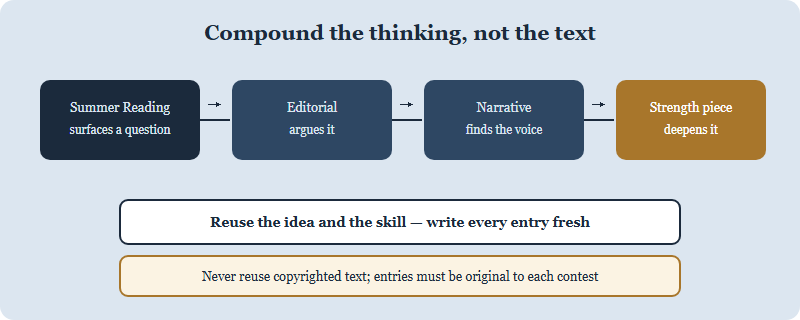
The most efficient — and most defensible — way to build a portfolio is to let each entry feed the next. The thinking you do for a Summer Reading response can surface the question you argue in an editorial; the voice you develop in a personal narrative carries into a review. This compounding is the real reason a sequenced year beats scattered one-offs.
Questions about the contests?
Scan the WeChat QR code — we help with contest registration, one-on-one topic coaching, and full guidance to the deadline.
Scan the WeChat QR code

But two firm lines apply. You must not reproduce copyrighted text — your own or anyone else’s published work — and each contest typically requires that the entry be original and not previously submitted elsewhere. So reuse the idea, the curiosity and the skill; write each entry fresh for its contest. Where a contest requires sources, handle them properly — our note on finding and shaping your story covers turning a recurring interest into specific, sourced material rather than a recycled draft.
Plan the year around your exams, not against them
For students at international schools in China, the limiting factor is rarely talent — it is the calendar. The flagship Student Editorial Contest often lands in late winter, exactly when mock exams and IB internal-assessment deadlines pile up. A portfolio plan that ignores this collapses in February.
- Map contest windows against your exam calendar first. If spring is brutal, weight your portfolio toward summer and autumn contests, where you will write better.
- Protect the flagship. Whichever contest you choose as your headline entry, block three to four weeks of drafting time and defend it from being eaten by revision for finals.
- Use summer as your engine. The weekly Summer Reading Contest is the one low-stakes window with no exam competing for attention — it is where the habit and the early portfolio pieces should come from.
What we see with China-based students
This site is run by the editorial team at Hanlin Education, and we work each year with students at international schools in China who enter these contests. The students who build a real portfolio — rather than entering one contest and stopping — share three habits. They start in summer, so the deadline muscle is built before the high-profile contests open. They pick a genuine through-line and let it organise their year, which makes each entry sharper and the whole set more memorable. And they revise relentlessly, treating every contest as another rep. Recognition is never guaranteed — the pools are large and these contests are competitive — but students we have supported have earned standing in the Learning Network’s contests, including an Honorable Mention in the Summer Reading Contest. We share that not as a headline number but as proof that a focused, sequenced international portfolio gets read on the same page as students anywhere.
Frequently asked questions
How many NYT contests should I enter in one year?
Three or four deliberate entries beat a dozen rushed ones. Pick a summer warm-up, one flagship, and one or two strength contests, and give each real drafting time rather than entering everything.
Should all my contest entries share a theme?
A genuine through-line makes a portfolio cohere and memorable, but force nothing. Judges score each entry on its own merits, so let a real interest organise the year rather than restating one argument in different forms.
Can I reuse a contest entry for another contest?
No. Reuse the thinking and the skill, but write each entry fresh — contests typically require original work not submitted elsewhere, and you must never reproduce copyrighted text. Confirm originality rules on the official site.
Will a contest portfolio get me into a top university?
No contest result guarantees admission. A portfolio strengthens your writing and your application narrative as evidence of a developing writer, but its largest payoff is the skill you build along the way.
This site is an independent editorial guide to The New York Times Learning Network’s free student writing contests, operated by Hanlin Education for China-based international-school students. We are not affiliated with, endorsed by, or sponsored by The New York Times Company or its Learning Network. Contest names, formats and dates change by season — always confirm the current line-up and rules on the official NYT Learning Network. Confirmed errors are corrected within 7 working days.