If you are weighing the New York Times Learning Network writing contests against other student writing competitions, the honest answer is that they solve different problems. The Learning Network contests are free, short-form and year-round — built for compression and a real voice. Long-form essay competitions reward sustained argument and research; other writing prizes reward different things again. This independent guide maps the differences in length, cost, format and admissions signal so international students can choose deliberately rather than by reputation alone.
The core difference: short-form voice vs. long-form argument
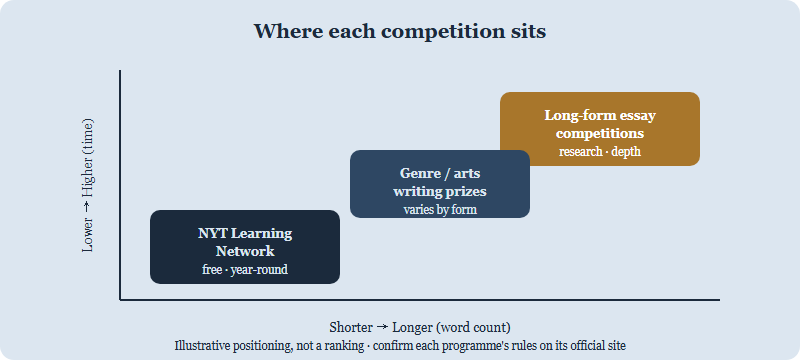
Almost every meaningful difference flows from one variable: length. A Learning Network editorial is roughly 450 words; many academic essay competitions ask for 1,500 to 2,000 words or more. That single gap changes what skill is being tested, how long the work takes, and what kind of student each format suits.
- Short-form (NYT Learning Network): compression, clarity, a specific voice, and saying one thing well. Fast to draft, fast to revise, low cost of entry — and excellent training for the college essay, which is itself short.
- Long-form essay competitions: sustained reasoning, research, structure across thousands of words, and depth in a discipline. A bigger time investment, often suited to students targeting a specific subject.
Neither is “better.” A student who writes a tight, surprising 450-word editorial is demonstrating a genuinely valuable skill — one many long essays never show. For the full menu of Learning Network contests and how to pick one, start with our guide to the NYT writing contests.
About the comparisons below: we describe other competitions only in broad, well-known terms. Their eligibility, word limits, fees, deadlines and prizes change and differ by programme — confirm every specific on each competition’s own official website, and confirm NYT contest details on the official NYT Learning Network. This guide is not affiliated with any of them.
A side-by-side map of the landscape
The table below sketches the categories of student writing competition, not a ranking. It is deliberately general on the non-NYT programmes, because their exact rules vary and move — use it to understand the shape of each option, then verify the current details on each official site.
| Dimension | NYT Learning Network contests | Long-form academic essay competitions | Other student writing / arts prizes |
| Typical length | Short (~100–600 words) | Long (often 1,500–2,000+ words) | Varies widely by category |
| Cost | Free | Sometimes an entry fee — confirm | Varies — confirm |
| What it rewards | Compression, voice, one sharp idea | Research, sustained argument, depth | Craft in a specific form (story, poetry, etc.) |
| Frequency | Year-round, ~a dozen contests | Usually annual, by subject | Usually annual |
| Best for | Building a writing habit; college-essay skill | Subject specialists; deep dives | Genre writers |
| Eligibility | Ages ~13–19 worldwide | Varies (often upper secondary) | Varies |
The pattern is clear: the Learning Network occupies the short-form, free, high-frequency corner of the landscape. That makes it unusually accessible — there is almost always one open, nothing to pay, and a low barrier to a first attempt. It also makes it the natural on-ramp before, or alongside, a heavier long-form competition.
Which signal does a college reader value?
Families often ask which competition “looks best.” The more useful framing: different competitions send different signals, and the best one depends on your goal.
| If your goal is… | The format that tends to fit |
| Show you can write a sharp, voice-driven short piece (like a college essay) | NYT Learning Network contests |
| Demonstrate deep interest and research in one subject | A long-form academic essay competition in that field |
| Show craft as a storyteller or poet | A genre-specific writing prize |
| Build a writing habit and a body of work over a year | NYT Learning Network contests (sequenced) |
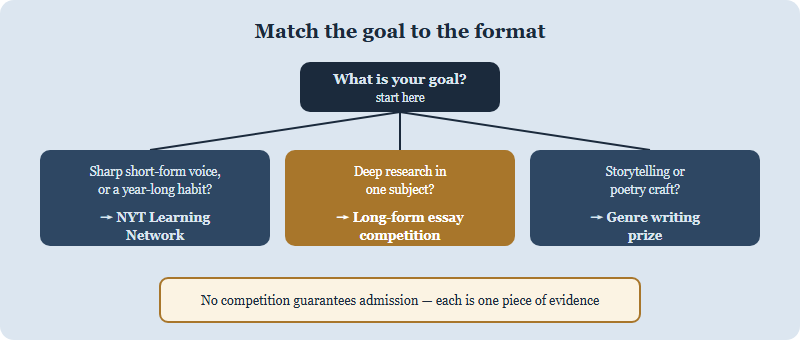
An important honesty check applies across all of them: no writing competition guarantees admission anywhere. Recognition in any reputable contest is a credible signal, but admissions readers weigh it as one piece of evidence among many — and they can tell the difference between a genuinely strong piece and a padded one. The Learning Network’s particular advantage for applicants is that its contests train the exact short-form skill the application itself demands, so the work compounds even when no award follows.
Why “free and short” is a strategic advantage
For international students deciding where to spend limited time and money, the Learning Network’s structure has under-appreciated strategic value:
Questions about the contests?
Scan the WeChat QR code — we help with contest registration, one-on-one topic coaching, and full guidance to the deadline.
Scan the WeChat QR code

- No fee removes the gamble. Because entry is free, a Learning Network contest is a low-risk way to test whether competitive writing suits you before committing to a fee-charging, months-long essay competition.
- Short pieces let you iterate. You can enter several contests across a year and learn from each, where a single long essay might be your only at-bat for the season.
- Year-round timing fits a busy calendar. With contests opening across the school year, you can write when your exam schedule allows — see the recurring windows in our contest calendar.
- It feeds long-form work. The argument you sharpen in a 450-word editorial can become the seed of a 2,000-word essay for another competition. The formats are allies, not rivals.
The smartest plan for many students is not “NYT or a long-form competition” but a sequence: use the free, short Learning Network contests to build the habit and find your subjects, then invest in one heavier essay competition where your interest runs deepest. Our note on finding and shaping your story applies to both ends of that pipeline.
What we see with China-based students
This site is run by the editorial team at Hanlin Education, and we work each year with students at international schools in China who enter a range of writing competitions. A few patterns hold. Students who start with the free, short Learning Network contests make better decisions about whether to invest in a long, fee-charging essay competition — they have tested the work first. Students who treat the formats as complementary — short-form for habit and voice, long-form for a subject deep-dive — build a more convincing overall profile than those who chase a single “prestigious” prize. And across both, the students who place are the ones who pick a narrow, genuine topic rather than a broad impressive-sounding one. Recognition is never guaranteed in any of these contests — the pools are large and competitive — but a focused approach, in the right format for the goal, is what gets an international entry read closely.
Frequently asked questions
Are NYT writing contests easier than long-form essay competitions?
Not easier, different. Short-form contests test compression and voice in a few hundred words; long-form competitions test research and sustained argument. Each is competitive in its own way — confirm rules on each official site.
Which writing competition looks best for college?
There is no universal “best.” Different competitions send different signals, and none guarantees admission. The Learning Network’s edge is that it trains the short, voice-driven writing a college essay itself requires.
Can I enter both NYT contests and other essay competitions?
Yes, and many students do. A common strategy is to use the free short NYT contests to build a habit, then invest in one long-form competition in your strongest subject. Keep each entry original.
Do NYT contests cost anything to enter?
No — the Learning Network’s student writing contests are free and require no subscription. Other competitions may charge a fee, so always confirm cost and rules on each programme’s official website.
This site is an independent editorial guide to The New York Times Learning Network’s free student writing contests, operated by Hanlin Education for China-based international-school students. We are not affiliated with, endorsed by, or sponsored by The New York Times Company or its Learning Network, nor with any other competition named or described here. Eligibility, length, fees, deadlines and prizes change and differ by programme — always confirm current details on each official site, and on the official NYT Learning Network. Confirmed errors are corrected within 7 working days.