You submitted your NYT Learning Network contest entry — what happens now? Your entry goes into a judging period, results are later announced on the Learning Network site, and recognized work is typically published or listed there. Timelines and recognition categories vary by contest and cycle, so the official page is your source of truth. This guide covers what to expect while you wait, how to record an honor honestly, and — most importantly — what your next move is in either outcome.
What happens to your entry after the deadline
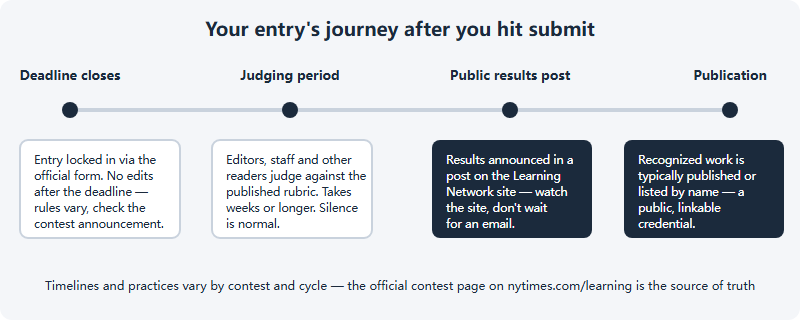
Learning Network contests close on a published deadline, and after that the reading begins. The Learning Network has described its judging as involving its own editors and staff along with other qualified readers such as educators and, for some contests, New York Times journalists — the exact panel varies by contest and year, and the current contest announcement is the place to check who is reading. Entries are read against the criteria published in each contest’s announcement and rubric, which is why we tell students to treat the rubric as the assignment brief, not fine print.
Three practical things are true of this period:
- You will not get interim updates. There is no application portal with a status bar. Silence between deadline and announcement is normal and means nothing about your entry.
- Judging takes time. Popular contests draw large entry pools, and reading them well takes weeks — for some contests, longer. The announcement date, where one is given, appears on the official contest page; where none is given, watch the Learning Network’s posts.
- Results appear in public, not in your inbox first. The Learning Network’s standard practice is to announce results in a post on its site, publishing or naming the recognized students. Some cycles and contests may also involve direct contact — but the public post is the reliable channel, so know where to look rather than waiting on email. Confirm the announcement practice for your specific contest on nytimes.com/learning.
How recognition works — and how to talk about it honestly
Learning Network contests have historically recognized more than a single winner. Depending on the contest and cycle, announcements have named winners plus additional tiers such as runners-up and honorable mentions, and some contests publish finalist lists. The exact tier names, counts and whether your full text gets published all vary — check your contest’s announcement rather than assuming this year mirrors last year.
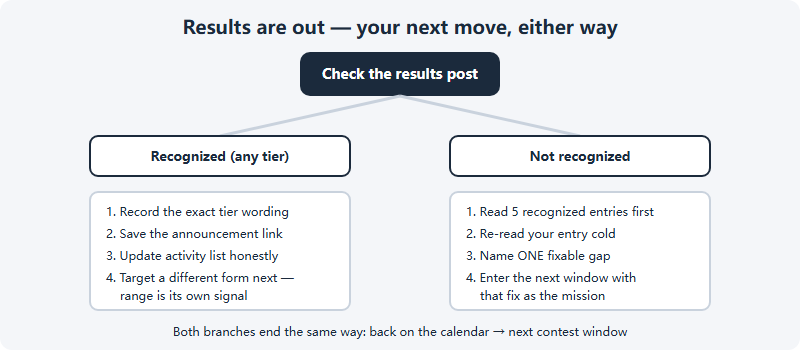
If you are recognized at any tier, record it precisely. On an activity list or CV, accuracy is the credential:
| Outcome | What it means | How to record it (honest wording) |
|---|---|---|
| Winner | Top tier for that contest cycle; work typically published on the Learning Network | “Winner, [Contest Name], The New York Times Learning Network, [year]” — link the announcement post |
| Runner-up / Finalist | Named tier below winner; practices vary by contest | Use the exact tier word the announcement used — never round “finalist” up to “winner” |
| Honorable mention | Named recognition, usually a longer list | “Honorable Mention, [Contest Name], NYT Learning Network, [year]” — still a real, checkable honor |
| Not recognized | The overwhelmingly common outcome in any large contest — not a verdict on you as a writer | Nothing goes on the list — but the entry becomes raw material for the next cycle (see below) |
Two cautions. First, never inflate the tier: results posts are public and searchable, which is exactly what makes the honor valuable — and inflation checkable. Second, keep perspective on what any single result means: recognition is a genuine writing credential, but no contest result guarantees anything in admissions. We have written an overview of the whole contest family if you are deciding where this fits in your bigger picture.
While you wait: the two-week rule
The waiting period is where most students waste their momentum. You have just finished the hardest part of a writing cycle — drafting, revising and shipping a piece to a real external deadline. That machinery goes cold fast. Our editorial desk’s standing advice: within two weeks of submitting, start the next piece.
- Open the calendar and pick your next target. The Learning Network runs contests across the school year, so there is almost always a next form to work toward — the 2025-26 contest calendar maps every window. If you just shipped an argument piece, consider a craft change-up: a review after an editorial, a narrative after an open letter.
- Write the debrief while it’s fresh. Ten minutes, three questions: What was hardest? What did I fix in revision that I should catch earlier next time? What would I attempt if I were braver? This note is disproportionately valuable when you start the next entry.
- Do not refresh the results page daily. Set a monthly reminder to check the Learning Network’s announcements, then close the tab. Checking more often changes nothing except your mood.
If you don’t place: the diagnostic re-read
Most entries in any large contest are not recognized — that is arithmetic, not judgment. But an unplaced entry is only a loss if you extract nothing from it. Wait until results are out, then run this three-step diagnostic:
- Step 1 — Read the winners first. When the Learning Network publishes the recognized entries, read five of them before re-reading your own. You are looking for the gap: Is it material (they had a sharper subject)? Structure (their turn landed harder)? Compression (they did more inside the word limit)?
- Step 2 — Re-read your entry cold. A month after submission you finally have the distance to see it as a judge did — usually within the first three sentences you will spot what you could not see in submission week.
- Step 3 — Name one deficit, then aim the next entry at it. Not five deficits — one. “My opening described instead of hooked” is a fixable, trainable gap. Feed it into your next cycle deliberately.
Also consider redeploying the material. An unplaced contest entry can often grow into a school-magazine piece, a personal-statement seed, or a stronger entry in a different form next cycle. One rule: if you rework it for a future Learning Network contest, check that contest’s rules on previously submitted or published work first — requirements about original, unpublished entries are standard, and the definitions matter. When in doubt, write fresh.
Questions about the contests?
Scan the WeChat QR code — we help with contest registration, one-on-one topic coaching, and full guidance to the deadline.
Scan the WeChat QR code

The compounding view: one result is a data point, not a destiny
Here is the pattern we see across cohorts of China-based international-school students who work these contests seriously: almost nobody places on a first attempt, and the students who eventually earn recognition are the ones who submitted to three, four, five contest windows across a school year — each entry visibly better than the last because each cycle ran the full loop of draft, ship, wait, diagnose, redraft. The Learning Network’s calendar structure rewards exactly this: multiple contests, multiple forms, multiple chances per year, all free to enter (confirm entry requirements for your contest and age/location eligibility on the official site).
So the real answer to “I submitted — now what?” is: you are one-fifth of the way through a year-long apprenticeship that happens to have prize checkpoints. Protect the writing habit between deadlines, treat every results post as reading material, and let the record build.
FAQ
How long after the deadline are NYT contest results announced?
It varies by contest and cycle — judging large entry pools takes weeks or longer. Watch the contest’s own page and the Learning Network’s announcement posts on nytimes.com/learning rather than expecting an email.
Will I be notified directly if I win?
The reliable channel is the public results post on the Learning Network site, where recognized students are named or published. Direct contact practices vary by contest — confirm on the official page, and monitor the site yourself.
Can I reuse an unplaced entry for another contest?
Often the material can be reworked — but check the target contest’s rules on original, unpublished, not-previously-submitted work first. Definitions vary by contest. When the rules are ambiguous, writing fresh is the safe route.
Is an honorable mention worth putting on my activity list?
Yes — it is a named, publicly checkable honor from a large contest. Record the exact tier wording and year, and link the announcement. Precision is what makes it credible.
This is an independent guide operated by Hanlin Education for China-based international-school students. It is not affiliated with, endorsed by, or sponsored by The New York Times Company or its Learning Network. Contest details change; always confirm current rules, dates and eligibility on nytimes.com/learning. Factual errors flagged to our editorial desk are corrected within 7 working days.