How do you prepare for a New York Times Learning Network writing contest without a writing coach? You read like one. A mentor text — a published piece in the same genre as your target contest — teaches structure, openings and endings faster than any checklist, because it shows the moves working. This guide gives you a four-pass reading protocol, a map of which published writing to study for each contest, and the bright line between imitating a structure and copying a text.
Why reading beats drafting (at first)
Students preparing for contests — whether the Student Editorial, the Review, or the Open Letters Contest — usually default to volume: write more entries, get more feedback. But feedback can only fix what is on the page. The bigger problem for most first-time entrants is that they have never consciously seen the form they are attempting. They have read editorials, but never noticed where the concession paragraph sits. They have read reviews, but never marked the exact sentence where judgment first appears.
A mentor text closes that gap. The Learning Network itself has long pointed students toward published models — its contest announcements and teaching resources regularly link to examples of the genre, and past winning entries from many contests are published on the Learning Network site, where anyone can study them. (What gets published, and where, varies by contest and by year; browse the official Learning Network pages to see what exists for your target contest.)
The method matters, though. Reading a great editorial the way you read your phone — once, fast, for the gist — teaches you almost nothing about how it was built. The four-pass protocol below turns the same 600 words into a private masterclass.
The four-pass protocol
Work with one mentor text at a time. Print it or paste it into a document where you can annotate. Each pass has one job.
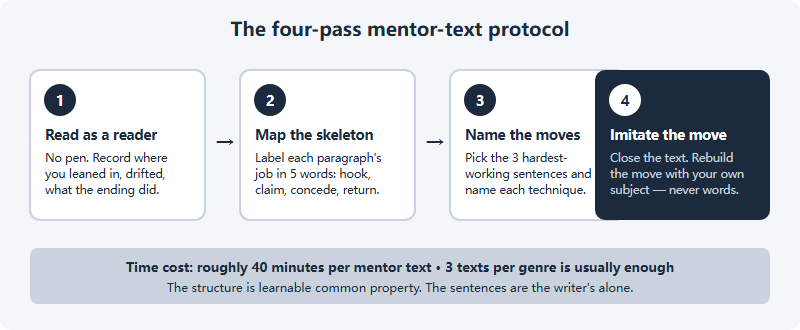
- Pass 1 — Read as a reader. No pen. Read straight through and record only your honest reactions: where you leaned in, where you drifted, what you felt at the end. This baseline matters because every structural trick you find later exists to produce exactly these reactions.
- Pass 2 — Map the skeleton. Number the paragraphs. Beside each, write its job in five words or fewer: “hooks with scene,” “states claim,” “concedes counter-argument,” “returns to opening image.” You are extracting the architecture — what a paragraph does, not what it says. Do this for three texts in the same genre and the recurring skeleton becomes unmistakable.
- Pass 3 — Zoom to sentence moves. Choose the three sentences that did the most work (usually the opening, the turn, the last line). For each, name the move: a concrete image before any abstraction; a one-sentence paragraph after a long one; a statistic immediately humanized by a person. These moves are transferable technique — the writer’s property is the words, not the move.
- Pass 4 — Imitate the move, never the words. Close the mentor text. Using your own subject — your city, your argument, your grandmother’s kitchen — write an opening that uses the same move you named in Pass 3. If the mentor opened with a sound, open with a sound from your world. Then compare: did the move survive the transplant? This is the oldest writing pedagogy there is, and it produces original work, because the content is entirely yours.
What to read for which contest
Each Learning Network contest has a living professional genre behind it. That is the point of the contests — they invite students to write in real journalistic and literary forms. Match your reading to your target (the full 2025-26 calendar shows when each contest runs):
| Target contest | Mentor genre to study | What to extract |
|---|---|---|
| Student Editorial | Short opinion essays and editorials (opinion sections, guest essays) | Where the claim lands; how evidence and concession are sequenced; endings that widen without going vague |
| Review Contest | Professional criticism — film, restaurant, music, game reviews | The judgment sentence; how description carries opinion; the balance of summary versus assessment |
| Personal Narrative / Tiny Memoir | Short personal essays and memoir columns | Scene versus summary; the reflective turn; how one small moment stands for something larger |
| STEM Writing | Science journalism written for general readers | The explainer ladder — hook, stakes, mechanism, so-what; how jargon is translated without condescension |
| Open Letters | Published open letters and direct-address essays | How the addressee shapes tone; the ask; the pivot from personal grievance to public stakes |
| Profile / Coming of Age | Profiles and human-interest features | Quote selection; physical detail as characterization; structure that alternates scene and background |
Two sourcing notes for students in China. First, if NYT access is inconsistent, the mentor-text method still works with any high-quality publication in the same genre — the skeleton of a good review is not proprietary to one newspaper. Second, past winning student entries that the Learning Network has published are the single most useful mentor texts available, because they demonstrate the form at your word limit and age level. Study them with the same four passes. For a broader orientation to how the contest family fits together, start with our overview of all the Learning Network contests.
The originality line: imitate structure, never language
This method lives next to a bright line, and you should know exactly where it is.
Questions about the contests?
Scan the WeChat QR code — we help with contest registration, one-on-one topic coaching, and full guidance to the deadline.
Scan the WeChat QR code

- Always allowed: noticing that strong editorials often concede a counter-argument around two-thirds in, and doing the same. Structural conventions, rhetorical moves, paragraph jobs — these are the shared grammar of a genre. Every professional learned them by reading.
- Never allowed: reusing a mentor text’s sentences, images, distinctive phrases, or its specific argument dressed in synonyms. Learning Network contests require original, unpublished student work, and entries are expected to be the student’s own writing — recent cycles also spell out limits on AI assistance. Confirm the current originality and AI policy for your contest on the official site, because the details are updated cycle to cycle.
- The self-test: after Pass 4, put your imitation beside the mentor. If a stranger could tell which text taught you the move but could not match any phrase between them, you are on the right side of the line. If phrases match, delete and rebuild from your own material.
A related caution: do not paste mentor texts into an AI tool and ask it to “write something similar for me.” That fails the originality requirement twice over — the output is neither your writing nor honestly derived. Use the protocol; it is barely slower and the skill stays with you.
A six-week reading schedule before your target deadline
Deadlines vary by contest and are announced on the official Learning Network calendar each school year — build backwards from yours (and confirm it on the official page, as dates can shift between cycles).
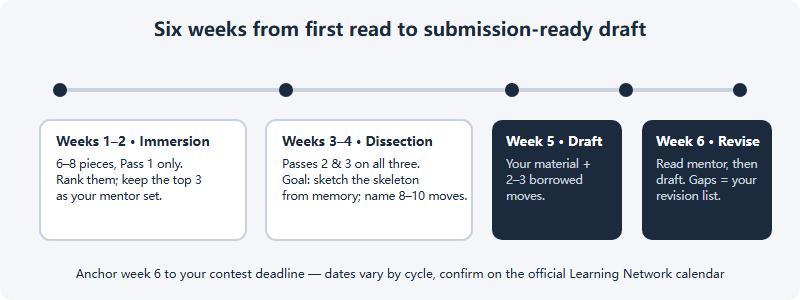
- Weeks 1–2 — Immersion. Read six to eight pieces in your target genre, Pass 1 only. You are calibrating taste: rank them, and keep the top three as your mentor set.
- Weeks 3–4 — Dissection. Run Passes 2 and 3 on your three mentors. By the end you should be able to sketch the genre’s skeleton from memory and name eight to ten sentence-level moves.
- Week 5 — Transfer drafting. Draft your entry using your own material and two or three borrowed moves. Expect the first draft to be worse than your mentors; that is normal and temporary.
- Week 6 — Revision against the mentors. Reread your best mentor, then your draft, back to back. The gaps you now see — a soft opening, a missing turn — are your revision list. Cut to the word limit last.
FAQ
Is imitating the structure of a published article plagiarism?
No. Genre structures — hook, claim, concession, return — are shared conventions every writer learns by reading. Plagiarism is reusing language, images or a specific argument. Imitate the move with your own material; never the words.
Where can I find past winning entries to study?
The Learning Network publishes winning student work for many of its contests on its own site. Coverage varies by contest and year, so browse the official contest pages at nytimes.com/learning to see what exists for yours.
What if I can’t reliably access The New York Times from China?
The method transfers. Any high-quality publication in the same genre — plus past student winners you can reach — teaches the same skeleton. The four passes matter more than the masthead.
How many mentor texts do I actually need?
Three per genre, read with all four passes, is usually enough to internalize the skeleton. Thirty texts skimmed once teach less than three studied properly — depth beats volume here.
This is an independent guide operated by Hanlin Education for China-based international-school students. It is not affiliated with, endorsed by, or sponsored by The New York Times Company or its Learning Network. Contest details change; always confirm current rules, dates and eligibility on nytimes.com/learning. Factual errors flagged to our editorial desk are corrected within 7 working days.